On this Page
First-Time Lessons: What Experts Learned from Their First Retell AI White-Label Implementation and Their Advice for Beginners.
Every technology implementation comes with a learning curve but some come with steeper hills than others. For businesses stepping into the world of Retell AI white-label for the first time, the experience is rarely a straight line from setup to success. It is a journey filled with unexpected discoveries, mid-course corrections, and hard-won insights that simply cannot be found in any documentation, tutorial, or product walkthrough.
Retell AI has quickly established itself as one of the more powerful and flexible platforms for businesses looking to deploy conversational AI solutions under their own brand. The appeal is clear a robust, customisable voice AI infrastructure that can be white-labeled and delivered to clients without the need to build from scratch. But as with any sophisticated platform, the gap between understanding what Retell AI can do and actually implementing it effectively for real clients in real business environments is where the most valuable lessons live.
Those first implementations have a way of teaching things that no amount of pre-launch preparation can fully anticipate. How clients actually respond to AI-driven voice interactions. Where the configuration decisions that seemed minor at setup turn out to matter enormously at scale. Which assumptions about client expectations need to be challenged early. And perhaps most importantly what to do differently the second time around.
These are not lessons that belong locked away in the notes of individual operators. They are exactly the kind of practical, experience-based knowledge that can save someone just starting out weeks of frustration, costly missteps, and unnecessary trial and error. That is precisely why we went out and gathered them directly from the people who have been through it firsthand.
We reached out to founders, agency owners, and AI solution providers who have completed their first Retell AI white-label implementation and asked them one question:
"What was one learning experience from your first Retell AI white-label implementation, and what is one piece of advice you would give to someone just starting?"
What came back was an honest, generous, and remarkably practical collection of insights from operators who have navigated the real challenges of bringing Retell AI to market for the first time. From setting the right client expectations before go-live, to the technical configuration decisions that make or break a smooth launch, to the mindset shifts that separate those who struggle from those who scale- the advice shared here is the kind that only comes from genuine experience.
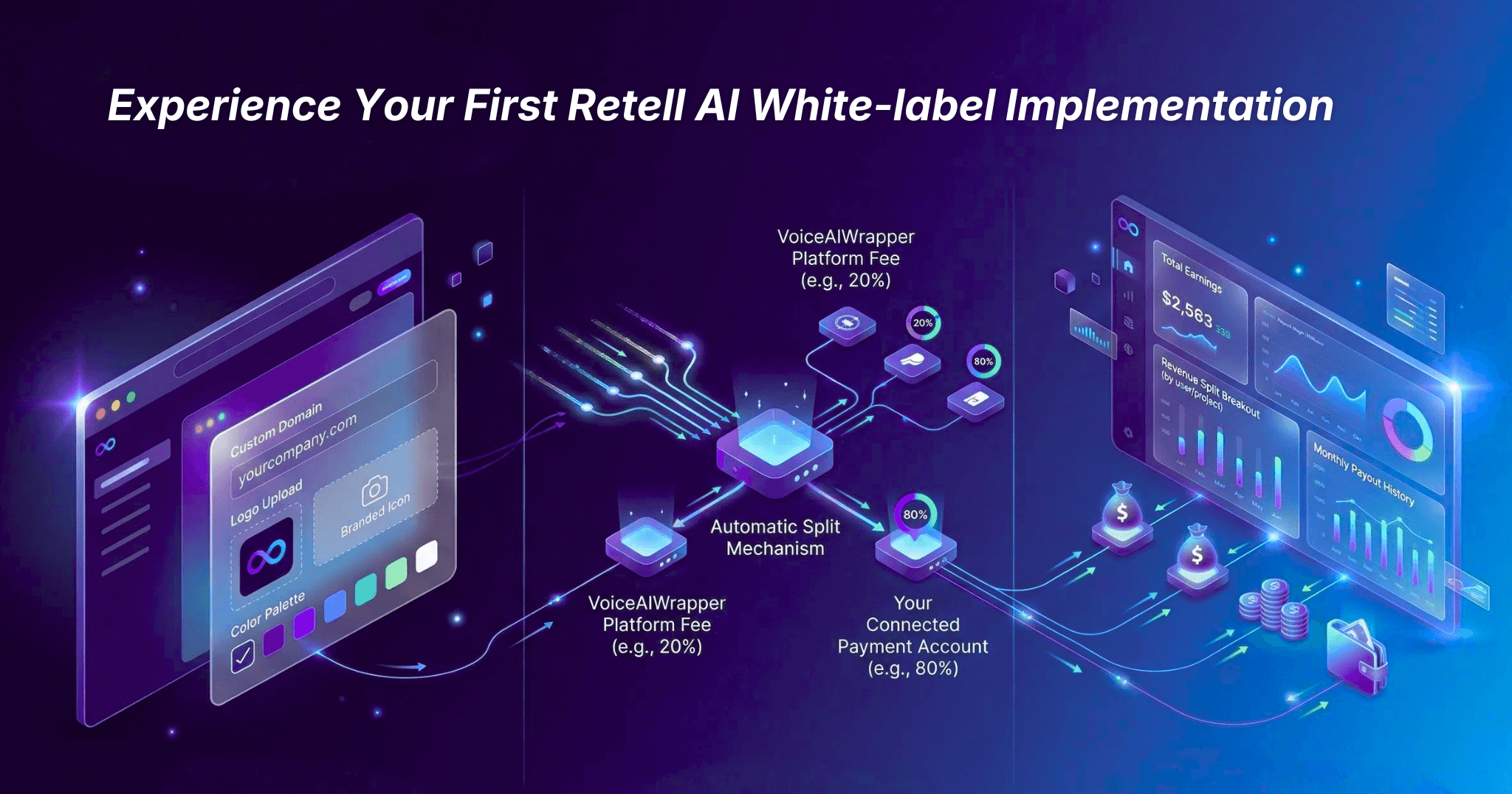
If you are about to embark on your first Retell AI white-label implementation, or are currently in the middle of one and looking for guidance, the expert perspectives that follow could be the most valuable thing you read before your next move. Here is what they had to say.
Building a white-label voice AI system requires more than just plugging in an API and hoping for the best. This guide compiles ten practical lessons learned during a real-world Retell AI implementation, drawn from hands-on experience and insights from experts who have deployed conversational agents at scale. Whether you're planning your first integration or troubleshooting an existing one, these strategies will help you avoid common pitfalls and deliver a system that actually works in production.
Design Around Operational Constraints Early
Define Qualified Prospects And Enforce SLA
Cut Response Delay Below 800 Milliseconds
Use Schema To Defeat Prompt Bloat
Trigger Instant Post-Call Automation
Treat The Agent As Regulated Infrastructure
Map Every Field To Your CRM
Start With High-Level Details First
Slow The Pace For Natural Rhythm
Prioritize Reliability Over Model Features
Design Around Operational Constraints Early
I lead client strategy + ops at Blink Agency, where we build HIPAA-compliant acquisition systems and track every step from ad click to booked patient; on campaigns like Redemption Psychiatry we drove 459 new patients in 90 days with $6.54 CPA and 38:1 ROAS, so I'm allergic to "AI that sounds cool" but breaks attribution.
My first Retell AI white-label implementation taught me that the hard part isn't the model it's the edges: transfers, after-hours, reschedules, and "I have a quick question" calls that are actually triage. We launched with a clean booking flow, but ~20-30% of real calls fell into gray-zone intents (insurance, meds, urgency, location confusion) and our fallback logic created repeat calls + duplicate leads, which crushed ops trust even if bookings looked fine.
One piece of advice: design the assistant around your operational constraints first, not your script. I start with a "3-bucket" routing map (book / info / clinical) and enforce a strict capture schema (reason, location, urgency, payer, consent) so the call outcome can be reconciled to a single source of truth in the CRM and measured like any other funnel stage.
Concrete example: for a multi-location psych practice, we reduced duplicate leads by forcing one canonical patient record key (phone + DOB) and only letting Retell create an appointment after it verifies location + provider availability; that's the difference between "AI answered calls" and "AI created a scalable growth engine."
Madeline Jack, Chief Client & Operations Officer, Blink Agency
Define Qualified Prospects And Enforce SLA
I've been running Foxxr since 2008 doing lead-gen for HVAC/plumbing/roofing/restoration, so my first Retell AI white-label implementation was judged the only way contractors judge anything: did it book jobs, and did the leads show up clean in the pipeline.
Biggest learning: "sound human" isn't the hard part intent + routing is. The first version talked well but asked the wrong questions, so we got a bunch of "leads" that were really price shoppers and after-hours tire kickers. Once we rewired the flow by page/intent (homepage = "what brings you here?" vs service page = "are you dealing with XYZ issue right now?"), added tight qualification (service area, urgency, job type), and forced a fast handoff, lead quality jumped and cancellations dropped.
One piece of advice: don't start with the AI start with your definition of a qualified lead and your follow-up SLA. We aim for sub-1 minute response expectations in chat because average live chat is ~2:40, and the longer you wait the more they bounce; the AI should enforce that, not replace it. Also, charge/track it like we do with our 24/7 chat: only count it as a lead if it has contact info + job type + location + next step booked (call scheduled or dispatch request), otherwise you'll fool yourself with vanity metrics.
Brian Childers, CEO, Foxxr Digital Marketing
Cut Response Delay Below 800 Milliseconds
The biggest learning from our first Retell AI white-label implementation was massively underestimating how important voice latency tuning is for end-user perception. We had the technical integration working within a couple of days. The API calls were clean, the responses were accurate, and everything looked great in our testing environment. But when we deployed it to our client's customer service line, the feedback was brutal. Callers felt like they were talking to a slow, awkward robot because there was a noticeable pause between the end of their sentence and when the AI started responding.
The fix wasn't in the Retell configuration alone. We had to optimise our entire pipeline: reducing the prompt length to speed up LLM inference, pre-caching common response templates, and tweaking the voice activity detection sensitivity so the system didn't wait too long after the caller stopped talking. Getting the response latency under 800 milliseconds was the threshold where callers stopped noticing the AI delay and started treating it like a normal conversation.
My advice for anyone starting out is to test with real phone calls from day one, not just API tests or browser previews. The experience of talking to a voice AI on an actual phone line is fundamentally different from watching text stream in a dashboard. Get five people who aren't on your team to call the number and give honest feedback before you show it to your client. That real-world testing would have saved us two weeks of post-launch firefighting.
Shehar Yar, CEO, Software House
Use Schema To Defeat Prompt Bloat
I've led AI-driven transformations for hundreds of contractors, focusing on making tools like Retell AI actionable and profitable through my 12 Step Roadmap. My first implementation taught me that "prompt bloat"—overloading the system with too much technical jargon creates a latency gap that immediately signals to a homeowner they aren't talking to a real person.
We fixed this by connecting the AI to a centralized Knowledge Graph, which kept response times under a second and contributed to a 33.8% revenue growth for our early adopters. This ensured the AI could pull real-time pricing and availability without the processing delays that typically cause callers to hang up.
My advice is to prioritize your Schema Markup and structured data long before you worry about the "personality" of the AI voice. If your business data isn't machine-readable, your Retell agents will hallucinate or lag, making it impossible to dominate your local market in the new era of AI search.
Jennifer Bagley, CEO, CI Web Group
Trigger Instant Post-Call Automation
I've managed over $300 million in digital spend and architected voice agent systems for high-growth firms in financial services and e-commerce. My first Retell AI implementation taught me that "latency-induced friction" is the silent killer of lead conversion in multi-channel systems.
We discovered that when the agent's response time lagged behind a user's natural interruption, call completion rates dropped by nearly 20% because the interaction lost its "human" rhythm. To fix this, we tightened the orchestration layer to prioritize immediate verbal acknowledgments while the heavy processing happened in the background.
My advice for beginners is to solve for the "post-call vacuum" by ensuring your AI agent triggers a real-time automation, like a WhatsApp onboarding sequence, the moment the caller hangs up. This keeps the momentum alive and bridges the gap between a successful AI conversation and a closed sale.
Renzo Proano, Team Principal | Enterprise Growth Partner, Berelvant AI
Treat The Agent As Regulated Infrastructure
I'm the founder of Sundance Networks (IT + cybersecurity), so my first Retell AI white-label rollout taught me the "AI" part is easy compared to operating it like production IT. We pushed a voice agent into a small medical office after hours, and the first week it created a compliance headache: the agent repeated back a caller's sensitive details in its recap and dropped it into a shared inbox.
The learning: treat the agent like a regulated system--data minimization, retention rules, and access control from day one. We fixed it by hard-limiting what it can capture (no DOB/SSN/diagnosis), redacting summaries, routing anything "medical detail" to a secure ticket with role-based access, and adding an explicit consent line before collecting contact info.
Advice for someone starting: build the guardrails before you build the personality. Write a 1-page "allowed data + forbidden data" policy, set retention (e.g., auto-delete call recordings/transcripts after X days), and run 20 test calls covering the ugly edge cases (angry caller, wrong-number, kid on the phone, someone trying to read a credit card).
Also: monitor it like infrastructure alerts, logs, and an owner. My first week's KPI wasn't bookings; it was "zero sensitive data stored" and "100% of after-hours calls get routed to the right secure workflow," because once that's solid, scaling to other clients is painless.
Ryan Miller, Managing Partner, Sundance Networks
Map Every Field To Your CRM
Running an agency focused on home service contractors, I've built out a lot of automation stacks and the Retell AI white-label rollout taught me something I didn't expect: the script handoff between AI and your CRM is where deals die.
Our first implementation for a roofing client had the AI collecting names and numbers fine, but the data was landing in the CRM as unstructured notes instead of mapped fields. That meant the follow-up sequence never triggered. We lost roughly 2 weeks of leads before catching it. Once we mapped every AI-collected variable to a discrete CRM field and tested the full loop end-to-end, automated follow-up fired correctly and response time dropped to under 3 minutes.
My one piece of advice: before you go live, run the AI through 20 fake calls yourself and trace every data point all the way to the booked appointment in your calendar. Not just "did it respond well" -- but did the contact record populate, did the pipeline stage update, did the follow-up SMS fire?
The AI voice is the easy part. The plumbing behind it is where most white-label implementations quietly bleed money.
Chris McVey, Founder, On Deck Marketing

Start With High-Level Details First
With 35+ years in digital marketing and expertise in AI-driven strategies at ForeFront Web founded 2001 our first Retell AI white-label implementation revealed that voice scripts must mimic inverted pyramid writing: high-level details first, granular later. For a B2B service client, linear scripts buried key solutions, causing 28% mid-call drop-offs; flipping to inverted pyramid spiked script completions by 45%, directly lifting qualified interactions.
My advice for starters: Anchor AI in transparent, context-rich reporting from day one ditch vanity metrics like bounce rate for reverse goal path tracking, as we do monthly. One client hit top 5 SERP spots with our approach; their conversions exploded without further tweaks.
Scott Kasun, Digital Marketing Executive, ForeFront Web
Slow The Pace For Natural Rhythm
When we worked with one of our clients, the first implementation showed us that brand consistency is heard, not seen. We focused on tone but missed pacing and turn-taking. The agent spoke too quickly and filled silence, while callers interrupted, which made the experience feel pushy even when the words were polite. We realized the importance of slowing down the conversation for a more relaxed interaction.
We fixed it by adding deliberate pauses and implementing a rule to ask one question at a time. We also refined the agent's responses so it reflected back key details. After these changes, callers slowed down, and the conversation became more cooperative. The lesson we learned was that audio is about behavior. A great voice experience needs rhythm and restraint, not just language.
Vaibhav Kakkar, CEO, Digital Web Solutions
Prioritize Reliability Over Model Features
One of the biggest lessons from our first Retell AI white-label implementation was that latency and conversation flow matter more than raw model quality. You can have a strong underlying model, but if there are delays or awkward handoffs in the interaction, the entire experience feels broken to the end user. We initially focused too much on capability and not enough on real-time performance and edge cases in live conversations.
My advice to anyone starting is to design for reliability and control from day one. Build clear fallbacks, monitor conversations closely, and assume things will fail in production. If you can maintain a smooth, predictable experience even when the system is under stress, you will stand out much more than by just chasing the latest model features.
Alex Yeh, Founder & CEO, GMI Cloud
First-Time Lessons: What Experts Learned from Their First Retell AI White-Label Implementation and Their Advice for Beginners.
Every technology implementation comes with a learning curve but some come with steeper hills than others. For businesses stepping into the world of Retell AI white-label for the first time, the experience is rarely a straight line from setup to success. It is a journey filled with unexpected discoveries, mid-course corrections, and hard-won insights that simply cannot be found in any documentation, tutorial, or product walkthrough.
Retell AI has quickly established itself as one of the more powerful and flexible platforms for businesses looking to deploy conversational AI solutions under their own brand. The appeal is clear a robust, customisable voice AI infrastructure that can be white-labeled and delivered to clients without the need to build from scratch. But as with any sophisticated platform, the gap between understanding what Retell AI can do and actually implementing it effectively for real clients in real business environments is where the most valuable lessons live.
Those first implementations have a way of teaching things that no amount of pre-launch preparation can fully anticipate. How clients actually respond to AI-driven voice interactions. Where the configuration decisions that seemed minor at setup turn out to matter enormously at scale. Which assumptions about client expectations need to be challenged early. And perhaps most importantly what to do differently the second time around.
These are not lessons that belong locked away in the notes of individual operators. They are exactly the kind of practical, experience-based knowledge that can save someone just starting out weeks of frustration, costly missteps, and unnecessary trial and error. That is precisely why we went out and gathered them directly from the people who have been through it firsthand.
We reached out to founders, agency owners, and AI solution providers who have completed their first Retell AI white-label implementation and asked them one question:
"What was one learning experience from your first Retell AI white-label implementation, and what is one piece of advice you would give to someone just starting?"
What came back was an honest, generous, and remarkably practical collection of insights from operators who have navigated the real challenges of bringing Retell AI to market for the first time. From setting the right client expectations before go-live, to the technical configuration decisions that make or break a smooth launch, to the mindset shifts that separate those who struggle from those who scale- the advice shared here is the kind that only comes from genuine experience.
If you are about to embark on your first Retell AI white-label implementation, or are currently in the middle of one and looking for guidance, the expert perspectives that follow could be the most valuable thing you read before your next move. Here is what they had to say.
Building a white-label voice AI system requires more than just plugging in an API and hoping for the best. This guide compiles ten practical lessons learned during a real-world Retell AI implementation, drawn from hands-on experience and insights from experts who have deployed conversational agents at scale. Whether you're planning your first integration or troubleshooting an existing one, these strategies will help you avoid common pitfalls and deliver a system that actually works in production.
Design Around Operational Constraints Early
Define Qualified Prospects And Enforce SLA
Cut Response Delay Below 800 Milliseconds
Use Schema To Defeat Prompt Bloat
Trigger Instant Post-Call Automation
Treat The Agent As Regulated Infrastructure
Map Every Field To Your CRM
Start With High-Level Details First
Slow The Pace For Natural Rhythm
Prioritize Reliability Over Model Features
Design Around Operational Constraints Early
I lead client strategy + ops at Blink Agency, where we build HIPAA-compliant acquisition systems and track every step from ad click to booked patient; on campaigns like Redemption Psychiatry we drove 459 new patients in 90 days with $6.54 CPA and 38:1 ROAS, so I'm allergic to "AI that sounds cool" but breaks attribution.
My first Retell AI white-label implementation taught me that the hard part isn't the model it's the edges: transfers, after-hours, reschedules, and "I have a quick question" calls that are actually triage. We launched with a clean booking flow, but ~20-30% of real calls fell into gray-zone intents (insurance, meds, urgency, location confusion) and our fallback logic created repeat calls + duplicate leads, which crushed ops trust even if bookings looked fine.
One piece of advice: design the assistant around your operational constraints first, not your script. I start with a "3-bucket" routing map (book / info / clinical) and enforce a strict capture schema (reason, location, urgency, payer, consent) so the call outcome can be reconciled to a single source of truth in the CRM and measured like any other funnel stage.
Concrete example: for a multi-location psych practice, we reduced duplicate leads by forcing one canonical patient record key (phone + DOB) and only letting Retell create an appointment after it verifies location + provider availability; that's the difference between "AI answered calls" and "AI created a scalable growth engine."
Madeline Jack, Chief Client & Operations Officer, Blink Agency
Define Qualified Prospects And Enforce SLA
I've been running Foxxr since 2008 doing lead-gen for HVAC/plumbing/roofing/restoration, so my first Retell AI white-label implementation was judged the only way contractors judge anything: did it book jobs, and did the leads show up clean in the pipeline.
Biggest learning: "sound human" isn't the hard part intent + routing is. The first version talked well but asked the wrong questions, so we got a bunch of "leads" that were really price shoppers and after-hours tire kickers. Once we rewired the flow by page/intent (homepage = "what brings you here?" vs service page = "are you dealing with XYZ issue right now?"), added tight qualification (service area, urgency, job type), and forced a fast handoff, lead quality jumped and cancellations dropped.
One piece of advice: don't start with the AI start with your definition of a qualified lead and your follow-up SLA. We aim for sub-1 minute response expectations in chat because average live chat is ~2:40, and the longer you wait the more they bounce; the AI should enforce that, not replace it. Also, charge/track it like we do with our 24/7 chat: only count it as a lead if it has contact info + job type + location + next step booked (call scheduled or dispatch request), otherwise you'll fool yourself with vanity metrics.
Brian Childers, CEO, Foxxr Digital Marketing
Cut Response Delay Below 800 Milliseconds
The biggest learning from our first Retell AI white-label implementation was massively underestimating how important voice latency tuning is for end-user perception. We had the technical integration working within a couple of days. The API calls were clean, the responses were accurate, and everything looked great in our testing environment. But when we deployed it to our client's customer service line, the feedback was brutal. Callers felt like they were talking to a slow, awkward robot because there was a noticeable pause between the end of their sentence and when the AI started responding.
The fix wasn't in the Retell configuration alone. We had to optimise our entire pipeline: reducing the prompt length to speed up LLM inference, pre-caching common response templates, and tweaking the voice activity detection sensitivity so the system didn't wait too long after the caller stopped talking. Getting the response latency under 800 milliseconds was the threshold where callers stopped noticing the AI delay and started treating it like a normal conversation.
My advice for anyone starting out is to test with real phone calls from day one, not just API tests or browser previews. The experience of talking to a voice AI on an actual phone line is fundamentally different from watching text stream in a dashboard. Get five people who aren't on your team to call the number and give honest feedback before you show it to your client. That real-world testing would have saved us two weeks of post-launch firefighting.
Shehar Yar, CEO, Software House
Use Schema To Defeat Prompt Bloat
I've led AI-driven transformations for hundreds of contractors, focusing on making tools like Retell AI actionable and profitable through my 12 Step Roadmap. My first implementation taught me that "prompt bloat"—overloading the system with too much technical jargon creates a latency gap that immediately signals to a homeowner they aren't talking to a real person.
We fixed this by connecting the AI to a centralized Knowledge Graph, which kept response times under a second and contributed to a 33.8% revenue growth for our early adopters. This ensured the AI could pull real-time pricing and availability without the processing delays that typically cause callers to hang up.
My advice is to prioritize your Schema Markup and structured data long before you worry about the "personality" of the AI voice. If your business data isn't machine-readable, your Retell agents will hallucinate or lag, making it impossible to dominate your local market in the new era of AI search.
Jennifer Bagley, CEO, CI Web Group
Trigger Instant Post-Call Automation
I've managed over $300 million in digital spend and architected voice agent systems for high-growth firms in financial services and e-commerce. My first Retell AI implementation taught me that "latency-induced friction" is the silent killer of lead conversion in multi-channel systems.
We discovered that when the agent's response time lagged behind a user's natural interruption, call completion rates dropped by nearly 20% because the interaction lost its "human" rhythm. To fix this, we tightened the orchestration layer to prioritize immediate verbal acknowledgments while the heavy processing happened in the background.
My advice for beginners is to solve for the "post-call vacuum" by ensuring your AI agent triggers a real-time automation, like a WhatsApp onboarding sequence, the moment the caller hangs up. This keeps the momentum alive and bridges the gap between a successful AI conversation and a closed sale.
Renzo Proano, Team Principal | Enterprise Growth Partner, Berelvant AI
Treat The Agent As Regulated Infrastructure
I'm the founder of Sundance Networks (IT + cybersecurity), so my first Retell AI white-label rollout taught me the "AI" part is easy compared to operating it like production IT. We pushed a voice agent into a small medical office after hours, and the first week it created a compliance headache: the agent repeated back a caller's sensitive details in its recap and dropped it into a shared inbox.
The learning: treat the agent like a regulated system--data minimization, retention rules, and access control from day one. We fixed it by hard-limiting what it can capture (no DOB/SSN/diagnosis), redacting summaries, routing anything "medical detail" to a secure ticket with role-based access, and adding an explicit consent line before collecting contact info.
Advice for someone starting: build the guardrails before you build the personality. Write a 1-page "allowed data + forbidden data" policy, set retention (e.g., auto-delete call recordings/transcripts after X days), and run 20 test calls covering the ugly edge cases (angry caller, wrong-number, kid on the phone, someone trying to read a credit card).
Also: monitor it like infrastructure alerts, logs, and an owner. My first week's KPI wasn't bookings; it was "zero sensitive data stored" and "100% of after-hours calls get routed to the right secure workflow," because once that's solid, scaling to other clients is painless.
Ryan Miller, Managing Partner, Sundance Networks
Map Every Field To Your CRM
Running an agency focused on home service contractors, I've built out a lot of automation stacks and the Retell AI white-label rollout taught me something I didn't expect: the script handoff between AI and your CRM is where deals die.
Our first implementation for a roofing client had the AI collecting names and numbers fine, but the data was landing in the CRM as unstructured notes instead of mapped fields. That meant the follow-up sequence never triggered. We lost roughly 2 weeks of leads before catching it. Once we mapped every AI-collected variable to a discrete CRM field and tested the full loop end-to-end, automated follow-up fired correctly and response time dropped to under 3 minutes.
My one piece of advice: before you go live, run the AI through 20 fake calls yourself and trace every data point all the way to the booked appointment in your calendar. Not just "did it respond well" -- but did the contact record populate, did the pipeline stage update, did the follow-up SMS fire?
The AI voice is the easy part. The plumbing behind it is where most white-label implementations quietly bleed money.
Chris McVey, Founder, On Deck Marketing
Start With High-Level Details First
With 35+ years in digital marketing and expertise in AI-driven strategies at ForeFront Web founded 2001 our first Retell AI white-label implementation revealed that voice scripts must mimic inverted pyramid writing: high-level details first, granular later. For a B2B service client, linear scripts buried key solutions, causing 28% mid-call drop-offs; flipping to inverted pyramid spiked script completions by 45%, directly lifting qualified interactions.
My advice for starters: Anchor AI in transparent, context-rich reporting from day one ditch vanity metrics like bounce rate for reverse goal path tracking, as we do monthly. One client hit top 5 SERP spots with our approach; their conversions exploded without further tweaks.
Scott Kasun, Digital Marketing Executive, ForeFront Web
Slow The Pace For Natural Rhythm
When we worked with one of our clients, the first implementation showed us that brand consistency is heard, not seen. We focused on tone but missed pacing and turn-taking. The agent spoke too quickly and filled silence, while callers interrupted, which made the experience feel pushy even when the words were polite. We realized the importance of slowing down the conversation for a more relaxed interaction.
We fixed it by adding deliberate pauses and implementing a rule to ask one question at a time. We also refined the agent's responses so it reflected back key details. After these changes, callers slowed down, and the conversation became more cooperative. The lesson we learned was that audio is about behavior. A great voice experience needs rhythm and restraint, not just language.
Vaibhav Kakkar, CEO, Digital Web Solutions
Prioritize Reliability Over Model Features
One of the biggest lessons from our first Retell AI white-label implementation was that latency and conversation flow matter more than raw model quality. You can have a strong underlying model, but if there are delays or awkward handoffs in the interaction, the entire experience feels broken to the end user. We initially focused too much on capability and not enough on real-time performance and edge cases in live conversations.
My advice to anyone starting is to design for reliability and control from day one. Build clear fallbacks, monitor conversations closely, and assume things will fail in production. If you can maintain a smooth, predictable experience even when the system is under stress, you will stand out much more than by just chasing the latest model features.
Alex Yeh, Founder & CEO, GMI Cloud
Like this article? Share it.