
THE HONEST PICTURE
If you are building voice AI on Vapi for your agency, there are real cases where another path serves you better. Direct Vapi suits solo developers shipping one custom enterprise integration where code-level customization matters. Retell wins on single use cases where 40 milliseconds of median latency beats build flexibility (Tested Media April 2026: Retell 680ms vs Vapi 720ms). Where VoiceAIWrapper wins: listed Vapi platform partner at docs.vapi.ai/providers/voiceaiwrapper, 3 providers under one branded dashboard (Vapi, Retell, ElevenLabs), Stripe rebilling on Growth at $79/mo, 60-minute setup, SOC 2 + GDPR + HIPAA with signed BAA on Pro at $499/mo, and zero markup on voice minutes.
What shipped between March and May 2026
Vapi shipped a substantial product wave in Q1 2026, much of it directly relevant to agencies running multi-client deployments. The official changelog aggregates the full feature list. Below: the items with the largest impact on agency builds, with the relevant Vapi documentation linked per row.
The 1,500ms default that’s killing your Vapi agent
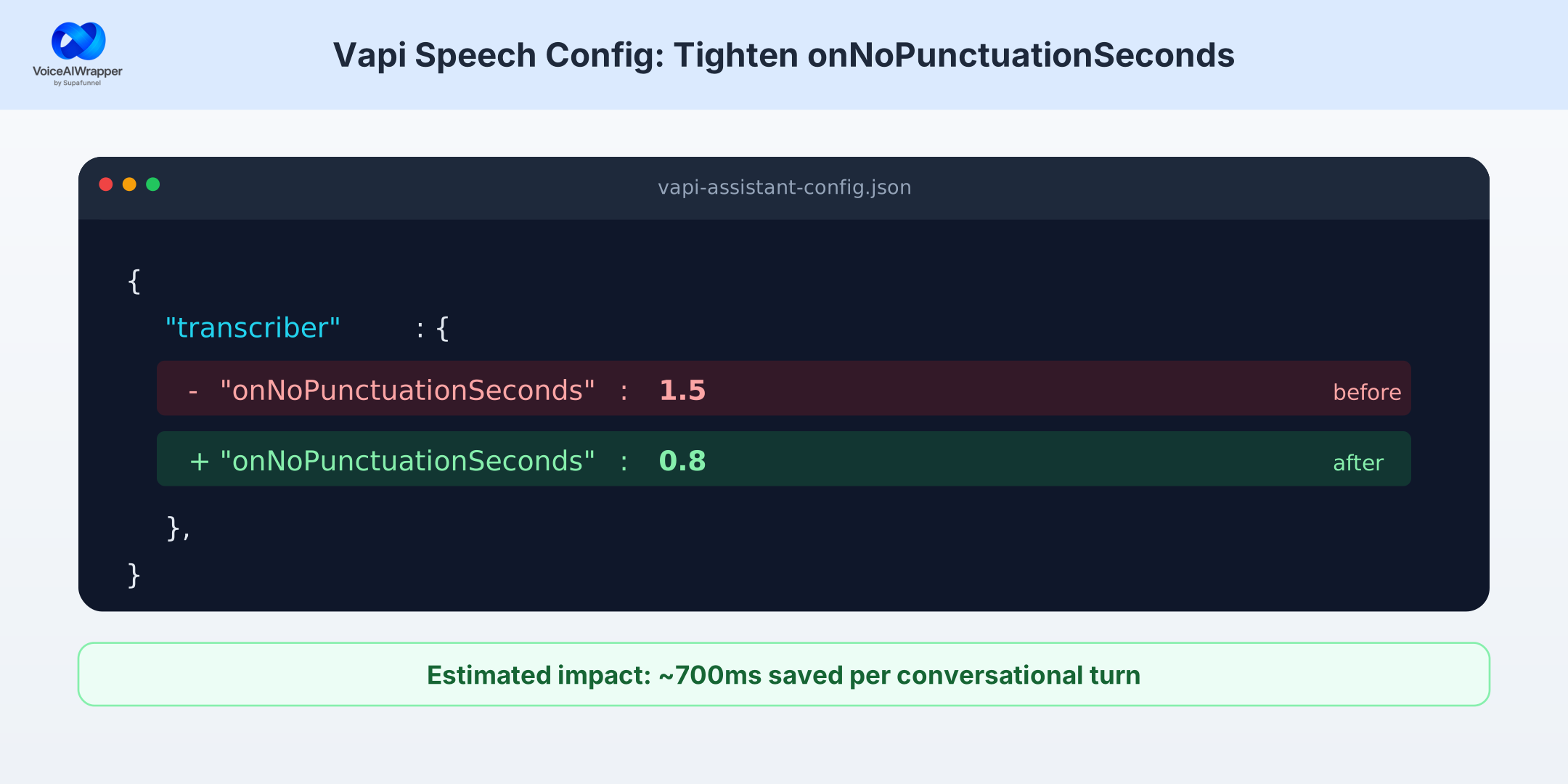
Vapi’s default turn-detection settings include a 1.5-second “no punctuation” wait window. The agent waits 1,500ms after the caller stops speaking before considering the turn complete. That single setting adds more latency than the entire transcription + language model + voice synthesis pipeline combined. AssemblyAI’s engineering team documented this in their July 2025 lowest-latency Vapi build guide as the most overlooked latency killer in Vapi configurations.
The fix is one configuration line. AssemblyAI’s stack achieves ~465ms end-to-end on web by tightening (or fully disabling) the default. Separately, in a 2025 Vapi community thread, Vapi support recommended setting onNoPunctuationSeconds to 0.8 as an immediate-win configuration change.
1,200 milliseconds: the conversational ceiling
1,200 milliseconds end-to-end is the empirical upper limit for conversational flow. Above this number, callers consciously detect they are talking to AI. Below it, they treat the agent as a human-paced conversation. This is not a target. It is the ceiling.
The number is convergent across two sources. Vapi’s own engineering blog from July 2025 establishes 1,200ms as the operating budget. Jordan Dearsley (Vapi team member, 30,881 followers) hit 2,042 reactions on a LinkedIn post in August 2025 stating, “At Vapi, we operate under a strict 1,200ms end-to-end budget for every conversational turn.”
The component latency budget
For an agency targeting the 465ms web / 965ms telephony floor, here is the per-component spend the budget allows. Use this as a target sheet during build; treat the ceiling row as your hard cutoff for go/no-go.
Methodology: Component targets sourced from AssemblyAI’s documented optimized Vapi stack (HackerNoon repost, March 2026). Telephony overhead figure also from AssemblyAI’s data. The 1,200ms ceiling is from Vapi’s own engineering blog (July 2025) and confirmed in the Jordan Dearsley LinkedIn post. Your actual numbers will vary by provider region, model size, and tool-call complexity.
Practitioner April 2026 latency benchmarks: where Vapi actually sits
Tested Media ran 500 production calls per platform in March 2026, then a 200-caller blind A/B test for voice quality, then 4,200 tool-call accuracy tests. The April 2026 published results are the strongest practitioner production benchmark in scope. Below, the latency table verbatim from the methodology.
Honest read: Retell wins on raw median latency (680ms vs Vapi’s 720ms). Vapi wins on build flexibility per the same review: “Vapi is the most flexible code-first platform. Build time is 2 to 3x longer than Retell.” For agencies optimizing a specific use case where 40ms median matters more than build flexibility, Retell is the right pick. For agencies that want one platform to deliver across many use cases, Vapi’s flexibility justifies the slightly higher median.
Source caveat: Tested Media is a digital marketing agency, not a neutral analyst firm. Article authored by Ryan Whitton (Senior Content Strategist). Methodology is disclosed and sample size is meaningful. Cross-reference with your own production tests.
What it actually feels like to run multi-client Vapi deployments through VoiceAIWrapper
We are listed as a Vapi platform partner, where Vapi describes VoiceAIWrapper as “the ultimate white-label platform built specifically for Vapi agencies.” We operate Vapi-backed agent deployments for agencies through the VoiceAIWrapper runtime, which gives us a particular vantage point on which Vapi configurations matter most in production. A few unscripted observations from inside the runtime:
The 1,500ms default is the first audit finding, every time
Almost every agency that reports “Vapi feels slow” has the default onNoPunctuationSeconds sitting untouched at 1.5 seconds. Tightening it to 0.8 (Vapi support’s recommended value in their community thread) is felt by callers within the same hour. There is no provider swap that delivers a comparable latency win. It is a single configuration line. We have not yet audited a “slow Vapi agent” complaint where that line was already tightened.
Telephony surprises more than latency surprises
A demo over web socket at 465ms feels human. The same agent over PSTN at 965ms still feels human. The same agent serving an international caller back to US-located Vapi infrastructure hits 3-plus seconds and feels broken. International deployment scoping is the single most common gap in client SOWs we see. Agencies pricing US-only retainers should still flag the international constraint in writing before signing, because the moment the client expands geographically, the conversation reopens.
The April 2026 Soniox outage was the wake-up call
Agencies that had not enabled transcriber auto-fallback on individual assistants lost calls during the incident. The fix is one toggle in the Vapi dashboard. We had the fallback configured at the runtime level months earlier, so deployments through VoiceAIWrapper rode through without client-facing failure. Most of the work after launch is fallback-and-recovery architecture, not initial build. LLM-layer fallback remains the gap agencies architect around manually; Vapi has not shipped native LLM fallback as of May 2026.
The HIPAA-mode provider lock is scope-defining for healthcare work
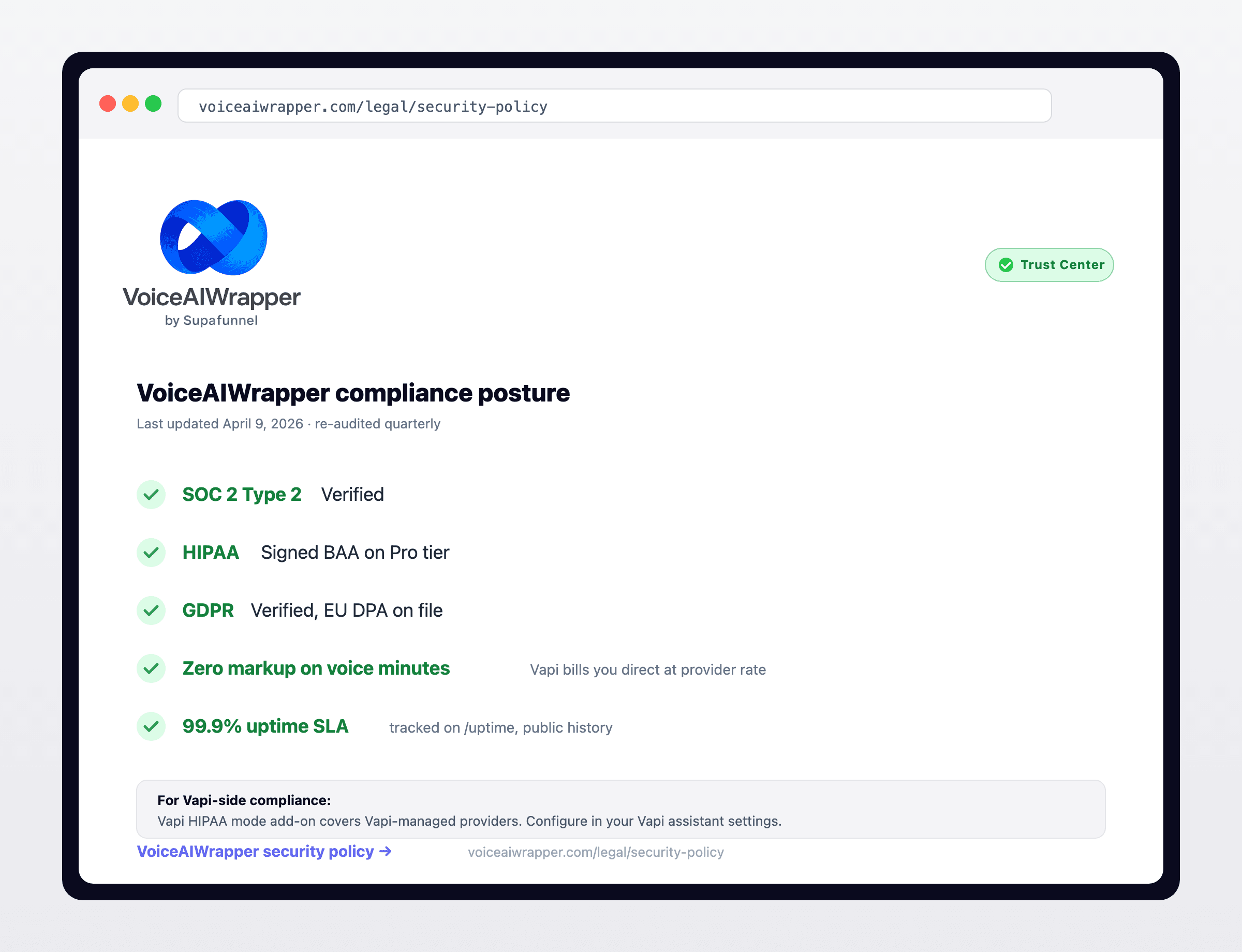
Confirm BAA availability and deployment requirements with support before deploying. Current new-customer plan information does not assign BAA entitlements to PayasYouGo or Scale. Existing users are grandfathered into their previous plans. Do not process PHI until the required agreements are executed for the platform, provider and agency layers. References: security policy page
What a Vapi voice agent actually costs per minute in 2026
The advertised Vapi platform fee is $0.05 per minute. The all-in cost when speech-to-text, language model, text-to-speech, and telephony are stacked typically lands between $0.12 and $0.33 per minute for typical agency configurations. Five 2026 third-party pricing analyses converge on this range. Agencies pricing client retainers off the $0.05 number get burned in month two.
Monthly cost projection by client volume
Use this when scoping a client retainer. The all-in number is what comes out of your bank, not the platform fee. Assumes the Standard stack (~$0.25/min average across the range).
Methodology + sources:
Component cost references: Dograh January 2026 (calculated $0.164/min conservative baseline), CloudTalk April 2026 (Vapi $0.05 + TTS $0.07 + LLM $0.20 + STT $0.01 + telephony $0.01 to $0.05 = $0.30-$0.33/min), VoiceFleet March 2026 ($0.12 to $0.26/min), Retell AI review May 2026 ($0.13 to $0.31+/min), Softailed April 2026 (wider $0.07 to $1.03/min based on stack choices). Premium row figures are modeled estimates, not vendor-confirmed. Voice minutes pass directly to your Vapi account at provider rates; VoiceAIWrapper does not mark up voice minutes.
The fallback configuration every production agent needs (and the April 2026 outage that proved why)
On April 2, 2026, Soniox transcriber service degraded. Calls using Soniox as the primary transcriber terminated unexpectedly with the error code call.in-progress.error-vapifault-soniox-transcriber-failed. Per Vapi’s status page, agencies who had transcriber fallback enabled experienced no client-facing failure. Agencies who hadn’t enabled it, lost the call.
Earlier in the same window, Vapi shipped both transcriber auto-fallback and voice fallback as native, dashboard-toggleable configurations. The configuration is not on by default. Every production agency deployment should set both before the next provider outage happens. There will be a next provider outage; Vapi’s status page recorded 23 incidents in the 90 days ending 2026-05-10.
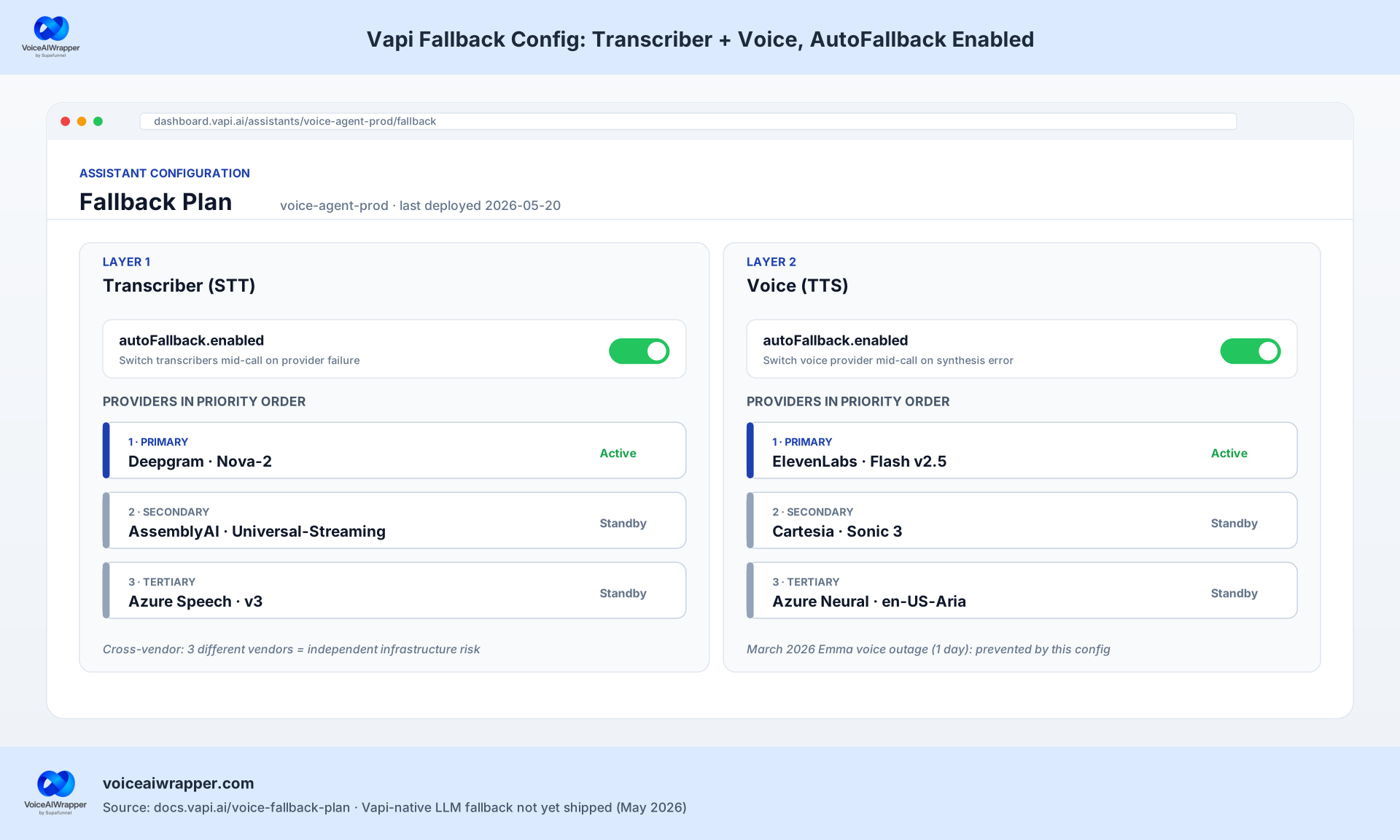
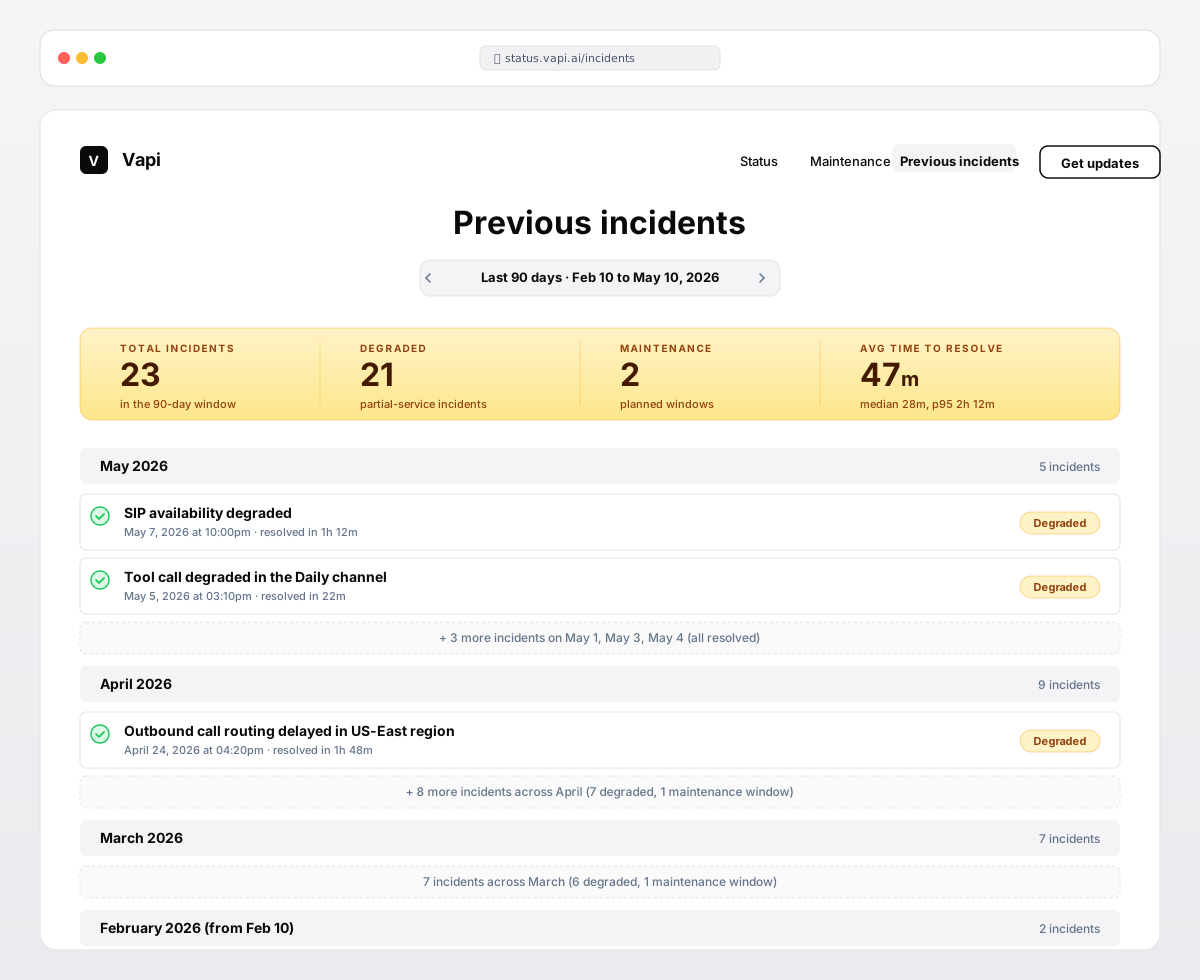
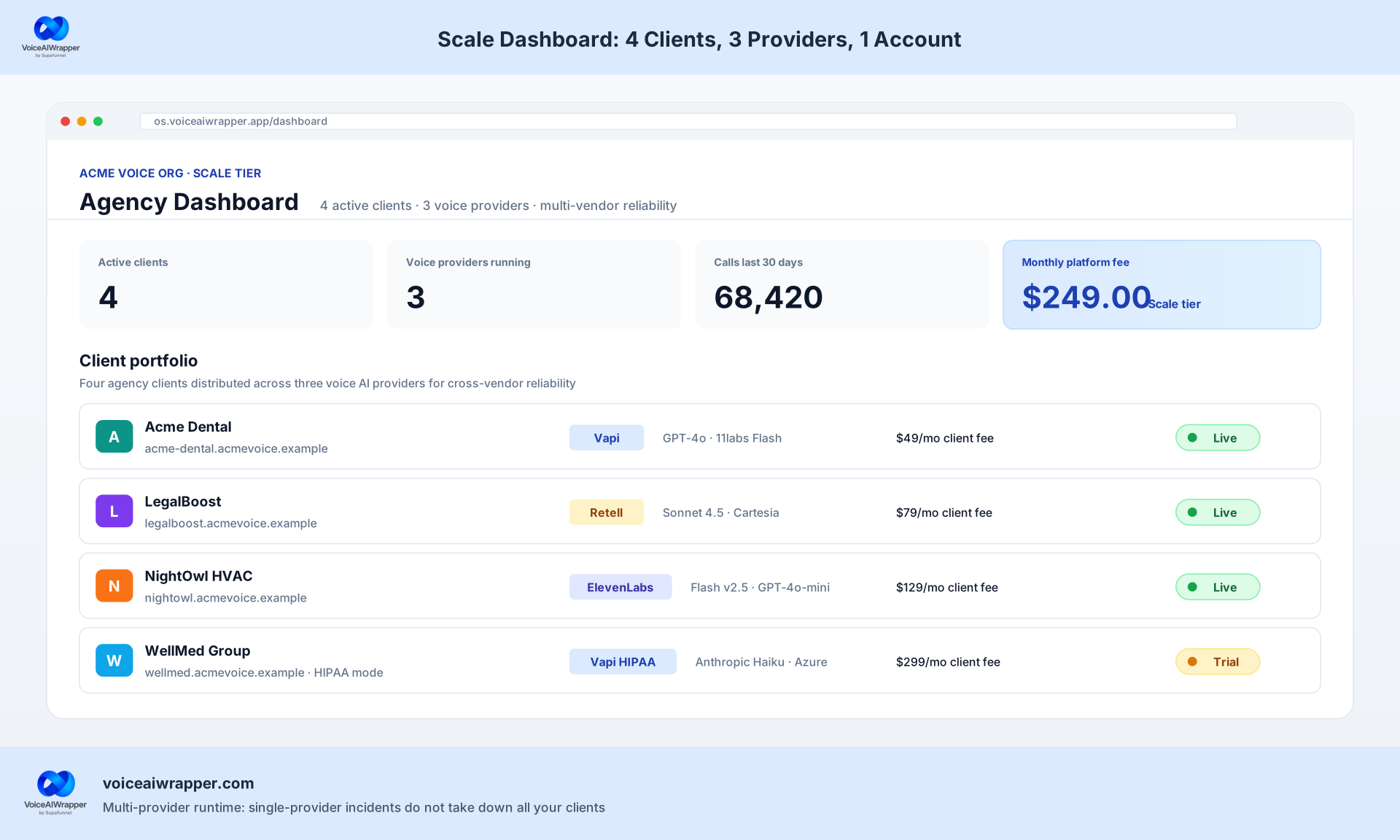
""What about LLM-layer fallback? Vapi doesn't ship that natively."Correct, and this is the gap agencies should architect around. The 9-day GPT inference incident logged on Vapi's status page (March 10-19, 2026) affected any agent using a single LLM provider. There is no Vapi-native fallback at the LLM layer as of May 2026. Practical workaround: maintain a tested second LLM (e.g., Anthropic Claude or a Groq-hosted Llama model) and a deployment script to swap providers when an incident is reported. VoiceAIWrapper customers who run multiple Vapi providers in parallel route around single-vendor LLM incidents structurally; our uptime page documents how platform downtime in any single provider does not translate to client downtime when the runtime executes on multiple providers.
Composer, Monitoring, Squads v2, Flux: the four updates with the most agency impact
These four are the highest-impact features for an agency that builds and operates client deployments at scale.
Composer Alpha: build a full agent from a prompt
Vapi's in-dashboard AI assistant builds, debugs, and adjusts agents from plain text prompts. The webinar Q&A confirms an end-to-end agent with CRM integration, knowledge base, multilingual, and inbound + outbound capability in 30 minutes. Currently no extra cost during alpha.
Why it matters: shrinks discovery-to-demo from days to hours. Use it to ship client demos in the same call. Pair with VoiceAIWrapper's 60-minute branded portal setup for an end-to-end "prompt-to-client-ready" cycle. Vapi Composer Webinar FAQ
Monitoring GA: 4 tiers, 2 are Enterprise-only
Infrastructure (latency, dropped calls) and Technical (integration errors) are broadly available. Effectiveness (intent fulfillment) and Compliance (prompt adherence) are Enterprise-only. Agencies pitching managed-monitoring SLAs need to scope this in their pricing conversation with Vapi.
Why it matters: if your client retainer promises "we monitor and optimize weekly," the higher-value monitoring tiers are the ones agencies pay extra for. Plan accordingly when scoping retainer pricing. Vapi Monitoring blog
Squads v2: visual builder for multi-assistant flows
Drag-and-drop canvas for orchestrating multi-assistant workflows. Live call view shows which assistant is active and which tool is being called. Designed and debugged visually instead of through JSON configuration.
Why it matters: client-facing complex flows (intake > qualification > scheduling > confirmation) ship faster. Reduces the gap between sales scope and engineering build. Vapi docs: Squads
Deepgram Flux + Inworld TTS: lower latency surface
Deepgram Flux (flux-general-en, flux-general-multi) combines Nova-3 STT accuracy with native turn detection in one model. Inworld TTS adds an emotionally expressive voice option at ~200ms initial audio latency.
Why it matters: Flux removes the configuration foot-gun where turn-detection misconfiguration adds 500-1500ms. Inworld is competitive with ElevenLabs Flash on latency with different voice character. Vapi docs: Inworld TTS
HIPAA mode locks the provider list. Pre-qualify before scoping healthcare clients.
Why your web demo lies about phone latency
Web latency is not telephony latency
An optimized Vapi stack hits ~465ms end-to-end on web. Telephony adds approximately 600ms of network overhead, putting phone calls at ~965ms minimum. International deployments compound further: Vapi servers are US-located, and a Vapi community thread documented a UAE-to-USA production case at 3-4 seconds end-to-end. Vapi support confirmed in the same thread that international latency is a structural limitation pending more server locations.
What this means for your demo?
Practical agency move.
The agency-readiness layer on top of Vapi (and Retell, ElevenLabs)
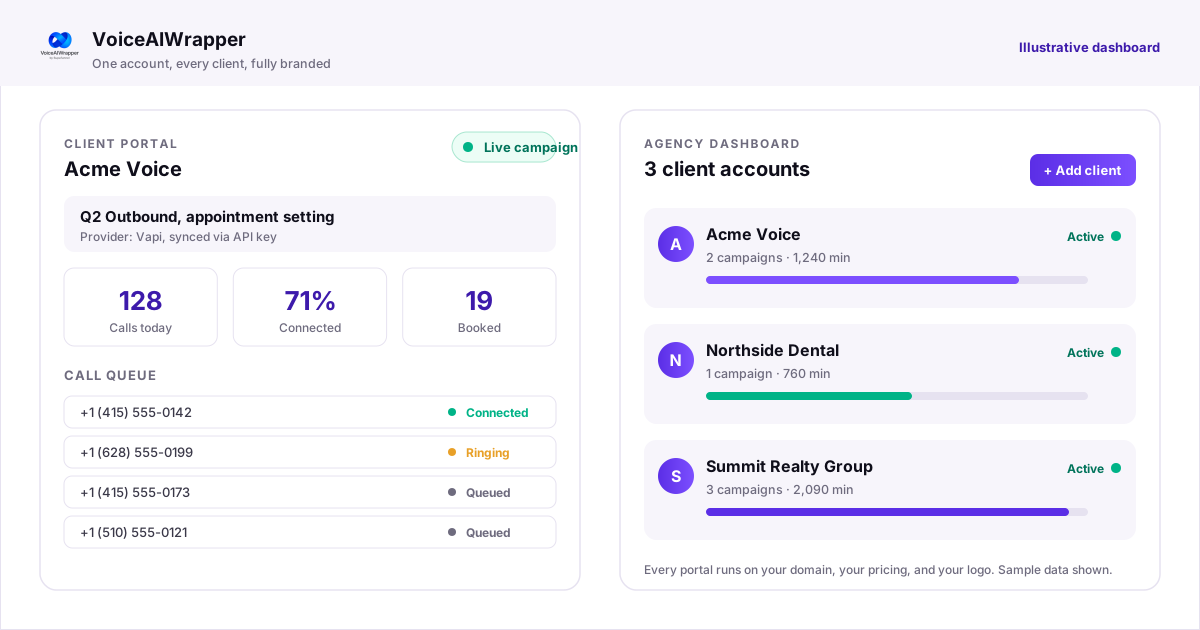
Vapi is the underlying voice AI infrastructure. VoiceAIWrapper is the agency-readiness layer on top of it. We are a listed Vapi platform partner. We do not replace Vapi; we make Vapi (and four other providers) easier for agencies to package, brand, and resell to multi-client portfolios.
Honest concession: when this playbook is the wrong reference
Skip this guide if...
Your use case is not a real-time conversational voice agent.
You're a solo developer building one agent for one client.
Your agency exclusively builds chat (not voice) AI.
Retell is structurally a better fit for your one specific use case.
The 6-step Vapi optimization checklist for agency production
Run this checklist on every new client agent before going live. Each step has a single configuration outcome. Estimated total time: 45 minutes per agent.
Frequently Asked Questions
What is the lowest end-to-end latency achievable on Vapi in 2026?
Roughly 465 milliseconds end-to-end on web with a fully optimized stack: AssemblyAI Universal-Streaming for transcription (90ms), Groq-hosted Llama 4 Maverick 17B for the language model (200ms), and ElevenLabs Flash v2.5 for text-to-speech (75ms). On telephony, expect 600ms additional network overhead, so the practical phone-call floor is closer to 965ms. Source: AssemblyAI engineering team, July 2025.
What is the most common Vapi performance mistake agencies make?
Leaving the default turn-detection settings in place. Vapi defaults include a 1.5-second no-punctuation wait before considering the caller finished speaking, which alone adds more latency than the entire transcription, language model, and voice synthesis pipeline combined. The fix is one configuration setting. Sources: AssemblyAI engineering team, July 2025 (the 1.5-second cost). Separately, Vapi support recommended a 0.8-second value in a 2025 community thread.
What does a Vapi voice agent actually cost per minute in 2026?
The advertised Vapi platform fee is $0.05 per minute. The all-in cost including speech-to-text, language model, text-to-speech, and telephony typically lands between $0.12 and $0.33 per minute depending on the provider stack. Dograh's January 2026 conservative-baseline calculation came in at $0.164 per minute. CloudTalk's April 2026 breakdown for a standard ElevenLabs + GPT-4o stack hit $0.30 to $0.33 per minute. Voice minutes bill direct to providers, never marked up by VoiceAIWrapper.
Does Vapi support multi-provider fallback?
Yes, at the transcriber and voice layers. Set assistant.transcriber.fallbackPlan.autoFallback.enabled = true to auto-fallback transcription mid-call, and configure 2-3 backup voice providers from different vendors. Vapi does not yet ship native LLM-layer fallback. The April 2026 Soniox transcriber outage and the March 2026 9-day GPT inference incident are the case studies for why every production agent needs both layers configured.
What Vapi features shipped between March and May 2026 that affect agency builds?
Composer Alpha (in-dashboard agent builder), Monitoring GA (four tiers, two Enterprise-only), Squads v2 visual builder for multi-assistant flows, Deepgram Flux (transcription with native turn detection), Inworld TTS, voice plus transcriber auto-fallback, HIPAA mode dashboard toggle, Zero Data Retention mode, variable passing between tool calls, and Cross-Platform Continuity for voice-to-SMS context. Full changelog at Vapi What's New.
Is the latency I see in Vapi's dashboard the same latency my agent will hit in production?
No. Vapi support has confirmed in community threads that the latency shown next to each LLM in the dashboard reflects shared-cluster averages, not your individual deployment's latency. Agencies optimizing off the dashboard number are looking at the wrong signal. Bring Your Own Key (BYOK) endpoints with custom routing typically deliver materially lower latency than the shared-cluster figures suggest.
What is the 1,200ms ceiling for voice agents?
1,200 milliseconds is the empirical upper limit for conversational flow before callers consciously detect they are talking to an AI agent. Both Vapi's engineering blog and a LinkedIn post from Vapi team member Jordan Dearsley converge on this number. Treat 1,200ms as the hard ceiling, not the target. Optimized stacks should aim for ~465ms on web and ~965ms on telephony.
Is VoiceAIWrapper listed as a Vapi partner?
Stripe, external billing and GoHighLevel integration are available on both current plans. Scale includes campaign APIs and external billing API access; these APIs are not included in PayasYouGo.
Vapi primary sources
2. Composer Alpha webinar Q&A (2026-03-20)
3. Vapi Monitoring GA announcement (2026-04-15)
4. Enhanced Security Mode (2026-04-01)
5. Open stack vs integrated (2026-05-01)
6. Unity AI healthcare scheduling case study (2026-05-07)
7. Vapi engineering on the 1,200ms ceiling (Jul 2025)
Practitioner and third-party 2026 sources
14. HackerNoon repost of AssemblyAI: 465ms latency stack (2026-03-25) · the 1,500ms default cost
15. Tested Media: Retell vs Vapi vs Bland vs Synthflow benchmark (April 2026, Ryan Whitton) · 500-call production benchmark
16. Dograh Blog: Self-Hosted vs Vapi TCO (2026-01-14) · $0.164/min baseline
17. CloudTalk: Vapi AI pricing breakdown (2026-04-17) · $0.30 to $0.33/min Standard stack
18. VoiceFleet: Honest Vapi AI review (2026-03-07) · $0.12 to $0.26/min
19. Retell AI: Vapi review (2026-05-01) · $0.13 to $0.31+/min documented range
20. Softailed: Vapi review (2026-04-19) · component pricing analysis
21. Softcery: Choosing an LLM for voice agents (2026-04-24) · per-model TTFT comparison
Disclaimer : This page is published by VoiceAIWrapper and reflects our perspective; we encourage you to evaluate Vapi (and our platform) on your own production calls.
Like this article? Share it.