THE HONEST PICTURE
If you are evaluating voice AI platforms for your agency, there are real cases where another platform serves you better. We will name them. Vapi wins when you need maximum code-level flexibility and are comfortable building your own agency layer. Retell AI wins for lower-latency deployments where you are comfortable managing the resale infrastructure yourself. ElevenLabs Agents wins for brand-voice precision and multilingual coverage on a direct, non-white-label basis. Synthflow wins if you need an all-in-one proprietary agent builder bundled with white-label resale on a single engine. Where VoiceAIWrapper wins: the only platform that white-labels all five conversational agent platforms (Vapi, Retell, ElevenLabs, Bolna, Ultravox) in one account; agency markup pricing with no revenue sharing; Stripe client rebilling from $79/month; 60-minute first-client setup; SOC 2 Type 2 + signed HIPAA BAA on Pro tier.
Want to see the head-to-head against a specific platform? Read the comparison pages: VoiceAIWrapper Compare Pages. Want to try it on your own client work first? Start the 7-day trial.
Why voice AI is a viable agency revenue line in 2026?
Three years ago, voice AI was a proof-of-concept item in agency new-business decks. Now it is a production service. The shift happened because the cost curve moved fast enough to change the unit economics for clients outside the enterprise.
The global voice AI agents market was valued at $2.4 billion in 2024 and is projected to reach $47.5 billion by 2034, a compound annual growth rate of 34.8%. The broader conversational AI market was valued at $14.79 billion in 2025 and is projected to reach $17.97 billion in 2026, growing to $82.46 billion by 2034.
These are market-size forecasts, not agency revenue guarantees. What they tell you is that client demand exists and is growing across verticals. For an agency, that matters more than the absolute dollar figure.
In the United States, 153.5 million people actively use voice assistants in 2025, projected to reach 157.1 million by the end of 2026, per Statista’s voice assistant user data compiled in DemandSage’s April 2026 voice search statistics roundup. That is not a “30% of all search queries” figure (that claim is unsourced and traces to a 2016 Google statement about mobile app queries only). The real adoption signal is simpler: voice as an input modality has moved from novelty to a regular habit for a material share of consumers, and that creates legitimate use cases for outbound and inbound AI voice in client-facing workflows.
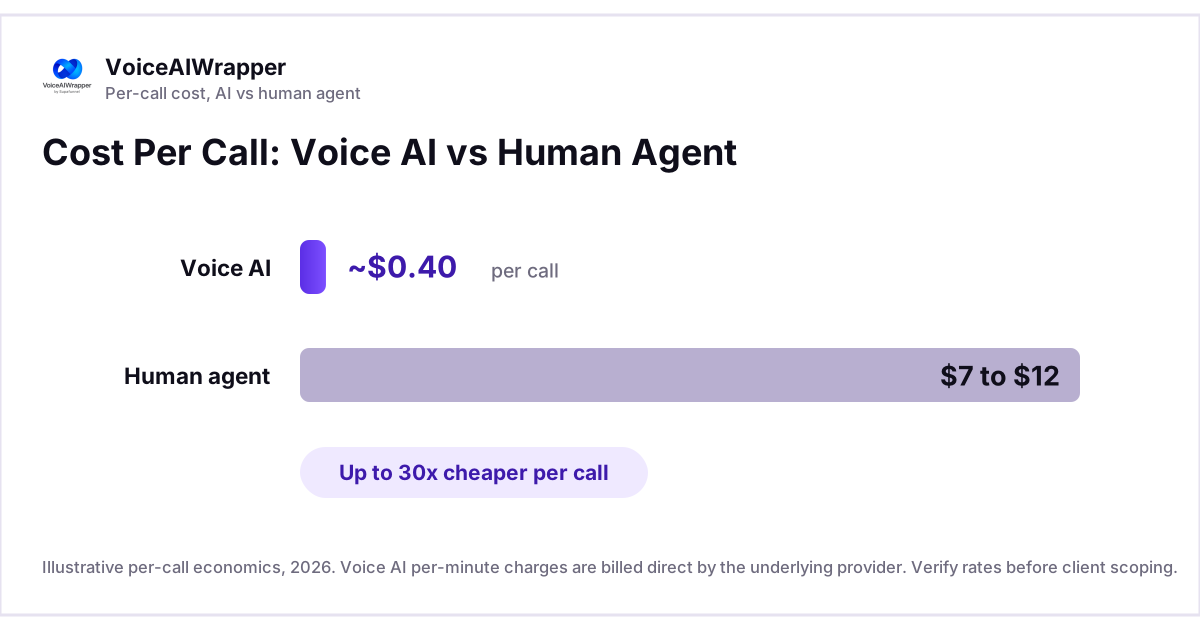
On the cost side, the economics are compelling enough to present to clients without hedging. AI-handled calls cost roughly $0.40 per call. Human agent interactions run $7-12 per call. That is a 90-95% per-call cost reduction. The gap holds across providers and architectures. What varies is how well the AI handles the specific call type, which is why use-case selection matters more than the platform decision.
For agencies, the pitch is not “AI is cheaper.” The pitch is: “Your clients have repetitive, high-volume call workflows that AI handles at a fraction of the cost, at any hour, without the variance that comes with a human team. Your agency can design, deploy, and manage those systems as a retained service.”
Five use cases with verified outcomes
Not every use case is equally proven. The five below have real deployment data attached. Where the data comes from a single provider’s case study, that provenance is noted. Provider-published case studies are not independent audits, but they are specific, attributable, and at least falsifiable in a way that unsourced percentages are not.
1. 24/7 inbound customer service
Inbound voice AI agents handle routine call types at any hour: account inquiries, status checks, scheduling, FAQs, basic troubleshooting. The primary business case is cost reduction plus extended coverage without adding headcount.
What the data shows: in a Retell AI deployment for Matic Insurance, 80% of customers completed AI-handled calls without requesting a human agent, and the company maintained a 90 Net Promoter Score throughout the rollout. Over a single quarter, the AI fielded more than 8,000 calls with an 85 to 90% transfer success rate on scheduled appointment calls.
The honest framing for clients: AI handles volume well when the call script is predictable. Complex, emotionally sensitive, or legally regulated interactions still need human review. Build the handoff logic before launch, not after.
2. Outbound speed-to-lead qualification
Lead response time is one of the most evidence-backed levers in B2B sales. The faster a lead is contacted after submitting a form, the higher the rate of conversion to a booked meeting. AI outbound callers remove the human lag entirely.
A Retell AI deployment for ISpeedToLead reduced lead response time from 100 minutes to under 5 minutes, a 20x improvement. The call-to-meeting booking rate increased by 40%, and the team went from sporadic demo bookings to 20-30 demos booked weekly via AI.
Separately, Retell’s deployment for TripleTen, an online tech education company, ran 17,000 outbound calls per month with a 20% improvement in pickup and conversion rates, which Retell’s case study attributes to its Branded Call ID feature (verified caller ID display), not conversation quality alone. The AI agent’s conversion rate matched the human admissions team when the human team could not handle the inbound volume alone.
The limit here is audience tolerance. Some industries, and some demographics within those industries, respond negatively to AI-initiated calls. Pre-launch A/B testing with a small cohort before scaling is worth the extra week.
3. Appointment booking and confirmation
Appointment reminder and confirmation calls are one of the clearest ROI use cases for voice AI because the economic math is straightforward: a no-show costs a service business a fixed amount per slot. Reduce no-shows and the return is calculable without any assumptions.
Automated appointment reminders are widely documented to cut no-shows, but published figures vary by industry, reminder modality (SMS, voice, email), and patient population, so the voice-specific attribution depends on the implementation. The Retell AI deployment for Matic Insurance found that AI-scheduled appointment calls achieved an 85-90% transfer success rate and higher answer rates compared to human-initiated appointment calls in A/B testing.
For agency clients in healthcare, dental, legal, and home services, this use case typically has the clearest before/after measurement because scheduling software already tracks no-show rates.
4. Onboarding and welcome sequences
Post-signup voice touchpoints improve product engagement and reduce early churn. An AI voice agent can reach a new customer within minutes of signup with a personalized welcome call, offer a brief orientation, and route follow-up questions to the right team.
The public data on AI-driven onboarding is thinner than the data on outbound qualification or inbound service, so we hedge here. The Retell deployment for TripleTen noted that the AI agent “provides a more consistent experience” compared to the human admissions team, which is the structural advantage of AI onboarding at scale: consistency of information, not variability based on which rep picked up.
What agencies should watch: voice onboarding adds friction if the product setup is too complex to cover in a two-minute call. Scope the call to a single outcome (confirm the account is active, answer one FAQ, schedule a kickoff) rather than trying to replicate a full human onboarding session.
5. Outbound surveys and feedback collection
Voice surveys have historically achieved higher completion rates than email surveys. Email survey response rates benchmark at 6-15% depending on list quality and frequency. [via Delighted 2024, DemandSage 2025] Traditional phone surveys exceeded 60% in their peak era, though that figure has declined substantially.
No independent, controlled study was found comparing AI-initiated voice survey completion to email specifically. The dossier for this page found one uncited estimate in a Retell blog post (35% AI phone survey completion vs. under 10% email) but that figure is not sourced to a primary study. Agencies who want to claim a specific completion-rate advantage should run their own A/B test against an email baseline before presenting the figure to clients. The qualitative case is sound; the specific multiplier is not yet verified.
Revenue models agencies are using
Most agencies build voice AI revenue across multiple model types rather than picking one. The five models below are not mutually exclusive. The right combination depends on the client’s business model, the use case, and what your agency can measure.
A note on margins: several industry sources quote gross margin ranges for voice AI services (typically 50-80%). These figures are not independently verified for this guide. Margins depend heavily on provider costs, staff time for optimization, client churn, and whether the agency is building custom agents per client or deploying a repeatable template. Any margin estimate you present to clients should come from your own actual cost data, not from industry benchmarks.
Real case studies: what the numbers actually look like
The figures below come from published case studies on provider websites. They are not VoiceAIWrapper customer stories, they are deployments built on the same underlying platforms (Vapi, Retell, ElevenLabs) that VoiceAIWrapper white-labels. They are the closest available public evidence for what agencies can realistically present to prospects.
Case study 1, Vapi platform
Instawork: 1M+ minutes of voice screening per month
Instawork, a labor marketplace platform, built an AI voice screening workflow on Vapi. The goal: screen hourly workers at scale before routing them to human recruiters. Published January 14, 2026.
- 185% lower cost per call
- 250x increase in screenings
- 330% better skills matching
- 430 days concept to production
Source: Vapi, “Instawork Case Study,” January 14, 2026. Quote from Adam, VP of Engineering, Instawork: “Vapi has been a great partner for Instawork. Their platform allowed us to scale to millions of calls reliably with no performance issues.”
Case study 2, Retell AI platform
ISpeedToLead: lead response time cut from 100 minutes to under 5 minutes
ISpeedToLead deployed a Retell AI voice agent to call inbound leads immediately after form submission. The business case was speed-to-lead: the longer the gap between form submission and first contact, the lower the conversion rate.
- 1100 min → under 5 min response
- 2+40% call-to-meeting booking
- 320-30 demos booked weekly
Source: Retell AI, “ISpeedToLead Case Study,” 2024-2025 data.
Case study 3, Retell AI platform
Matic Insurance: 8,000+ AI-handled calls with 90 NPS
Matic Insurance deployed a Retell AI voice agent for inbound call handling and appointment scheduling. Q1 2025 data. The specific challenge: maintain customer satisfaction while reducing human agent load on routine calls.
- 18,000+ AI-handled calls in Q1 2025
- 285-90% transfer success rate
- 380% self-service completion
- 490 NPS maintained
Source: Retell AI, “Matic Insurance Case Study,” Q1 2025 data.
Case study 4, ElevenLabs Agents platform
Embrace Pet Insurance via Regal: 96.5% customer satisfaction
Embrace Pet Insurance integrated ElevenLabs voice agents into their contact center via Regal. The metric reported is CSAT from AI-handled interactions. Published September 5, 2025.
- 196.5% customer satisfaction
- 2+17% completed qualified transfers
Source: ElevenLabs, “Regal Integrates with ElevenLabs,” September 5, 2025.
A broader benchmark from independent research: a Forrester Consulting Total Economic Impact study on enterprise voice AI deployments (four customers across energy, healthcare, hospitality, and insurance) found an average 391% ROI over three years, with a payback period under six months. Agent labor cost savings totalled $10.3 million in PV over the three-year period. This is enterprise-scale data on a specific platform (PolyAI); the figure is cited here as an industry reference, not a claim about what any agency client will achieve.
They are outcomes from the underlying platforms that VoiceAIWrapper builds on top of. The cleanest VoiceAIWrapper signal you can verify today is on the customer-review side: 5.0 out of 5 stars from 17 verified agency reviews on SaaSHub, plus the Vapi partnership listing. A documented agency case study with revenue and retention metrics is on the production roadmap; we’d rather ship one verified story than a generic claim.
Where VoiceAIWrapper fits in an agency’s voice AI motion
VoiceAIWrapper is not an agent builder. Agents are built and configured inside the provider’s platform. What VoiceAIWrapper adds is the white-label resale layer that sits on top of those agents.
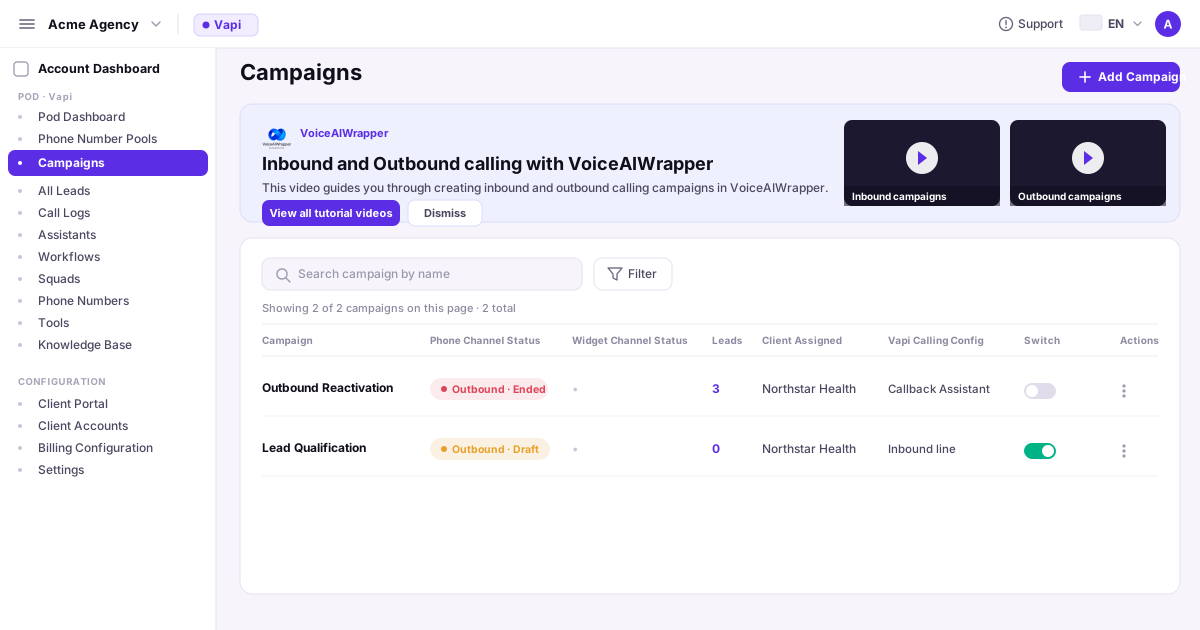
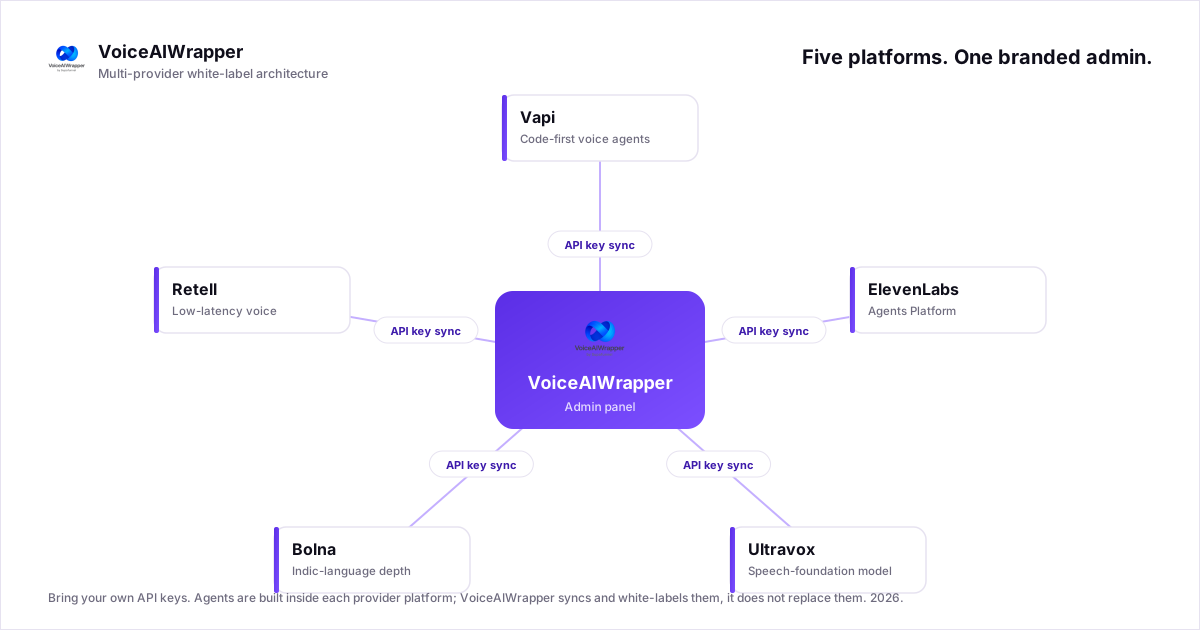
Here is the actual workflow: the agency builds and tests an agent inside the provider (Vapi, Retell, ElevenLabs Agents Platform, Bolna, or Ultravox). Each of those is a full conversational agent platform with its own agent runtime, knowledge base support, tool calling, conversation management, and analytics. The agency pastes the provider’s API key into their VoiceAIWrapper admin. Every agent, knowledge base, and phone number from that provider account syncs into VoiceAIWrapper within seconds. The agency then attaches synced agents to client portals and resells under their own brand at their own pricing.
VoiceAIWrapper is the only platform that white-labels all five conversational agent platforms in one account. For an agency serving clients in different verticals with different latency or language requirements, this means the agency is not locked into one provider’s capabilities. A legal services client running inbound call handling might run on Retell. A client needing Indic language support runs on Bolna. An enterprise client that needs a signed HIPAA BAA (see the HIPAA Compliance Posture) is on the Pro tier ($499/month). One agency account, multiple providers, isolated client portals. See the full VoiceAIWrapper Feature Set for the complete platform inventory.
VoiceAIWrapper-Native Features (What the Platform Adds That the Providers Do Not)
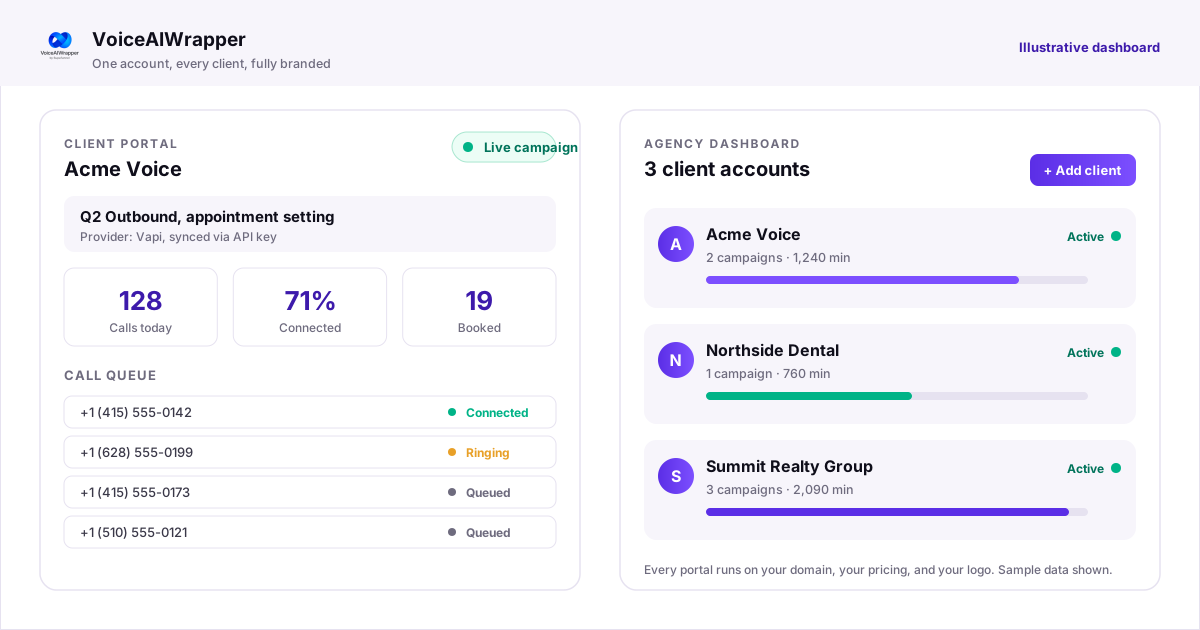
Sub-account architecture: one agency account with isolated client portals, each with separate analytics, billing plans, and logins. The agency’s client cannot see other clients.
Agency markup pricing: the provider bills the agency directly for minutes used. The agency sets its own client-facing pricing inside VoiceAIWrapper at any markup, currency, and billing frequency. No revenue sharing with VoiceAIWrapper.
Stripe client rebilling: available from Growth tier ($79/month). Multi-currency. Agencies can bill clients in-app through their own branded billing interface. External billing APIs are available at Pro tier.
Programmatic outbound campaign engine: cadence and retry controls (days, hours, retry count), scheduling guardrails for TCPA and GDPR compliance, lead status auto-update, funnel campaigns (route no-answers to a different agent with a different message), webhook-triggered campaigns.
Phone-number pool: distributes high-volume outbound across multiple numbers to reduce spam-flagging exposure on any single number. Handles inbound concurrency as well.
Smart callback: if the agent hears “call me back at 3pm,” it schedules the retry automatically at the specified time. No human intervention required.
CRM round-trip: fetch leads from a CRM, call them, push call outcomes and status back. Integrates via API/webhook or through n8n, Zapier, HubSpot, or GoHighLevel. Speed-to-lead automation is the primary use case here.
Per-client analytics: the agency sees its own cost view (including markup). The client sees a separate analytics view that does not expose the agency’s margin. Agencies control what each client can see and download.
White-label subdomain: keyword.youragency.com pattern. The agency picks the keyword (app, ai, calls, assistants). VoiceAIWrapper does not appear in the URL.
Pods architecture: one client portal can attach agents from multiple providers simultaneously. Useful for running A/B comparisons across providers for the same client.
Dummy client portal: the agency can spin up a test portal to verify exactly what the client will see before any client onboarding begins.
SaaS Creator (Pro tier): direct client signup from the agency’s own website, without the agency manually creating each portal.
What VoiceAIWrapper does not do
Agents are not built inside VoiceAIWrapper. Knowledge bases, voice selection, tool calls, MCP server integrations, voicemail handoff logic, transfer-to-human configuration, and SMS fallback all live inside the provider platform. VoiceAIWrapper syncs them, it does not replicate them. This is intentional: new provider features become available to VoiceAIWrapper agencies automatically without any update from VoiceAIWrapper’s side.
VoiceAIWrapper does not affect call latency. Latency is a provider-side metric. It does not mark up voice minutes. Provider charges go directly to the agency at the provider’s posted rates.
VoiceAIWrapper is listed as an official platform partner in the Vapi provider directory at VoiceAIWrapper Integration with Vapi.
5-step client onboarding framework
The framework below reflects what has worked for agency deployments based on public case study timelines and VoiceAIWrapper’s own platform setup data. The usual setup time for getting a first client live on VoiceAIWrapper is 60 minutes from account creation to a working client portal.
Use-case selection and fit assessment
Before any platform selection, determine whether the client's call workflow fits the five criteria Vapi's enterprise playbook identifies as markers for a successful AI deployment: high call volume (ideally repeatable and predictable), clear success criteria (you need to be able to measure whether the agent succeeded on each call), and strong backend system availability for CRM and calendar integration. Miss three of five and the deployment is likely to struggle. A one-page fit assessment before any signed statement of work is worth the hour it takes.
Provider selection and API key setup
On VoiceAIWrapper, the agency connects one or more provider accounts via API key. The platform supports Vapi, Retell, ElevenLabs Agents Platform, Bolna, and Ultravox simultaneously. Starter and Growth plans provide Vapi and Retell. Scale ($249/month) and Pro ($499/month) unlock all five. The selection depends on the client use case: Retell for lower-latency inbound, ElevenLabs for brand-voice precision, Bolna for Indic language requirements, Ultravox for clients who want a speech-foundation-model architecture. Build and test the agent inside the provider before connecting the API key to VoiceAIWrapper.
Client portal setup and white-label configuration
Create the client portal in VoiceAIWrapper. Set the white-label subdomain, upload the agency logo and client-specific branding, and configure what the client can see in their analytics view. Set agency markup pricing for the client's billing plan. Use the dummy client portal feature to verify the client experience before sending credentials. This stage takes roughly 60 minutes for a first client. Step-by-step screencasts are available at the VoiceAIWrapper Videos.
Pilot run with a controlled cohort
For outbound use cases: start with a small cohort (100-500 contacts) before scaling. For inbound: run a limited rollout to a subset of call types while human agents handle the rest. Establish a baseline measurement (current cost per call, current no-show rate, current lead response time) before launch so the comparison is clean. The Matic Insurance case study tested AI-scheduled appointment calls against human-initiated calls in A/B conditions before full rollout. This is the pattern that produces defensible ROI data.
Weekly optimization loop and retainer reporting
Voice AI deployments do not stay static. Caller patterns shift. Provider model updates change agent behavior without any change to the prompt. The weekly loop that Vapi documents in their enterprise playbook covers four items: top transfer reasons (why calls are being handed to humans), top tool errors, false success detection (calls marked as successful that weren't), and low-confidence transcripts. One targeted fix per week, documented with a before/after measurement, becomes the substance of a monthly client retainer report.
Common implementation challenges
Challenge 1: Telephony reputation and spam flagging
Outbound AI calling at volume can get phone numbers flagged as spam. This happens when numbers are not warmed up (starting at high call volume without a ramp period), not registered with CNAM databases, or not carrying proper STIR/SHAKEN attestation at the carrier level. Flagged numbers see answer rates drop from 40%+ to single digits within days. Recovery takes 2+ weeks.
The solution is procedural, not technical: warm up new numbers starting at roughly 50 calls per day over two weeks, confirm CNAM registration with the carrier, verify STIR/SHAKEN attestation, and monitor reputation dashboards (services like YouMail or Hiya’s B2B dashboard) daily. VoiceAIWrapper’s phone-number pool feature helps by distributing volume across multiple numbers so no single number absorbs a spam-triggering call density.
Challenge 2: Transfer and escalation logic
The most common live-deployment failure is an agent that does not know when to hand off to a human. Calls that should escalate (an angry customer, a complex question outside the knowledge base, a potential compliance risk) stay in the AI workflow too long. The client notices. Trust in the system drops.
Escalation logic should be explicit and conservative at launch. Build clear handoff triggers: specific phrases, detected sentiment flags, question types outside a defined scope. Widen the AI’s autonomy after you have reviewed 200-300 calls and confirmed the failure modes.
Challenge 3: Integration with existing CRM and calendar systems
Speed-to-lead and appointment booking use cases require real-time integration with the client’s CRM (typically Salesforce, HubSpot, or GoHighLevel) and calendar system. These integrations break in specific ways: authentication tokens expire, API rate limits are hit during campaign spikes, calendar availability data becomes stale. Budget for integration maintenance as an ongoing line item, not a one-time setup cost.
Challenge 4: Conversation design for edge cases
Most early voice AI deployments are designed around the happy path and break on edge cases: callers who give ambiguous answers, callers who switch languages mid-call, callers who ask about things completely outside the script. These edge cases are uncommon in any single call but inevitable at scale. The fix is a structured conversation QA process: review 50 random calls per week in the first month, categorize failure modes, and update the agent’s system prompt and knowledge base iteratively.
Challenge 5: Managing client expectations on AI behavior
Clients who have never seen a production voice AI deployment often have one of two wrong mental models: either they expect the agent to be indistinguishable from a human (it won’t be, at least not in every edge case), or they expect it to fail constantly (it won’t, on well-scoped use cases). The agency’s job is to set the right expectation before launch. Show the client real call recordings from comparable deployments. Walk them through what happens on a transfer. Agree on the success metric before day one.
When this guide does not fit
Future trends worth tracking
Three data points from recent research are relevant to where agency voice AI work is heading in the next 12-18 months.
AI agents are moving from experimental to operational: McKinsey’s State of AI 2025 (November 2025, 1,993 participants across 105 countries) found that 88% of companies now report regular AI use in at least one business function, and 62% are experimenting with or scaling AI agents specifically. That agent-specific adoption figure is the meaningful signal for voice AI agencies: enterprise clients are no longer asking whether to use AI agents, they are asking how.
AI adoption in marketing has passed the tipping point: Salesforce’s State of Marketing 2026 report (4,450 marketers surveyed, October-November 2025 survey period) found that 75% of marketers have adopted AI, and 87% use generative AI in at least one recurring workflow. These figures cover AI broadly, not voice AI specifically. But they tell you something useful about client readiness: marketing agency clients are not skeptical of AI in the abstract. The conversation is now about which specific workflows to automate, not whether to automate at all.
Multimodal agents are expanding the scope of the use case: ElevenLabs Agents Platform, one of the five platforms that VoiceAIWrapper supports, ships voice agents, chat agents, and multimodal agents in the same platform. Agencies who deploy a voice agent for a client today will find it increasingly natural to extend that deployment to a web chat widget or a phone-plus-chat multimodal interaction. VoiceAIWrapper’s white-label chat and multimodal widget support is already available for ElevenLabs and Retell on Scale and Pro tiers.
Gartner’s 2022 forecast is now testable: Gartner predicted in 2022 that conversational AI would reduce contact center agent labor costs by $80 billion by 2026. This is a 2022 forecast, not a 2026 finding. But it is now measurable. Agencies who want to build an authoritative voice in the category should be watching whether the contact center labor cost data in 2026 supports or contradicts that forecast.
Four objections agency owners raise
""My clients aren't ready for AI calling. They'll push back."Some clients will push back. The objection is usually about brand risk, not about the technology. The most effective response is not to argue for AI in general; it is to show them what a comparable deployment sounded like on a call recording. Matic Insurance's case study is useful here: 80% of customers completed AI-handled calls without requesting a human agent, and the company maintained a 90 NPS throughout. That is a concrete data point, not a marketing claim. Most clients who hear a real call recording with a well-designed agent will change their assessment.
""The setup is too complex. My team can't build this."The most technically demanding part of a voice AI deployment is the agent design: the system prompt, the knowledge base, the tool calls, the edge case handling. That work happens inside the provider's platform (Vapi, Retell, ElevenLabs, etc.) and is increasingly well-documented. The VoiceAIWrapper white-label layer on top of it does not require code. The canonical setup time for getting a first client portal live on VoiceAIWrapper is 60 minutes. The complexity people imagine is front-loaded; once the agent is built and tested, deploying it for additional clients is fast.
""I don't want to be locked into one AI provider."This is a legitimate concern and one worth naming clearly. VoiceAIWrapper is the only platform that white-labels all five conversational agent platforms (Vapi, Retell, ElevenLabs, Bolna, Ultravox) in a single account. [18] An agency using VoiceAIWrapper can run different clients on different providers, or run one client on multiple providers simultaneously using the pods architecture. If a provider raises prices, degrades in quality, or changes their terms, the agency can move clients to a different provider without rebuilding the white-label infrastructure.
""What if the provider goes down? That's my client's reputation."VoiceAIWrapper maintains 99.9% platform uptime. [master-brief.md] That is the uptime of the VoiceAIWrapper management layer, not the underlying providers. Provider outages are a real operational risk. VoiceAIWrapper surfaces provider degradation alerts and analytics so the agency knows when a provider is having issues. The platform does not auto-failover mid-call (intentional: mid-call failover creates a worse customer experience than a clean transfer to a human). The agency decides when to swap providers. For clients with high-availability requirements, the pods architecture allows pre-configuring a backup provider so the switch is fast.
Frequently Asked Questions
What is the best way for an agency to start with voice AI without risking a client relationship
Start with a use case that has a clean before/after measurement (no-show rate, lead response time, or cost per handled call) and run a controlled pilot with a subset of the client's call volume. Do not promise outcomes you cannot measure. Use real call recordings from comparable deployments (not demos) to set expectations. Build the escalation logic before launch, not after.
Which industries see the clearest ROI from voice AI?
Based on the case study data available in 2025-2026, the clearest ROI shows up in: staffing and labor marketplace screening (Instawork: 85% lower cost per call, 50x screening scale), speed-to-lead for high-volume lead generation (ISpeedToLead: 20x faster response, 40% booking rate lift), and insurance and healthcare inbound handling (Matic: 80% self-service completion with 90 NPS). Common thread: high call volume, repetitive and predictable call scripts, and a measurable success metric per call.
How do agencies price voice AI services for clients?
The most common models are a monthly management retainer covering optimization and reporting, a usage-based component tied to call volume or minutes, and in some cases a performance fee tied to a measurable outcome. VoiceAIWrapper lets agencies set their own client pricing plans inside the platform, charge in any currency, and rebill clients via Stripe starting on the Growth tier ($79/month). The platform does not take a revenue share.
What conversational agent platforms does VoiceAIWrapper support?
Five platforms: Vapi, Retell, ElevenLabs Agents Platform, Bolna, and Ultravox. Each is a full conversational agent platform with its own agent runtime, knowledge base, tool calling, and analytics. Starter and Growth plans include Vapi and Retell. Scale ($249/month) and Pro ($499/month) unlock all five. VoiceAIWrapper is listed as an official Vapi platform partner at docs.vapi.ai/providers/voiceaiwrapper.
Is voice AI compliant with GDPR and HIPAA?
VoiceAIWrapper is SOC 2 Type 2 documented, GDPR-compliant, and HIPAA-compliant. A signed Business Associate Agreement (BAA) is included in the Pro tier ($499/month) at no extra fee. Agencies handling protected health information should be on the Pro tier and should ensure their provider account also carries appropriate BAAs. Telephony compliance (TCPA call time restrictions, STIR/SHAKEN) is the agency's responsibility to configure via the telephony provider and VoiceAIWrapper's campaign scheduling guardrails.
What is the ROI evidence base for voice AI in 2025-2026?
The strongest independent evidence is a Forrester Consulting Total Economic Impact study on enterprise voice AI (four customers across energy, healthcare, hospitality, insurance, published July 29, 2025) that found 391% three-year ROI, under six-month payback, and $10.3 million in PV labor cost savings. Provider-published case studies (Vapi, Retell, ElevenLabs) show specific deployment outcomes: 85% per-call cost reduction, 40% booking rate improvement, 80% self-service completion. These are provider-published, not independent audits.
What does VoiceAIWrapper cost?
Plans: Starter $29/month (1-3 clients), Growth $79/month (5-15 clients, adds Stripe rebilling), Scale $249/month (unlimited clients, all five providers), Pro $499/month (adds SaaS Creator, AI Call Centre, dedicated support, signed BAA). Annual billing saves roughly 17%. 7-day free trial with Scale-tier access during the trial. VoiceAIWrapper does not charge a markup on voice minutes; minutes bill directly to the agency at the provider's posted rates. Pricing on VoiceAIWrapper pricing page.
Like this article? Share it.