14 Lessons Learned About Maintaining Quality Control With AI Products
Here are Hard-won lessons from founders running AI in production, on what actually keeps quality from slipping after launch.
AI products do not fail the way traditional software fails. A normal app crashes, throws an error, or hangs, and you know immediately. An AI product keeps running, keeps producing outputs that look fine, and quietly drops in quality in ways that do not show up until a customer notices. That gap between what looks right and what is actually right is where most teams lose control of quality, and by the time they figure it out, trust has already taken a hit. The 14 founders and operators below have each learned that lesson in production, and they have done the work to build systems that catch failures before the user does. Their answers cover input constraints, prompt versioning, shadow testing, continuous monitoring, human checkpoints, audit trails, culture vetoes, validation layers, prompt context limits, real-world scenario testing, mandatory checklists, data governance, simulation calibration, and integrated intake and review. Each lesson comes with the specific situation that taught it, so you can see exactly where the quality problem showed up and what the fix actually looked like.
AI products demand rigorous quality control, yet many teams struggle to establish reliable safeguards as they scale. Industry experts have identified 14 critical lessons that separate successful AI deployments from costly failures. These battle-tested strategies address everything from validation protocols to cultural accountability, offering practical frameworks for teams building AI systems where accuracy matters.
Constrain Inputs and Preview Outcomes
Version Instructions and Run Shadow Tests
Establish Continuous Oversight before Launch
Bake Expert Review into Workflow
Enforce Audit Trails and Confirmations
Add Daily Checkpoints and Alerts
Install Culture Veto Prior to Release
Create Validation Layers and Ownership
Limit Prompt Context for Quality
Blend Real Scenarios with Iteration
Make Checklists Mandatory
Govern Access and Protect Data
Calibrate Simulations to Clinical Reality
Integrate Intake, Process, and Checks
Constrain Inputs And Preview Outcomes
I'm Runbo Li, Co-Founder & CEO at Magic Hour.
The biggest lesson is simple: your users will always find the failure mode you didn't test for. And the only real quality control is shipping fast enough to catch it before it becomes a pattern.
Early on, we launched a face swap template that worked beautifully in our internal tests. Clean lighting, forward-facing portraits, standard aspect ratios. Within 48 hours, users were uploading group photos, blurry screenshots from FaceTime calls, images with sunglasses, side profiles, pets. The output quality tanked for those edge cases, and suddenly we had a perception problem. People weren't thinking "I uploaded a bad input." They were thinking "this product doesn't work."
That experience taught me what I call the "first-impression tax." With AI products, users don't give you the same grace period they give traditional software. If a Google Doc loads slowly, you blame your Wi-Fi. If an AI tool produces a bad output, you blame the tool. Permanently. You might never open it again.
So we rebuilt our entire approach around input guardrails rather than output hope. We added preprocessing steps that detect low-quality inputs before the model ever touches them. We built preview states so users can see what the AI is "seeing" before they commit a generation. And we created template-specific guidance that nudges people toward inputs that will actually produce great results.
The counterintuitive part is that constraining what users can do actually made them happier. Giving someone a blank canvas and a powerful model sounds like freedom, but it's really just a setup for disappointment. Giving someone a well-scoped template with clear guardrails? That's where the magic happens.
We monitor output quality daily. Not with automated metrics alone, but by literally watching generations come through the platform. David and I still review real user outputs every single morning. At our scale, with millions of users, that sounds insane. But the pattern recognition you build from doing that is irreplaceable.
Quality control with AI isn't a system you build once. It's a discipline you practice every day, like a chef tasting every dish before it leaves the kitchen.
Runbo Li, CEO, Magic Hour AI
Version Instructions And Run Shadow Tests
The biggest lesson I learned is that you cannot "test" AI quality into existence; you must "version" it into stability. Most developers treat LLMs like deterministic APIs. They aren't. They are moody, unpredictable, and prone to "silent regressions." At MyOpenClaw, we stopped relying on manual spot-checks. Instead, we built a dedicated prompt-management layer which eventually evolved into TTprompt to track how every subtle model update altered our agents' decision-making logic.
In TaoTalk, we experienced a major "hallucination spike" when a leading model provider pushed a "transparent" backend update. Our success rate for structured JSON extraction plummeted from 94% to 82% in a single afternoon. The solution wasn't adding more Python code. It was implementing a rigorous "shadow testing" pipeline. Now, every prompt iteration runs against 150+ historical edge cases before a single user sees it. If you don't own your prompt versioning and regression suite, the model provider effectively owns your product's reliability. It is a shift from software engineering to behavioral science.
Stop asking if the AI is "smart." Start measuring if it is "reliable."
RUTAO XU, Founder & COO, TAOAPEX LTD
Establish Continuous Oversight Before Launch
The biggest lesson was learning that AI quality control is not a phase. It is a permanent operating condition.
Traditional software has a finish line. You test it, fix the bugs, ship it, and the behavior is predictable from that point forward. AI products do not work that way. The model behaves differently as user inputs diversify, as edge cases accumulate, and as the real world turns out to be messier than your training data assumed.
We delivered a multilingual AI chatbot where everything tested perfectly across our defined scenarios. In production, users started combining languages mid-conversation, something we had not weighted heavily enough during testing. The system did not break catastrophically, but the response quality dropped in ways our pre-launch QA never caught.
The fix was less about the model and more about the monitoring layer we built around it. We introduced continuous output sampling where a percentage of real interactions get reviewed against quality benchmarks on an ongoing basis, not just at launch.
That single change transformed how we think about AI delivery. We now tell clients at the start of every AI engagement that go-live is not the end of quality control, it is the beginning of the most important phase of it. Teams that treat AI shipping like traditional software shipping will always be surprised by production behavior.
Build the monitoring layer before you build the model. That is the lesson.
Raj Jagani, CEO, Tibicle LLP
Bake Expert Review Into Workflow
AI gets things 90% right. That last 10% is where the real damage happens.
A wrong statistic stated with total confidence. A recommendation that sounds reasonable but misses the point entirely. You don't catch these easily because everything around them looks fine.
I work with private equity firms and alternative investment teams building AI systems where bad data can blow up decisions worth millions. After more than a decade studying how people actually use AI in these environments, the pattern is always the same: teams fall in love with the speed and stop checking the work.
That's where quality falls apart. Not because the AI is bad, but because nobody built a review step into the process.
Every system we build has human checkpoints baked in from day one. Not a quick skim before something goes out the door. So a real review from someone who knows the subject, knows the client, and will push back when the output misses something.
AI is a first draft. Treat it like one.
Leigh Coney, Principal Consultant, WorkWise Solutions
Enforce Audit Trails And Confirmations
Building SAFE for hundreds of law enforcement agencies taught me the big QC lesson for AI: you can't "average out" mistakes when the product is a chain-of-custody system—every AI output has to be provable after the fact.
So we treat AI like a junior evidence tech: it can suggest, but it can't silently decide. Any AI-assisted action (auto-tagging, routing, redaction suggestions, anomaly flags) must leave an audit trail showing who accepted it, what changed, when, and why—same mindset as logging every move from intake to disposition.
One practical example: if an AI model flags "unusual access" or proposes a classification, we require a human confirmation and we record the pre/post state. If that gets challenged later, you're not debating the model—you're showing the documented handling, access controls, and the exact decision point.
If you're building AI products, design QC around "explainable operations," not "better accuracy." In regulated environments (CJIS-level expectations), the fastest way to lose trust is an AI feature that can't be reconstructed during an audit or a court review.
Ben Townsend BR, CEO, Tracker Products
Add Daily Checkpoints And Alerts
We started using AI-powered scheduling software at our home services company about two years ago, and the quality control lesson I learned was expensive but straightforward. AI systems don't degrade gracefully. They work perfectly until suddenly they don't, and the failure mode catches you off guard because everything looked fine yesterday. Our system was handling dispatch routing, matching technicians to jobs based on skills, location, and equipment requirements. It worked beautifully for months. Routes were optimized, drive time was down, and customer satisfaction scores were up. Then one Monday, it started assigning our junior plumber to complex commercial jobs that required a master license. Nothing in the system had changed, no one had adjusted the parameters, but the AI had learned a pattern over the weekend that produced these mismatches. We caught it before anything dangerous happened, but it was a wake-up call. The lesson I learned is that you can't automate quality control away. You have to build human checkpoints into the process at regular intervals, even when everything looks like it's running smoothly. We now require a senior dispatcher to review the first ten assignments every morning before they go out. It takes about fifteen minutes, and it's caught several misassignments that would have resulted in the wrong technician showing up at a customer's door with the wrong parts. Another thing we implemented was automated alerts for outlier assignments. If the AI schedules someone outside their certified skill set or beyond their typical service radius, the system flags it immediately rather than waiting for a human to notice. At Accurate Home Services, we still use the AI for routing, but we treat it as a recommendation engine, not an authority. The technology handles the heavy lifting of optimization while our experienced team provides the judgment call that AI can't yet replicate. Quality control with AI isn't about catching the technology doing something wrong. It's about building systems that make the inevitable errors visible before they reach the customer.
Belle Florendo, Marketing coordinator, My Accurate Home and Commercial Services
Install Culture Veto Prior To Release
The lesson that hit hardest at memelord.com was learning that AI quality control is really a human taste problem disguised as a technical problem. When we started using AI tools to assist with content creation, we thought the quality issues would be factual errors or formatting glitches. The actual failures were about voice, tone, and cultural timing: AI-generated content that was technically correct but culturally off, which in meme marketing is worse than being factually wrong. A factually incorrect meme is a gaffe. A meme that's culturally tone-deaf is a brand-damaging moment that lives forever as a screenshot.
The quality control system that actually works is what I call "culture veto" checkpoints: before any AI-assisted content goes live, someone genuinely embedded in the community it's aimed at reviews it. Not for accuracy but for vibe. The question isn't "Is this correct?" it's "Would someone who lives inside this culture cringe at this, or share it?" That distinction sounds soft but it's the whole game in social content. AI can produce technically competent content at scale, but the quality bar that actually matters to an audience is almost never technical competence. It's cultural resonance, which still requires a human who genuinely cares about that culture somewhere in the loop.
Jason Levin, CEO/Founder, Memelord.com

Create Validation Layers And Ownership
The biggest lesson we learned is that AI doesn't fail loudly, it fails quietly.
Humans make visible mistakes while AI produces things that appear to be completed at first glance. For us, this made AI so much more dangerous! We realized that quality control is no longer about finding mistakes; instead, we must create systems in which mistakes are expected.
Now, instead of reviewing content, we created validation layers that dictate how AI output is validated. Validation layers define how an output is checked to be academically accurate, appropriate in tone, or compliant to some external requirement. Each output gets validated using some type of intended focus or intended action, and does not necessarily have the same level of scrutiny, but all outputs must have some sort of intentional scrutiny.
One concrete way we did this is by assigning human owners to every AI-produced output. The assigned human will now have the ultimate responsibility for the final product, which seems easy, but it has completely changed how we behave.
What surprised me most was that successful AI-assisted output will come from having more of a culture where speed never dominates the ability to judge.
AI produces outputs that are of a higher volume, and without sufficient levels of ownership, you will also be producing a higher volume of failed AI outputs.
Vasilii Kiselev, CEO & Co-Founder, Legacy Online School
Limit Prompt Context For Quality
I have run SEO and content operations at LinkedIn and large agencies, scaling performance across vast content operations and adopting production AI workflows. Through all of this, one lesson rang true time and time again.
If you give an AI model too much context to work with, the quality of its output will decline rapidly.
AI starts going off-topic quickly when given verbose and unfocused prompts. I've managed content operations where a 300+ word prompt returned something usable 40% of the time. As you can imagine this led to long cycles of editing. Prompts that kept context windows under 120 words returned cleaner drafts 90% of the time, reducing our time spent revising from 25 minutes per item to about 10. That extra 15 minutes per item will rack up when you're producing 50-100 items per month.
Shahid Shahmiri, Founder and CEO, Marketing Lad
Blend Real Scenarios With Iteration
Maintaining quality control in AI products requires relentless testing and a clear understanding of end-user needs. From my experience as the CEO of TradingFXVPS, where we optimize high-performance solutions for traders and financial platforms, one critical lesson stands out—quality control in AI is as much about understanding human behavior as it is about refining algorithms. AI tools can often make decisions based on incomplete or biased datasets, which is why we implemented a dual-layered QA process during the rollout of an automated latency analysis tool. By integrating real-world trading scenarios into our testing environment, we uncovered anomalies that would have otherwise been missed in synthetic simulations—this led to a 20% improvement in prediction accuracy for our clients.
Contrary to the assumption that automation fixes all errors, we focus on combining AI insights with human oversight, allowing traders to balance efficiency with precision. For instance, during our beta phase, we invited 50 active clients to stress-test the system under live conditions, identifying gaps that even the most sophisticated AI couldn't detect. My background in marketing has further taught me that quality isn't just technical—it's also about ensuring clarity and usability for end users. The takeaway? Delivering quality in AI isn't a one-time effort; it's an iterative process where both algorithms and user feedback play a vital role in continuous improvement.
Ace Zhuo, CEO | Sales and Marketing, Tech & Finance Expert, TradingFXVPS
Make Checklists Mandatory
The mistake we kept making was treating the review step as optional. Someone would look it over, think it sounded about right, and it would go to the client. Then we'd get a question about something that wasn't accurate or didn't match what we'd actually recommended.
The fix was building a real checklist rather than relying on a general read-through. Accuracy, tone, whether any claims needed backing up, whether it matched what we'd told the client in conversation. Four things, five minutes, every time.
Quality got noticeably more consistent. Not because the AI got better but because the standard got clearer. A quick read and a structured review are surprisingly different things even when the same person is doing both.
Nirmal Gyanwali, Founder & CEO, WP Creative
Govern Access And Protect Data
As the founder of an MSP and author of books on AI for business, I've learned that true quality control for AI products extends far beyond just checking outputs. A critical lesson is maintaining control over where and how AI is used within your organization.
Uncontrolled "shadow AI" use, where employees paste sensitive data into public tools, introduces massive quality risks. This not only exposes proprietary information, but also leads to inconsistent processes and unreliable outcomes, as data may be used to train external models.
To address this, we advocate for and implement secure, governed AI environments that prevent third-party training and keep company knowledge inside the organization. This approach ensures all AI-assisted work is consistent, secure, and utilizes the best model for each specific task without data leakage.
Roland Parker, Founder & CEO, Impress Computers
Calibrate Simulations To Clinical Reality
My background in biotechnology and clinical research at Johns Hopkins taught me that while digital models are precise, biological outcomes are highly variable. The most critical lesson in maintaining quality control with AI is ensuring the technology manages expectations rather than just simulating impossible ideals.
We use AI simulation technology to provide patients with a visual roadmap of their aesthetic treatments. We maintain quality by strictly calibrating these digital projections against the actual clinical limitations of our non-surgical procedures to ensure the predicted result is biologically achievable.
Quality control in aesthetics means using AI specifically as a tool for informed consent. This ethical alignment between digital simulation and medical reality is what allowed us to scale while winning the Better Business Bureau Torch Award for integrity.
Scott Melamed, President & CEO, ProMD Health
Integrate Intake, Process, And Checks
A key takeaway is that the quality assurance process for any AI product or service must extend beyond the performance of the model. It's possible to have an excellent model, but if the inputs (e.g., prompt, workflow, handoff, review process) are poor then you can still receive a poor quality output. Typically, the most common problems observed will arise in "real-life" environments, i.e. the output may sound authoritative, but contain factually incorrect information; or, something that worked well during pre-release quality assurance testing does not perform as expected when the customer uses it in a different context/considers different phrasing.
In general, the best way to ensure high-quality output is by implementing basic checks as to the output of the A.I. system rather than assuming that the A.I. will generate high-quality output without additional assistance. For instance, for high-stakes uses one could implement human review, define more restrictive prompts, create clear back-up/review procedures; and test against real customer usage on a regular basis. The most significant point is that the A.I. will produce high quality output ONLY when the entire system (i.e. all elements) surrounding the A.I., including but not limited to, inputs, processes, and reviews, are integrated and working together in a coordinated fashion, i.e. creating a successful "team effort" to achieve the desired output/results.
Anton Strasburg, Media Manager, FreeConference.com
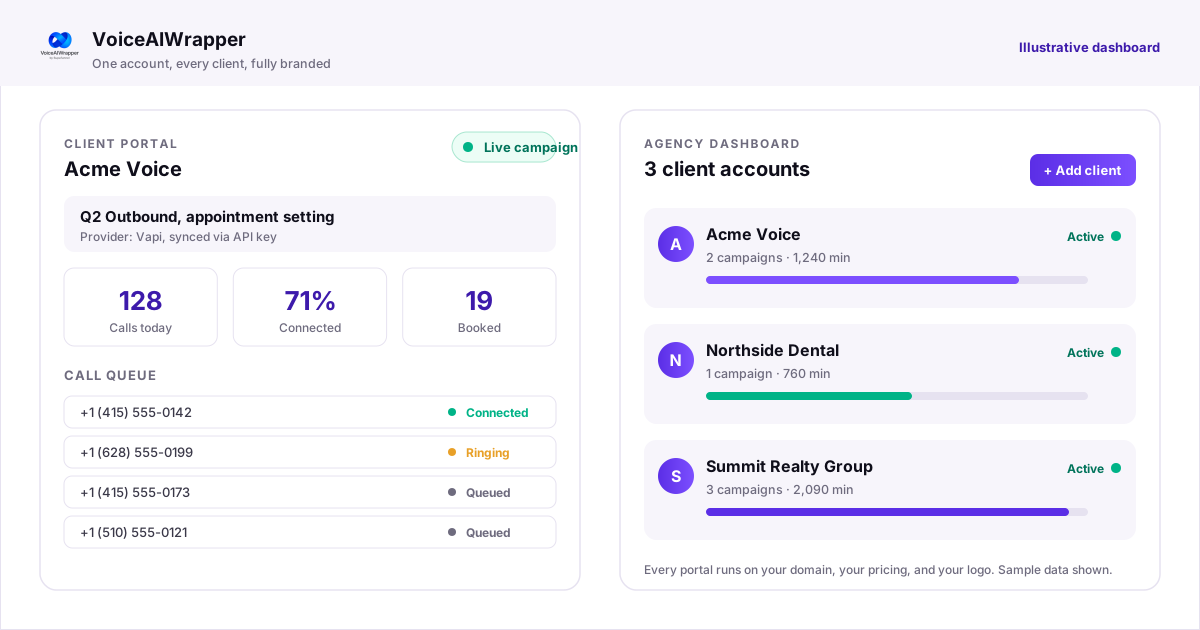
If you are delivering AI products to clients and want a white label platform that gives you the logging, analytics, and monitoring layer these lessons keep pointing at, we built VoiceAIWrapper so agencies can ship voice AI under their own brand without rebuilding the quality infrastructure every time.
Like this article? Share it.