VoiceAIWrapper platform features
Connect five supported conversational AI platforms. Give clients a branded portal. Run campaigns, client billing, data flows and reporting from one agency account.
A 7-day trial is available. A card is required. You choose a plan during signup, and your selected paid plan starts automatically on day 7 unless you cancel before then.
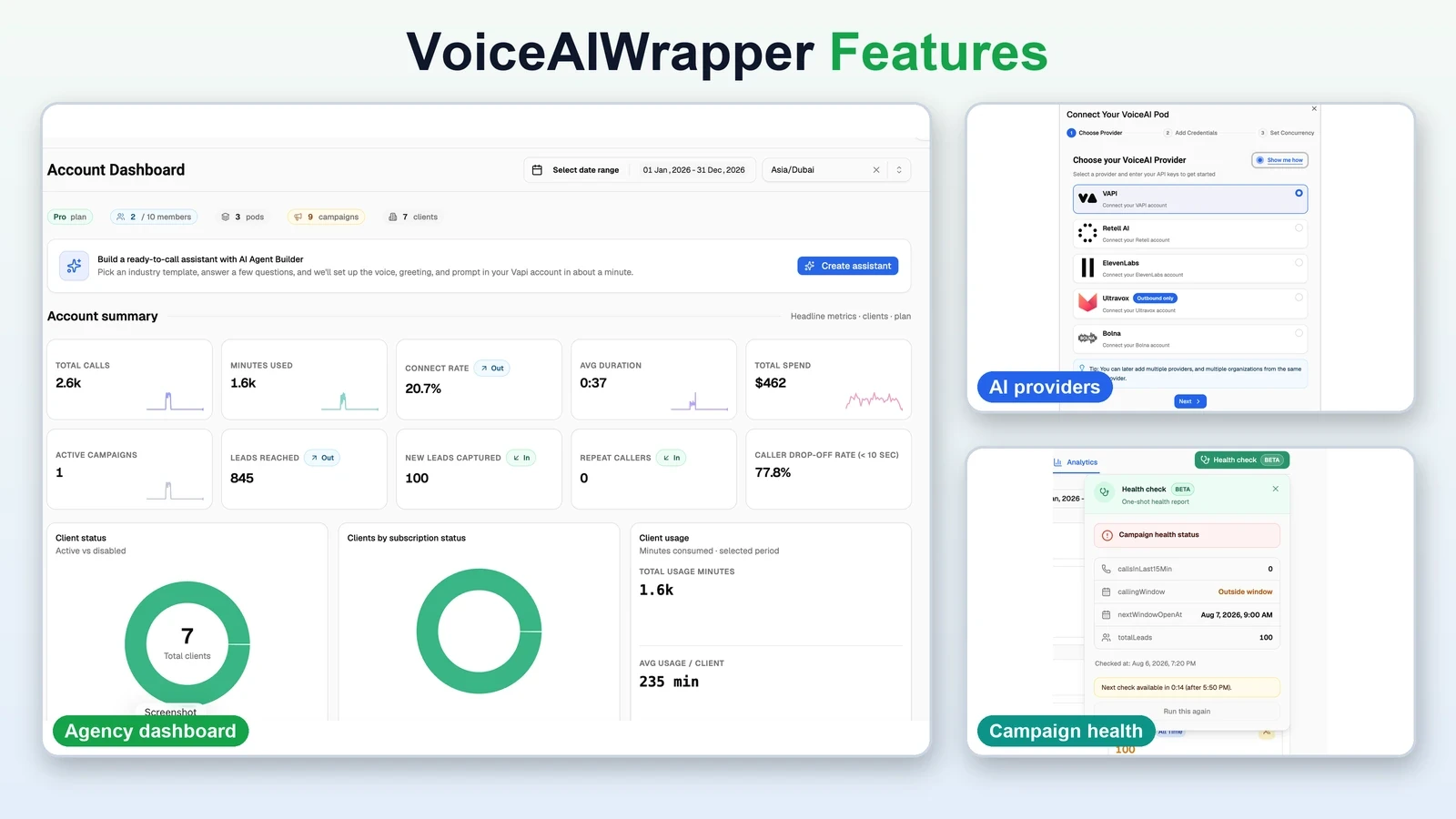
A platform for agencies managing client accounts
Use this page to understand the platform-wide capabilities. Use voice AI white-label pricing and plan limits for current plan availability and voice AI white-label use cases for specific agency workflows.
What agencies can manage
Connect five conversational AI platforms
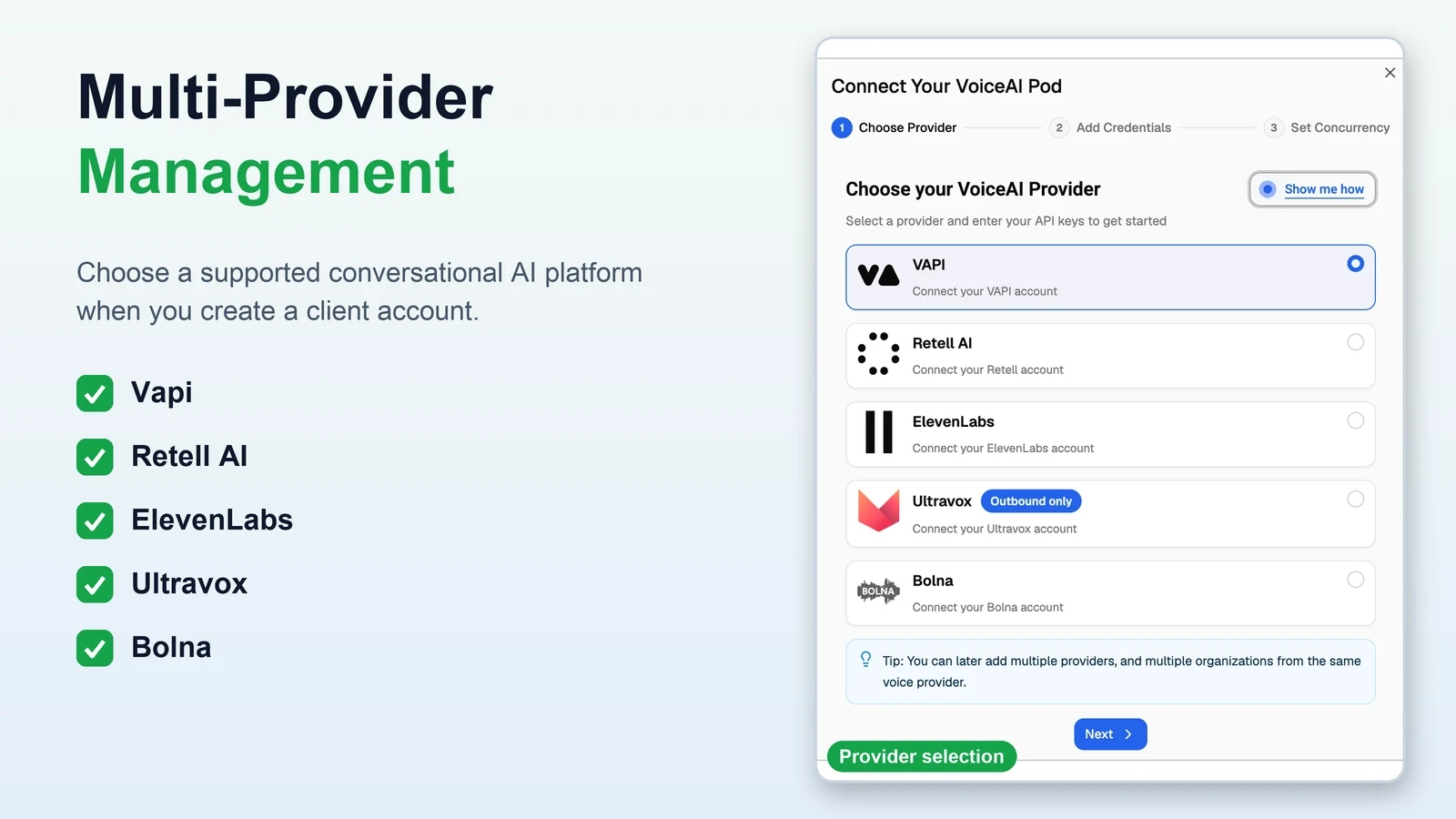
Choose a supported provider when creating a client account, then add the credentials required for that provider. VoiceAIWrapper currently supports Vapi, Retell AI, ElevenLabs Agents Platform, Bolna and Ultravox. The provider screen labels Ultravox as outbound-only, so it should not be selected for an inbound receptionist workflow.
The account structure lets an agency add more than one provider and more than one organization from the same provider. It does not promise complete feature parity across providers. The available agent, call and campaign functions depend on the connected provider and the selected VoiceAIWrapper plan.
See one dashboard for multiple voice AI providers, Vapi white label for agencies, the Retell AI white-label platform, or the guide to white-label ElevenLabs agents.
Brand and configure each client portal
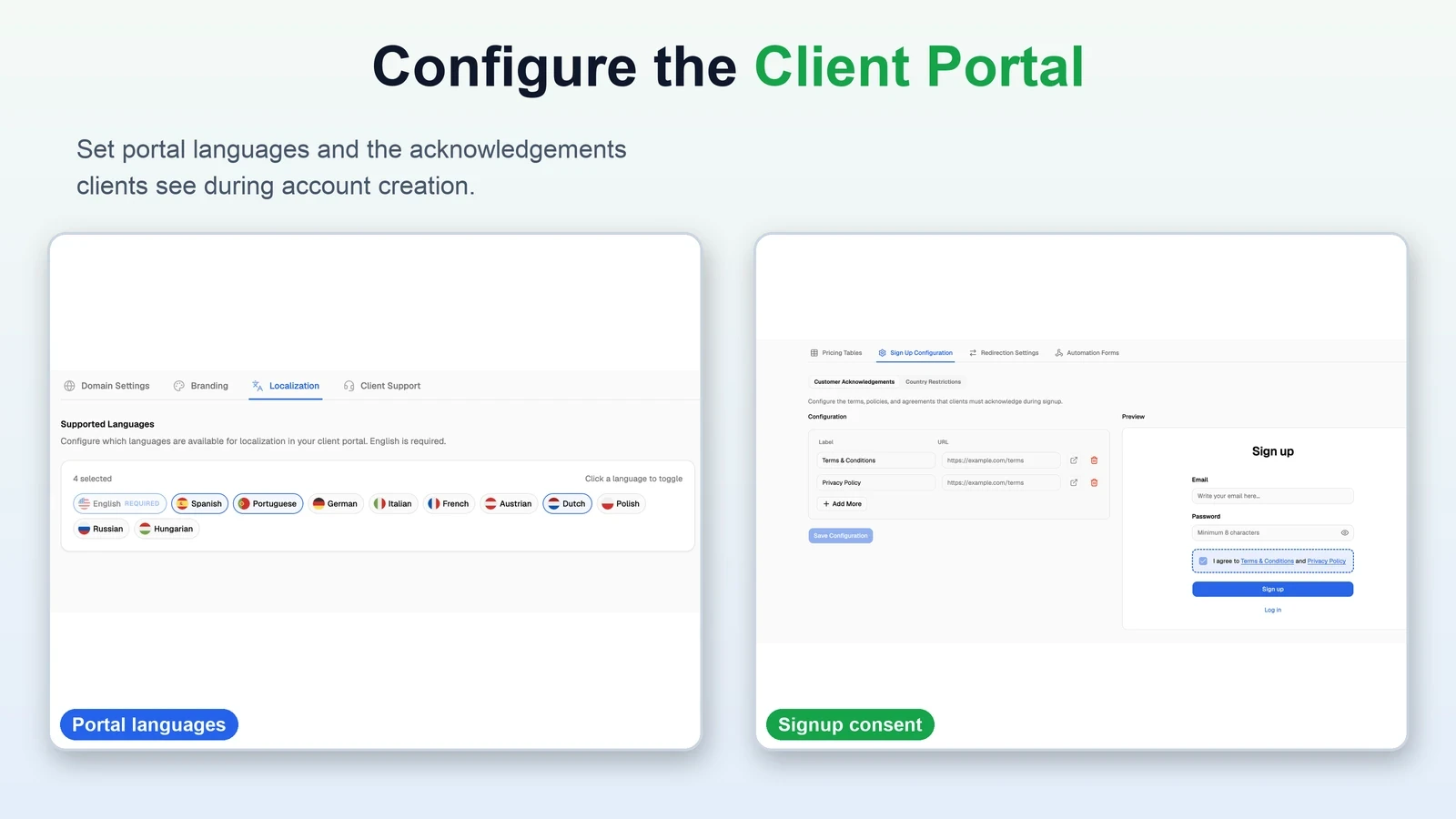
Agency administrators can configure the client-facing experience without exposing the underlying provider interface. Current controls include agency branding, domain settings, white-label email, portal languages, custom client-portal pages, client-portal forms, support widgets, client invitations, billing views and per-client settings. Some controls require a higher plan.
The localization screen supports English and shows selectable options for Spanish, Portuguese, German, Italian, French, Austrian, Dutch, Polish, Russian and Hungarian. The signup configuration lets an agency add acknowledgements such as its own terms and privacy links. These are configuration tools. The agency remains responsible for the wording, accuracy and legal suitability of the client-facing documents it adds.
For a role-by-role permission check covering agents, campaigns, billing and integrations, contact support before purchase.
Run inbound and outbound campaigns
VoiceAIWrapper brings campaign setup and day-to-day operations into the agency workspace. Current interfaces cover inbound and outbound campaigns, calling windows, retries, contact records, calls, transcripts, success labels, filters and a campaign health check that is currently marked Beta. Some calling controls and number-pool functions are plan-dependent.
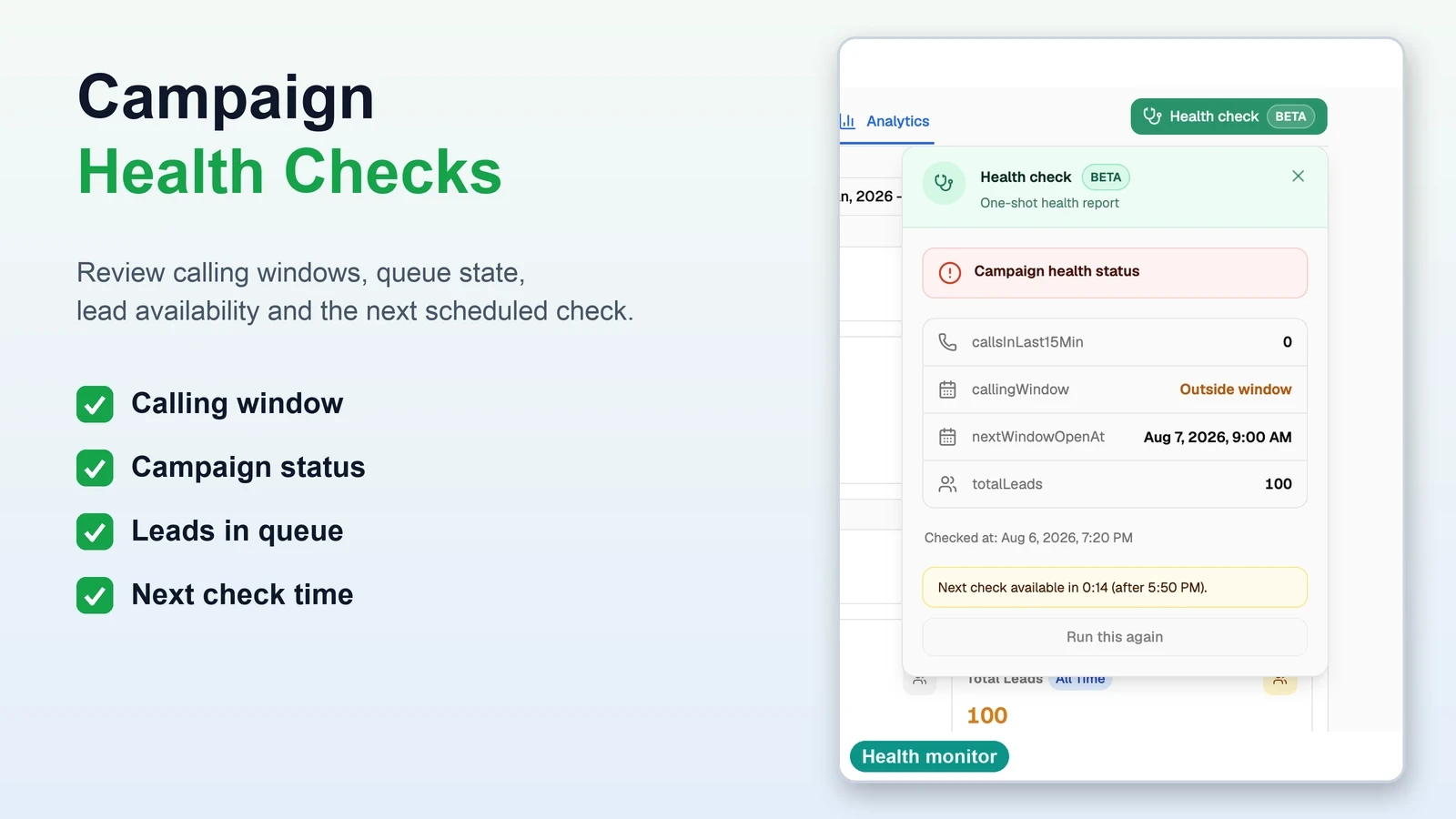
The interface labels campaign contact records as leads and reports them separately from calls. That distinction matters during diagnosis. A campaign can have leads available and still place no calls when its calling window is closed.
The campaign health screen, currently marked Beta, makes that failure mode visible. In the current product example, the campaign has 100 leads, zero calls in the last 15 minutes, an Outside window status and the next time the calling window opens. That is more useful than a generic warning because it points the operator to the configuration that is blocking activity. It does not guarantee that every campaign problem can be diagnosed or corrected automatically.
Configure how your clients sign up and pay
Agencies can connect their own Stripe account for client billing, create client-facing pricing tables, collect recurring payments, issue one-time charges and offer usage or recharge packs. External client billing is also available for agencies that handle billing outside VoiceAIWrapper.
The client signup settings let an agency add required acknowledgements and choose destinations after checkout, after a client trial begins, or after a no-payment signup. These controls govern the agency’s client portal. They do not describe the separate 7-day VoiceAIWrapper trial offered on this website.
VoiceAIWrapper takes no revenue share from what an agency charges its clients. The VoiceAIWrapper subscription, additional client-account charges, provider usage and telephony costs still apply. See the current pricing and plan limits before choosing a plan.

Connect CRM and workflow data through APIs and webhooks
VoiceAIWrapper supports campaign-lead API workflows and authenticated webhook headers. Broader API access and billing-system API access depend on the selected plan. Agencies can use these controls to send campaign data into the platform and pass call or status data to another system.
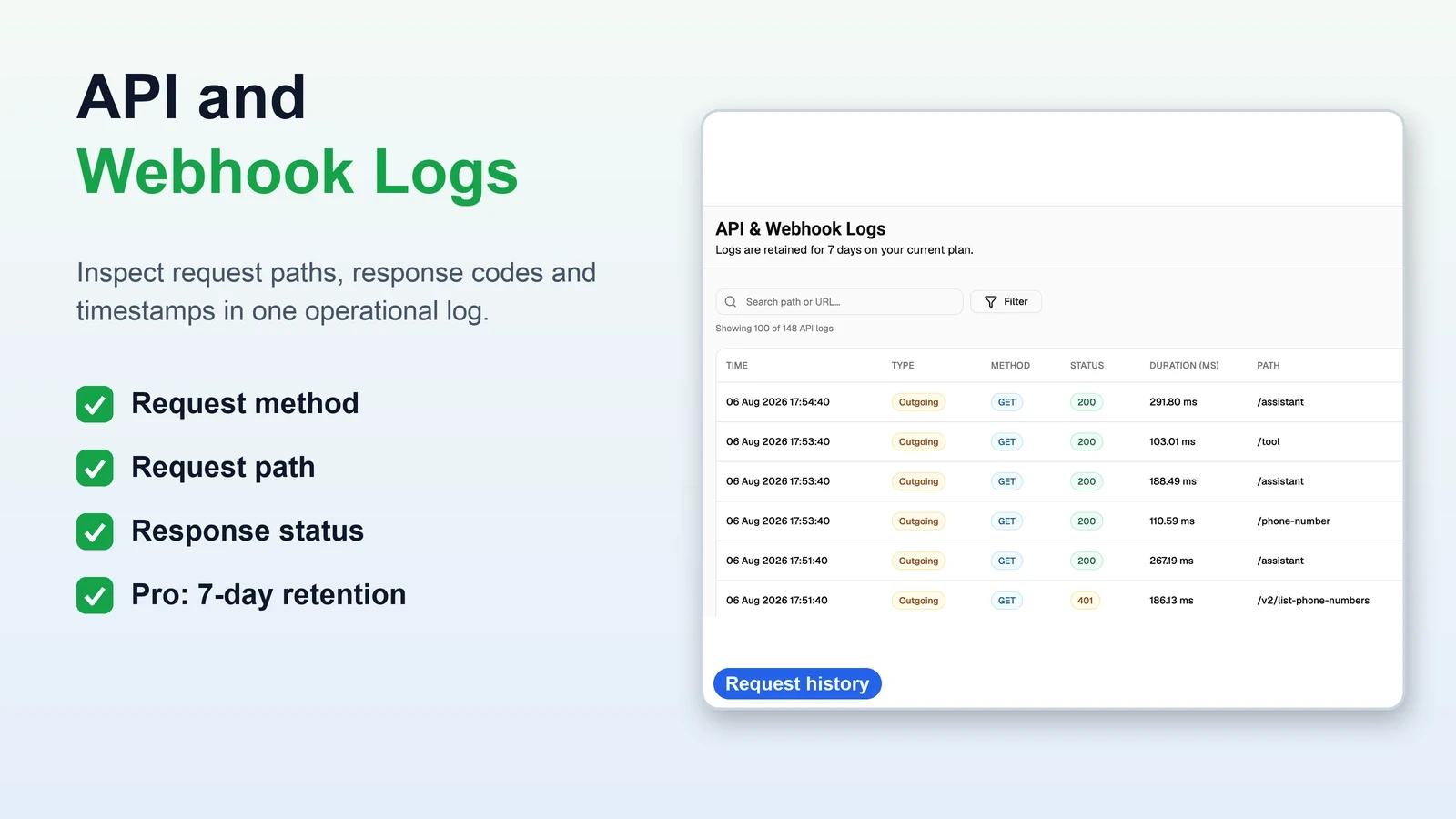
Operational logs show the request method, path, response status, duration and timestamp. The captured screen says logs are retained for seven days on its current plan. Current pricing lists seven-day API and webhook log retention on Pro, with an upgrade available. The log shows successful 200 responses and a 401 response in the same table, which helps an operator distinguish a working request from an authentication failure.
API access does not create a completed integration by itself. Field mapping, authentication, retries, error handling and data governance still need to be configured. See how to connect a CRM to voice AI agents.
Report account, client and campaign activity
The agency dashboard combines account, client and campaign views. Current product screens include calls, minutes, connect rate, average duration, provider spend, active campaigns, leads reached, new leads captured, repeat callers, short-call drop-off, client status and usage.
Campaign and call views add status records, transcripts and outcome labels. These measures help an agency review operations and explain activity to a client. They are not promises of lead quality, booked appointments, revenue or return on investment. The figures in the product image illustrate the reporting interface. They are not presented as customer results or a case study.
For a closer look at the account structure, see the multi-provider voice AI dashboard.
Security, compliance and access boundaries
VoiceAIWrapper states that it is SOC 2 Type 2, GDPR compliant and HIPAA compliant. These controls do not make every agency campaign or client workflow compliant by default. Agencies remain responsible for consent, client agreements, campaign rules, data handling, connected provider accounts and the way they configure the platform.
A signed Business Associate Agreement is available only to paid Pro customers. It is not included in any free trial, including a Pro trial.
Review the VoiceAIWrapper security controls and support for voice AI agencies. Support channels, response targets and access to onboarding differ by plan.
Which features are included in each plan?
Feature availability changes by plan, including supported providers, client-account limits, team access, portal controls, campaign functions and API scope. The VoiceAIWrapper pricing page is the current source for plan prices, included limits and extra client-account charges.
This Features page intentionally does not repeat the full pricing table. Keeping current plan details in one place reduces the risk that a feature page and the checkout flow show different information.
Where VoiceAIWrapper may not fit
VoiceAIWrapper may not fit if:
You need voice AI only for one internal business and do not need agency branding, client portals or client billing.
You expect the subscription to include provider or telephony usage.
You require every underlying provider feature to behave identically inside one interface.
You need a signed Business Associate Agreement during a free trial.
You do not want to manage provider accounts, client terms, consent, campaign rules or integration setup.
You can compare VoiceAIWrapper with other voice AI platforms before deciding. You can also meet the VoiceAIWrapper team, review the product roadmap, or read current customer reviews on SaaSHub.
Choose a plan based on the work you need to do
Compare provider access, client-account limits, portal controls, campaign functions, team access and APIs before starting. The trial follows the plan you select.
A card is required. Your selected paid plan starts automatically on day 7 unless you cancel before then. Trial feature access follows the selected plan.