The Business Case for AI in Your Call Center: How to Measure ROI

The Business Case for AI in Your Call Center: How to Measure ROI

Hero banner for guide on measuring ROI and building the business case for AI in call centers for agencies | VoiceAIWrapper.

|

Published:

|

Updated:

AI call center ROI is the financial return from automating routine contacts: lower labor cost per contact, higher first-contact resolution, and better retention, minus the cost to deploy. The honest version is double-digit, not 300%. Below is a framework you can defend to a finance team, with every number sourced.

  • 1Measure three things, not one. Cost per contact, first-contact resolution, and retention. A 30-day baseline before launch is what makes the gain attributable instead of assumed.
  • 2Use real benchmarks. The peer-reviewed productivity gain is about 14% on average (34% for new agents). Labor is 60% to 70% of cost. Each one-point first-contact-resolution gain is worth roughly $286,000 a year for a midsize center.
  • 3Know where it does not pay off. Low volume, high variability, or quality-over-cost cases. Klarna scaled back its AI-first support in 2025. We name the limits, not just the upside.

Building the case to switch from legacy systems?

Start with voice AI versus traditional IVR , or check VoiceAIWrapper pricing from $29/month to slot the platform cost into your own model.

On this Page


THE HONEST READ

AI call center ROI is real but routinely overstated. The defensible numbers from primary research: a 14% average productivity gain per agent, rising to 34% for the newest agents, from the Brynjolfsson Li and Raymond study ,of 5,179 agents (NBER, 2023). Labor is 60% to 70% of contact-center operating cost (ContactBabel), so even modest automation moves a large line item. Each one-point gain in first-contact resolution is worth about $286,000 a year for a midsize center (SQM Group). But as of December 2025 only 20% of customer-service leaders reported actual headcount reduction from AI (Gartner): the dominant pattern is handling more volume with the same team, not cutting staff. The 300%-plus ROI figures common in vendor marketing are not supported by independent data. VoiceAIWrapper's role is narrow and specific: it does not build or run the agent, it gives agencies a white-label layer over Vapi, Retell, ElevenLabs Agents, Bolna, and Ultravox with a flat platform fee and no per-minute markup, so the ROI model only carries platform cost plus pass-through usage.

Who this is for

This page is for two readers: the call-center or operations decision-maker building an internal business case for voice AI, and the agency owner who needs to justify the spend to a client with numbers that hold up. It covers the ROI formula, the metrics to track, real benchmark data, an illustrative model, and the honest limits. For the build mechanics, see the step-by-step guides to creating an inbound AI agent and an outbound AI calling agent.

KEY TAKEAWAYS

  • 1ROI has one formula and three sources. ROI = (benefits minus cost) divided by cost, times 100. The benefits come from lower labor cost per contact, higher first-contact resolution, and better retention. Everything else is detail.
  • 2The defensible productivity number is about 14%, not 300%. The Brynjolfsson, Li and Raymond study (NBER, 2023) measured a 14% average gain in issues resolved per hour across 5,179 agents, rising to 34% for the newest agents and near zero for the most experienced.
  • 3Baseline before you launch, or the ROI is unattributable. Capture cost per contact, average handle time, first-contact resolution, and CSAT for 30 days before the AI goes live. Without a baseline, you cannot separate the AI's effect from seasonality.
  • 4Labor is the lever. Labor is roughly 60% to 70% of contact-center operating cost (ContactBabel), which is why automating routine contacts moves the budget more than any other change.
  • 5First-contact resolution is the quietest ROI driver. SQM Group estimates every one-point gain in first-contact resolution is worth about $286,000 a year for a midsize center, because resolved-first calls do not generate repeat contacts.
  • 6Most deployments augment, they do not replace. As of December 2025, only 20% of customer-service leaders reported AI-driven headcount reduction (Gartner). The common outcome is more volume handled by the same team.
  • 7The cost advantage is not permanent. Gartner predicts GenAI cost per resolution may exceed offshore human-agent cost by 2030, and Klarna scaled back its AI-first support in May 2025 after quality dropped. Model the downside.
  • 8VoiceAIWrapper does not mark up voice minutes. The platform fee starts at $29/month; voice minutes bill directly to your provider at provider rates. Your ROI model only carries platform cost plus pass-through usage, which keeps the math clean.

Want to slot real platform costs into your ROI model?

The 7-day free trial of VoiceAIWrapper gives Scale-tier access, no credit card required, so you can see the actual platform cost (flat fee, no per-minute markup) before you build the business case. Compare tiers on the VoiceAIWrapper pricing page , or read why teams move off legacy IVR menus.

No credit card required · Cancel anytime

THE ROI FRAMEWORK

The AI call center ROI formula, and what goes into it

Return on investment (ROI) is the financial return divided by the cost of getting it. For an AI call center, the formula is the standard one. The work is in sourcing the inputs honestly rather than assuming them.

The formula

ROI = (financial benefits − implementation cost) ÷ implementation cost × 100

The benefits side has three sources, and a defensible business case names all three rather than leaning on one headline number:

  • Lower labor cost per contact. AI handles routine contacts and assists agents on the rest. The peer-reviewed productivity gain here is about 14% on average, from Brynjolfsson, Li and Raymond (NBER, 2023), measured across 5,179 real agents.

  • Higher first-contact resolution (FCR). Calls resolved on the first contact do not generate repeat contacts. SQM Group's benchmark research estimates each one-point FCR gain is worth about $286,000 a year for a midsize center.

  • Retained customers. Faster, more consistent resolution reduces churn. The foundational reference is Reichheld and Sasser (Harvard Business Review, 1990), whose retention-to-profit findings varied by industry (roughly 25% to 85%), so treat the high end as a ceiling, not a forecast.

The cost side is platform fees, integration and training, and voice-minute usage. A clean model keeps usage as a pass-through line: with VoiceAIWrapper, voice minutes bill directly to your underlying provider at their rate and are not marked up, so the only platform line in your model is a flat monthly fee. Before you run any of this, capture a 30-day baseline of each metric. Without a pre-launch baseline, you cannot separate the AI's effect from seasonality, staffing changes, or a product launch.

THE METRICS

The metrics that actually prove AI call center ROI

Track three groups. Optimizing one in isolation (usually cost) tends to damage another (usually experience), so the business case should show balanced movement. Define each term on first use; baseline each before launch.

METRIC GROUPWHAT TO MEASUREWHY IT CARRIES THE ROI
Cost per contact
COST
Fully-loaded cost to handle one call or chatThe headline efficiency number. Falls as AI absorbs routine volume.
Average handle time (AHT)
COST
Mean minutes per handled contactAgent-assist shortens it; in one McKinsey-documented case, gen AI cut knowledge-lookup time within a call by 65%.
Agent labor share
COST
Labor as a percent of total operating costLabor is 60% to 70% of cost (ContactBabel), so it is the lever automation actually moves.
First-contact resolution (FCR)
EFFICIENCY
Percent of issues solved on the first contact~$286,000/year per one-point gain for a midsize center (SQM Group).
Containment / deflection
EFFICIENCY
Share of contacts fully handled without a humanThe direct labor-offset metric. Set it against a baseline, not a vendor target.
Productivity (issues/hour)
EFFICIENCY
Resolved contacts per agent-hour+14% average, +34% for new agents (NBER, 2023). The defensible expectation.
CSAT and customer effort
EXPERIENCE
Post-contact satisfaction and effort scoresGuards against cost gains that quietly degrade service. The NBER study found fewer hostile interactions and fewer escalations, not a raw CSAT jump, so measure effort too.
Retention rate
EXPERIENCE
Customers retained over the periodThe slowest-moving but highest-value lever. Tie it to revenue, not call counts.

Definitions: AHT is average handle time. FCR is first-contact resolution. CSAT is customer satisfaction score. Containment (or deflection) is the share of contacts resolved without a human agent.

WHERE SAVINGS COME FROM

Where AI actually reduces call center cost

Cost savings are not evenly distributed. They concentrate where labor concentrates. Because labor is 60% to 70% of operating cost per ContactBabel's 2026 US guide, every credible savings story routes back to agent time.

1. Absorbing routine, repetitive contacts

The clearest savings come from contacts that are high-volume and predictable: order status, appointment booking, balance checks, basic FAQs. McKinsey estimates gen AI could reduce human-serviced contact volume by up to 50% depending on a company's existing automation, while noting that real progress has been slower than that ceiling suggests. Treat 50% as the optimistic bound, not the plan.

2. Making agents faster on the calls that stay human

The contacts that still need a person get cheaper too, through agent assist. The NBER study measured a 14% average lift in issues resolved per hour, concentrated in newer agents (34%), and an 8.6% reduction in agent attrition, which lowers recruiting and training cost. A Deloitte-documented implementation cut transfer rate from 40% to 22% over nine months despite a 36% rise in call volume.

3. Resolving more on the first contact

Repeat contacts are pure waste: the same issue, paid for twice. Lifting FCR removes that second contact entirely. SQM Group puts the value of a single FCR point at roughly $286,000 a year for a midsize center, which is why FCR is often the largest line in a mature business case even though it gets less attention than deflection.

ILLUSTRATIVE MODEL

An illustrative ROI model, with every input disclosed

Read this first: this is an illustrative model, not a client result. The numbers below are a worked example with disclosed, sourced assumptions so you can swap in your own. It is not a case study, and the inputs are deliberately conservative. We removed the prior version of this page's invented client ROI figures because they were not real.

Assume a 20-agent inbound center. The US median wage for customer service representatives was $20.59/hour in May 2024 (BLS) , about $42,800/year base. Loaded cost (benefits, training, recruiting, overhead) typically runs around 1.3 times base, so this model uses $55,000 per agent.

LINE ITEMASSUMPTIONANNUAL FIGURE
Agent base
BLS May 2024 median, $20.59/hr
$42,800 base x ~1.3 loaded$55,000 / agent
Productivity gain
NBER 2023, 14% average
20 agents x $55,000 x 14%$154,000 saved
FCR improvement
SQM Group, 1-point gain, midsize center
One-point FCR gain on a 69% baseline~$286,000 saved
Platform cost
VoiceAIWrapper Scale tier, $249/mo
White-label layer, flat fee, no per-minute markup~$3,000 cost
Voice minutes
Pass-through at provider rate
Billed directly to your provider, not marked upUsage-based

How to read thisEven before counting deflection or retention, the two sourced savings lines (productivity and a single FCR point) are an order of magnitude larger than the platform cost. That is the honest shape of call-center AI economics: the platform fee is rarely the deciding variable; agent time and repeat-contact elimination are. Swap in your own agent count, loaded cost, and baseline FCR before presenting this to a finance team. Voice-minute usage is a real cost; model it at your provider's published rate, since VoiceAIWrapper does not add a margin to it.

Put a real platform cost in your model

The 7-day free trial gives Scale-tier access with no credit card, so the platform-cost line in your ROI model is a real number, not an estimate. Voice minutes stay pass-through at your provider's rate. Compare tiers on VoiceAIWrapper pricing

No credit card required · Cancel anytime

REAL DEPLOYMENTS

What real deployments show, including the parts vendors skip

Honest evidence means citing named, dated sources, and disclosing the cases that did not stay rosy. These are real; the prior version of this page's four client case studies were not, and we removed them.

Klarna: a real win, and a real reversal

In February 2024 Klarna reported that its AI assistant handled two-thirds of customer service chats (2.3 million conversations) in its first month, cut resolution time from 11 minutes to under 2, and drove a 25% drop in repeat inquiries, with CSAT on par with human agents. That is the number every vendor quotes. Here is the part they skip: in May 2025 Klarna's CEO acknowledged the AI-first push went too far, saying cost "seems to have been too predominant an evaluation factor" and that the result was "lower quality." Klarna now runs a hybrid model with human escalation. The lesson for your business case: model the quality floor, not just the cost ceiling.

Deloitte-documented implementation: steady, unspectacular, real

A Deloitte Digital case (July 2025) tracked an unnamed company: transfer rate fell from 40% to 22% over nine months despite a 36% rise in call volume, CSAT improved from 4.17 to 4.26, language-understanding accuracy rose from 75% to 93%, and 500+ agents were migrated over roughly ten months. No 400% ROI headline, just compounding operational gains. This is closer to what a well-run deployment looks like than the case studies that circulate on vendor sites.

The academic anchor: NBER, 5,179 agents

The most rigorous study remains Brynjolfsson, Li and Raymond (NBER, 2023) : a 14% average productivity gain across 5,179 agents, 34% for the newest and least experienced, and 8.6% lower attrition. Notably, it did not find a statistically significant lift in raw CSAT; what it found was that customers were less likely to escalate or express hostility. Use the 14%/34% figures as your defensible productivity inputs.

FIRST-HAND . OPERATOR OBSERVATIONS

What I have actually seen agencies measure, and get wrong, on call-center ROI

This section is direct operator experience from running VoiceAIWrapper, a white-label layer that agencies use to resell voice AI to their own clients. It is not from a report.

The most common mistake is no baseline. Agencies turn on an agent, see calls getting answered, and tell the client it is working. Three months later the client asks what changed and there is no before number to point to. The agencies that keep clients are the ones that captured cost per contact, AHT, and FCR for thirty days before launch. Everything in this guide depends on that one discipline.

The second mistake is selling deflection and forgetting quality. Deflection is easy to show: this many calls never reached a human. But if the deflected callers were frustrated, the client feels it in churn within a quarter. The Klarna reversal is the public version of a pattern I see at small scale: a cost win that quietly created a quality problem. The fix is cheap, track CSAT or a simple effort question alongside deflection from day one, so you catch the trade-off before the client does.

The third pattern is over-claiming ROI. When an agency presents a 300% or 400% ROI number, the client's finance person discounts the entire proposal, because the number fails a smell test. A defensible 14% productivity figure with a sourced FCR line lands better than a fabricated headline. Conservative and cited beats impressive and hand-wavy in every procurement conversation I have watched.

The fourth is ignoring the cost trend. Voice-AI economics are not frozen. Gartner expects GenAI cost per resolution to rise over the rest of the decade. Build your model on this year's rates, but tell the client the per-resolution cost could move, so the contract is not priced as if it is permanent.

HOW VOICEAIWRAPPER FITS

How VoiceAIWrapper keeps the ROI math clean

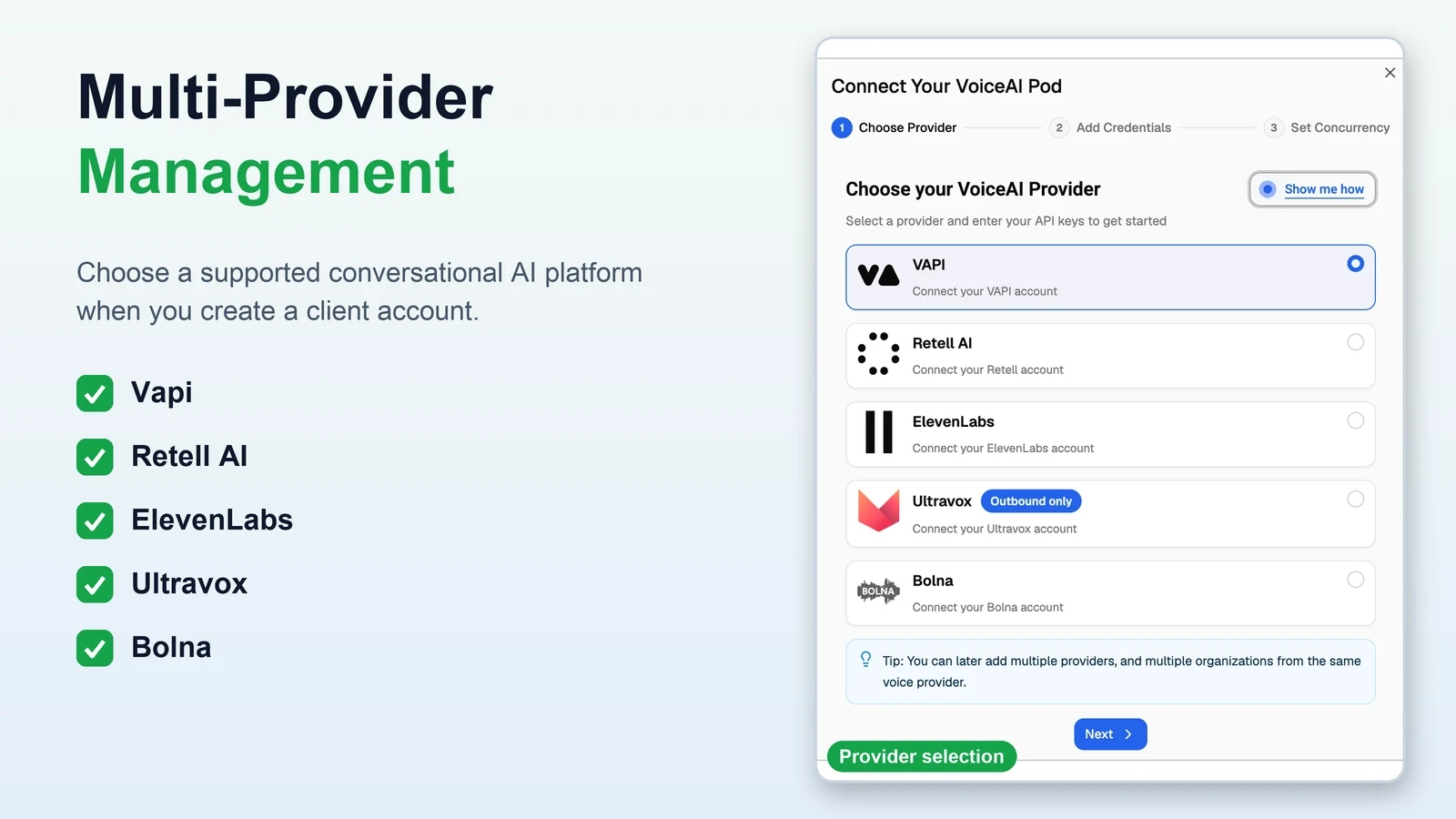
VoiceAIWrapper does not build or run the agent and is not a replacement for the underlying platforms. It is the agency layer on top of five conversational agent platforms (Vapi, Retell, ElevenLabs Agents, Bolna, and Ultravox), and it affects the ROI model in three specific ways.

  • No per-minute markup. Voice minutes bill directly to your provider at their rate. The only platform line in your model is a flat monthly fee from $29/month, which keeps usage cost transparent to you and your client.

  • Analytics you can report against. Call volume, handle time, and resolution data sit in one dashboard, so the monthly ROI report a client needs is a pull, not a rebuild. Reporting is what converts a one-off project into a retained, defensible line item.

  • One account, five platforms. You can match the provider to the use case (for example, pairing white-label Retell with high-volume inbound for its lower median latency) without separate contracts, which keeps the cost side of the model in one place. See VoiceAIWrapper's features for the full white-label layer.

    Screenshot of the VoiceAIWrapper analytics dashboard showing per-client call volume, average handle time, and first-contact-resolution metrics that agencies use to build a monthly AI call center ROI report for their clients.
WHEN THIS DOES NOT FIT

When AI does not deliver positive call center ROI

Be honest about the cases where the math does not work

Voice AI is not a universal win. If your situation matches one of these, automating aggressively will destroy value, not create it. Here is where to look instead.

  • 1Low call volume ROI comes from volume times per-contact savings. If you handle a few dozen calls a day, the platform and setup cost will outrun the savings. Instead, start with a single agent on a focused use case and the $29/month Starter tier, prove the unit economics on a small slice, and expand only if the per-contact math holds. The 5-step client onboarding framework covers how to structure that first deployment.
  • 2Highly variable, low-repeatability conversations If most calls are unique, complex, or emotionally loaded, deflection rates stay low and quality risk is high. Augment your human agents instead of replacing them; the NBER evidence is strongest for agent-assist, not full automation. For the build pattern, see the inbound AI agent guide.
  • 3Quality matters more than cost If a poor interaction costs you a high-value relationship, lead with quality. Klarna learned this publicly and moved back toward human support. Keep humans on the contacts that carry relationship risk and let AI take the routine tier.
  • 4You need vendor-neutral benchmarking, not a platform If your immediate need is independent data to size the opportunity rather than a tool to deploy, go to the primary analysts first: Gartner , Deloitte Digital , and ContactBabel publish contact-center research that no vendor page should replace. Come back to deployment once the business case is sized.

If the volume and repeatability test passes, build the case

Start a 7-day free trial to get the real platform-cost line for your model, then compare how the white-label platforms stack up before you commit.

No credit card required · Cancel anytime

TRUSTED BY 1,000+ AGENCIES ENGAGED

Frequently Asked Questions

Question

How do you calculate ROI for AI in a call center?

Answer

ROI = (financial benefits minus implementation costs) divided by implementation costs, times 100. Benefits come from three sources: lower labor cost per contact, higher first-contact resolution, and retained customers. Cost includes platform fees, integration, training, and pass-through voice minutes. Measure a 30-day baseline before launch so the gains are attributable, not assumed.


Question

What is a realistic productivity gain from AI call center agents?

Answer

The most rigorous study, Brynjolfsson, Li and Raymond (NBER, 2023), measured a 14% average gain in issues resolved per hour across 5,179 agents, rising to 34% for the newest agents and near zero for the most experienced. Treat double-digit, front-loaded-to-novices gains as the defensible expectation, not the 300%-plus figures some vendors advertise.


Question

Which metrics should I track to prove AI call center ROI?

Answer

Track three groups: cost (cost per contact, average handle time, agent labor share), efficiency (first-contact resolution, containment or deflection rate, average speed of answer), and experience (CSAT, customer effort score, retention). Baseline each metric before launch, then attribute change to the AI deployment rather than seasonality.


Question

How much can AI realistically reduce call center costs?

Answer

It depends on labor share and automation maturity. Labor is roughly 60% to 70% of contact-center operating cost (ContactBabel). SQM Group estimates every one-point gain in first-contact resolution saves about $286,000 a year for a midsize center. Gartner cautions that as of December 2025 only 20% of leaders reported actual headcount reduction; most gains show up as more volume handled, not fewer staff.


Question

Does VoiceAIWrapper mark up voice minutes?

Answer

No. Voice minutes are billed directly to your underlying provider (Vapi, Retell, ElevenLabs Agents, Bolna, or Ultravox) at their rates. VoiceAIWrapper charges a flat monthly platform fee starting at $29/month and does not add a per-minute margin, so your ROI model only carries the platform cost plus pass-through usage.


Question

When does AI not deliver positive call center ROI?

Answer

When call volume is low, conversations are highly variable, or quality matters more than cost. Klarna scaled back its AI-first support in May 2025 after quality dropped, and Gartner predicts GenAI cost per resolution may exceed offshore human-agent cost by 2030. If your case fails the volume and repeatability test, augmenting agents beats full automation.

Raj Baruah, Founder, VoiceAIWrapper

Raj built VoiceAIWrapper to give agencies the sub-account architecture, agency markup billing, and multi-provider white-label layer they would otherwise have to build from scratch on top of Vapi, Retell, ElevenLabs Agents, Bolna, and Ultravox. Because VoiceAIWrapper aggregates all 5 conversational agent platforms in a single operator account, Raj observes the market from a position that no single-provider analyst or operator has: what different provider architectures reveal about market direction, which latency and compliance thresholds trigger client decisions, and how per-minute cost structures interact with agency margin across different verticals. The market trends on this page reflect that multi-platform operational perspective, layered on top of the named primary research sources. For the agency monetization angle (how to price a retainer, which provider to pick per vertical, what VoiceAIWrapper's sub-account architecture costs at different agency sizes), see Voice AI Market 2026: $47B Agency Capture. Healthcare-vertical agencies should review the HIPAA compliance posture before scoping client retainers. LinkedIn: rajbaruah Listed Vapi platform partner VoiceAIWrapper LinkedIn Featured expert: Raj Baruah on Connectively VoiceAIWrapper Academy community on Skool 5.0/5 on SaaSHub (17 verified reviews)

No credit card required · Cancel anytime

Like this article? Share it.

Related Insights

Latest Insights

Found our insights helpful? Start your voice AI white label free trial

Our product is free to use for 7 days (no credit card required). You get access to premium features available in our Scale plan during your free trial.

Risk-free refund assurance.

If you are not satisfied with our product or support, we offer you a full refund. For details, please read our refund policy in the footer of our home page.

Used by 1000+ agencies.

99.9% uptime.

60-minute setup.

Found our insights helpful? Start your voice AI white label free trial

Our product is free to use for 7 days (no credit card required). You get access to premium features available in our Scale plan during your free trial.

Risk-free refund assurance.

If you are not satisfied with our product or support, we offer you a full refund. For details, please read our refund policy in the footer of our home page.

Used by 1000+ agencies.

99.9% uptime.

60-minute setup.

Found our insights helpful? Start your voice AI white label free trial

Our product is free to use for 7 days (no credit card required). You get access to premium features available in our Scale plan during your free trial.

Risk-free refund assurance.

If you are not satisfied with our product or support, we offer you a full refund. For details, please read our refund policy in the footer of our home page.

Used by 1000+ agencies.

99.9% uptime.

60-minute setup.