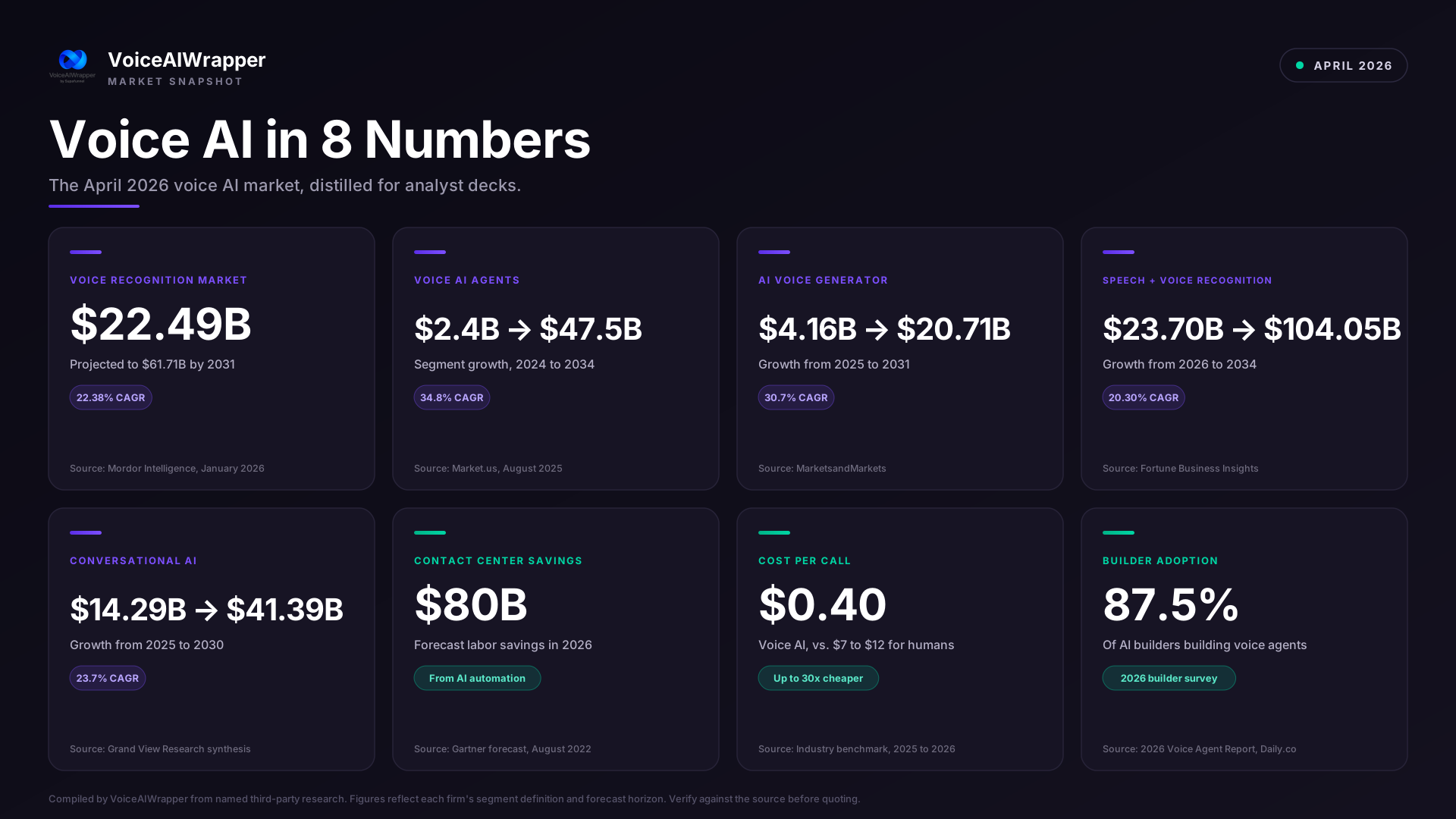
The AI voice agents market is on track from USD 2.4 billion in 2024 to USD 47.5 billion by 2034, a 34.8% CAGR (Market.us, April 2025). Three forces drive that growth: record vendor funding, a shift to speech-foundation-model architectures, and tightening AI-calling regulation.
Market size: USD 2.4B (2024) to USD 47.5B (2034) at 34.8% CAGR (Market.us). Grand View Research puts the same segment at USD 2.54B (2025) to USD 35.24B (2033) at 39.0%. Capital at scale: Vapi reached a $500M valuation (May 2026), Retell crossed $40M ARR while profitable on $4.6M raised, and ElevenLabs raised $500M at an $11B valuation (February 2026). What this page covers: macro-data trends across all 5 conversational agent platforms VoiceAIWrapper supports (Vapi, Retell, ElevenLabs Agents Platform, Bolna, Ultravox), plus funding activity, the competitive map, regulatory signals, and vertical adoption.
If you are evaluating voice AI market data, there are real cases where another source serves you better. We will name them. Grand View Research publishes the narrowest AI Voice Agents segment definition and is the most-cited figure in vendor press releases. Market.us gives the 34.8% CAGR used across most agency proposals. MarketsandMarkets covers the adjacent AI Voice Generator market (TTS plus synthesis, broader scope). Stanford HAI's AI Index Report 2025 is the authoritative cross-sector AI investment and adoption tracker that no single vendor report replaces. Where VoiceAIWrapper wins as an analytical surface: it aggregates live data across all 5 conversational agent platforms (Vapi, Retell, ElevenLabs Agents, Bolna, Ultravox) in one account, giving operators a five-platform view unavailable from any single provider; SOC 2 Type 2, GDPR, and HIPAA apply at the platform level; pricing from $29/month; and zero per-minute markup on provider minutes means cost data passes through unmodified.
IF YOU ARE HERE TO RESEARCH THE DATA AND ACT ON IT AS AN AGENCY
This page covers macro-data trends: funding rounds, technology architecture shifts, regulatory signals, and vertical adoption patterns. If you want the agency capture playbook (agency markup pricing math, sub-account architecture, per-client revenue scenarios), that lives on the companion page: Voice AI Market 2026: $47B Agency Capture. Both pages cite the same primary research sources; the framing and intended use differ.
KEY TAKEAWAYS
1Market size consensus: USD 2.4B-2.54B in 2024-2025, heading to USD 35B-47.5B by 2030-2034.Market.us (April 2025) puts the AI Voice Agents segment at USD 2.4B in 2024, USD 47.5B by 2034, CAGR 34.8%. Grand View Research estimates USD 2.54B in 2025, USD 35.24B by 2033, CAGR 39.0%. The range reflects segment definition differences, not data error.
2Healthcare is the fastest-growing sub-segment at 37.79% CAGR. The AI voice agents in healthcare market goes from USD 468 million in 2024 to USD 3.18 billion by 2030 (Grand View Research). Clinical documentation is the largest application at 17.54% of healthcare revenue. APAC is the fastest-growing region within voice user interface at 24.17% CAGR (Mordor Intelligence).
3BFSI is the largest vertical, holding 32.9% of the AI voice agents market in 2024. Consumer electronics (automotive, smart speakers) leads the broader voice user interface segment at 36.08% (Mordor Intelligence, May 2026). North America holds 40.2% of global AI voice agent revenue.
4Vendor capitalization signals institutional conviction in the platform layer. Vapi raised $50M Series B at $500M valuation (May 12, 2026), having processed 1 billion calls. Retell crossed $40M ARR and 40 million calls per month, profitable on $4.6M raised. ElevenLabs raised $500M Series D at $11B valuation (February 2026) with $330M+ ARR.
5Technology is shifting from STT-LLM-TTS pipelines toward multimodal and speech-foundation-model architectures. Traditional STT-LLM-TTS pipelines produce second-plus end-to-end latency. Speech-to-speech models built on speech-foundation-model architectures (Moshi by Kyutai, Ultravox by Fixie AI) reach the sub-second range by skipping the intermediate ASR stage those pipelines require. Sub-second is now the 2026 threshold for "natural" conversation.
6Regulatory signals are hardening in multiple jurisdictions simultaneously. FCC's AI-voice ruling (February 8, 2024) requires prior express written consent for AI-generated voice in calls. STIR/SHAKEN third-party authentication compliance was required by September 18, 2025. TCPA settlements in 2026 total $20M+ across Gen Digital ($9.95M), Albertsons ($5.9M), and Hy Cite ($4.75M).
7State-level disclosure law is compounding federal compliance burden. Texas SB 140 (effective September 2024) requires AI disclosure within 30 seconds. California AB 2602 (effective January 1, 2025) requires performers' contractual consent for digital voice replicas. EU AI Act Article 50 transparency obligations covering voice AI agents take effect August 2, 2026; the Act's Article 5 prohibited-practice rules applied from February 2, 2025.
8The white-label agency segment is growing faster than direct-buyer for SMB deployments. Synthflow's $20M Series A (June 2025, led by Accel) explicitly targeted the agency and white-label channel, the clearest institutional signal that this sub-segment attracts separate capital. No public market-size estimate exists specifically for the white-label voice AI resale segment.
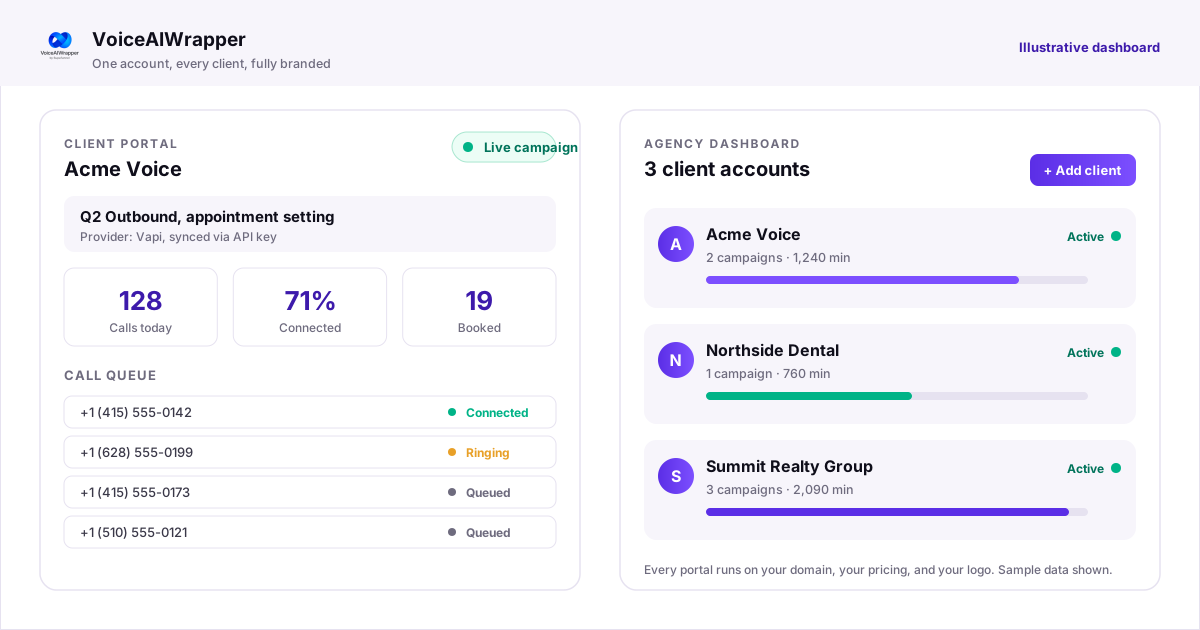
9VoiceAIWrapper's unique analytical surface: 5 conversational agent platforms tracked in one account. Vapi, Retell, ElevenLabs Agents Platform, Bolna, and Ultravox each run full agent runtimes. VoiceAIWrapper syncs them via API key and does not build agents; it is the agency monetization and portfolio management layer on top of those 5 platforms. No other platform white-labels all 5 in one account.
If you want to act on these trends as an agency, see the agency capture page.
The Voice AI Market 2026: $47B Agency Capture page covers agency markup pricing math, sub-account architecture, per-client revenue scenarios, and the 12-step agency market entry checklist. This page covers the macro data. That page covers what to do with it. Or start a 7-day free trial of VoiceAIWrapper, no card required.
The voice AI market is moving across five distinct axes simultaneously: forecasted size and CAGR, funding and vendor scale, technology architecture shifts, regulatory tightening, and vertical adoption. Each card below synthesizes the primary research data on one axis. For what to do with these trends as an agency, see the companion page Voice AI Market 2026: $47B Agency Capture. Sources- are from the market-size dossier;- are from the trends-supplement dossier.
1
Signal 1: The $47.5B Forecast, What the Research Firms Actually Agree On
Four independent research firms have published voice AI market forecasts within overlapping ranges. Their definitions differ, so the CAGR figures differ. The underlying agreement: the AI voice agents layer is growing at a 30-40% compound rate through the early 2030s, with the narrower the segment definition, the higher the reported CAGR.
Market.us (April 2025) (April 2025): USD 2.4B in 2024, USD 47.5B by 2034, CAGR 34.8%, AI Voice Agents segment, narrowest definition.
Grand View Research : USD 2.54B in 2025, USD 35.24B by 2033, CAGR 39.0%, AI Voice Agents segment, similar scope to Market.us.
MarketsandMarkets (December 2025) (December 2025): USD 4.16B in 2025, USD 20.71B by 2031, CAGR 30.7%, AI Voice Generator, broader TTS-and-synthesis scope.
Mordor Intelligence (May 2026) (May 2026): USD 15.48B in 2025, USD 52.08B by 2031, CAGR 22.41%, Voice User Interface, broadest scope including smart speakers and in-car.
Healthcare sub-segment: USD 468M in 2024, USD 3.18B by 2030, CAGR 37.79%, fastest-growing sub-segment across all firms.
BFSI is the largest single vertical at 32.9% of the AI voice agents market in 2024 (Market.us).
North America holds 40.2% of global AI voice agent revenue in 2024; APAC is fastest-growing region at 24.17% CAGR in the voice user interface market.
2
Signal 2: Funding and Vendor Scale, The Capital Flow Map for 2025-2026
Over $1.8 billion in disclosed equity rounds have closed across the voice AI segment in 2025-2026. The capital is concentrating in two tiers: enterprise-direct platforms (Sierra, ElevenLabs) and platform-layer voice agent infrastructure (Vapi, Retell). The speech infrastructure layer also raised significant capital: Deepgram closed $130M Series C at $1.3B valuation alongside its OfOne acquisition. The white-label agency channel saw Synthflow raise $20M Series A in June 2025.
ElevenLabs: $180M Series C (January 2025) at $3.3B valuation; $500M Series D (February 2026) at $11B valuation, $330M+ ARR, Sequoia + a16z + ICONIQ + Lightspeed.
Vapi: $50M Series B (May 12, 2026) at $500M valuation; 1 billion calls processed; 1M+ developers on self-serve; Peak XV Partners + Microsoft M12 + Kleiner Perkins + Bessemer.
Amazon Ring selected Vapi after evaluating 40+ AI voice vendors, the largest named enterprise validation of platform-layer voice AI to date.
Sierra: $350M at $10B (September 2025); $950M at $15B+ (May 2026, Tiger Global + GV); $150M ARR; 40%+ of Fortune 50, the enterprise-direct buyer benchmark
Retell: $40M+ ARR, 40M+ calls per month, profitable on $4.6M raised total, the capital-efficiency outlier in the category.
Bolna: $6.3M seed (January 2026, General Catalyst); 200K calls/day; $700K ARR trajectory; India-first with US/Brazil/Southeast Asia expansion plan.
Synthflow: $20M Series A (June 2025, Accel); 1,000+ customers; 45M calls handled; white-label and agency channel explicit in funding thesis.
3
Signal 3: Technology Trends, Multimodal, Speech-FM, and the Latency Benchmark Shift
Three technology trends are structurally changing voice AI architecture in 2026: multimodal voice-plus-text agents, speech-foundation-model (S2S) architectures, and the sub-second latency threshold becoming table stakes. Understanding which platforms have adopted each trend determines which platform fits which client use case.
Multimodal agents (voice + image + text in one conversation): ElevenLabs Agents Platform ships sendMultimodalMessage via WebSocket events as of late 2025; IBM partnership announced March 25, 2026 to bring voice into IBM's agentic AI stack.
Speech-foundation-model (S2S) architectures: Moshi (Kyutai, open-source CC-BY 4.0) demonstrates speech-foundation-model architecture with lower latency than traditional pipelines; Ultravox (Fixie AI) demonstrates the same architecture class.
Traditional STT-LLM-TTS pipelines produce second-plus end-to-end latency; S2S models achieve sub-second range, a materially lower latency.
Sub-second end-to-end is the 2026 industry consensus threshold for "natural" conversation; contact center satisfaction degrades noticeably above the sub-second threshold.
Retell at approximately sub-second median and Vapi at approximately sub-second median latency (Tested Media April 2026 per master-brief) represent the current platform-layer baseline in the STT-LLM-TTS architecture.
Open-source momentum: Pipecat (40+ AI models and services), LiveKit Agents (1.0 reached April 2025, used by Meta + OpenAI ChatGPT Voice + Character.ai), Whisper as the dominant open-weight STT foundation.
Multilingual depth: ElevenLabs supports 70+ languages; Bolna supports 10+ Indian languages including Hindi, Tamil, and Telugu.
4
Signal 4: Regulatory Signals, The Compliance Map for 2024-2026
Voice AI regulation is moving simultaneously at the federal, state, and international levels. TCPA settlements in 2026 alone total over $20 million. Agencies and platforms operating AI calling must track all three levels.
FCC AI-voice ruling (February 8, 2024, effective immediately): AI-generated voices in robocalls are "artificial" under TCPA; prior express written consent required; FCC proposed $6M fine for the AI Biden robocall targeting New Hampshire primary voters.
STIR/SHAKEN third-party authentication (required by September 18, 2025): VoIP providers must sign calls using their own SPC token; written agreement required with any third-party signing agent.
TCPA settlements 2026: Gen Digital (Norton/LifeLock) $9.95M (approximately 300,000 affected numbers); Albertsons $5.9M (suppression list gap); Hy Cite Enterprises $4.75M, settlement amounts large enough that enterprise procurement teams now treat compliance as a blocker.
EU AI Act: voice AI agents fall under Article 50 limited-risk transparency obligations, which take effect August 2, 2026 (the same date as high-risk provisions); the Act's Article 5 prohibited-practice rules applied from February 2, 2025; penalties up to 35M EUR or 7% of global turnover.
Texas SB 140 (effective September 2024): AI disclosure within 30 seconds of call start; voice cloning without consent prohibited; $1,000-$10,000 per-violation private right of action.
California AB 2602 (effective January 1, 2025): performers' contractual consent + professional representation required for any digital voice replica use.
California AB 489 (effective January 1, 2026): prohibits AI systems from implying a user is receiving care from a licensed healthcare professional.
5
Signal 5: Vertical Adoption, Where the Market Is Concentrating in 2026
BFSI holds the largest share of the AI voice agents market at 32.9% in 2024 (Market.us), but healthcare is growing fastest at 37.79% CAGR (Grand View Research). Retell's named enterprise customers illustrate the healthcare and financial services pattern most clearly.
BFSI (Banking, Financial Services, Insurance): 32.9% of AI voice agents market in 2024 (Market.us); loan servicing, fraud alerts, and collections are primary use cases
Healthcare: USD 468M in 2024 to USD 3.18B by 2030, CAGR 37.79% (Grand View Research); clinical documentation = 17.54% of healthcare revenue; North America = 54.17% of healthcare segment
Pine Park Health (Retell customer): scheduling NPS increased 38% after Retell deployment
Medical Data Systems (Retell customer): handles 100% of inbound calls with 30% transfer rate, collecting approximately $280,000 monthly
Amazon Ring (Vapi customer): evaluated 40+ AI voice vendors before selecting Vapi to handle 100% of inbound customer support calls
Retail and e-commerce: 11.66% of the voice user interface market; consumer electronics (including automotive) leads the broader VUI market at 36.08% (Mordor Intelligence, May 2026)
Healthcare cloud deployment: 85% revenue share in 2024 (Research and Markets); cloud-based deployment is the dominant architecture for healthcare AI voice.
Ready to act on these trends? The agency capture page covers the playbook.to act on these trends? The agency capture page covers the playbook.
The 5-platform competitive map: market position, scale signals, and technology differentiation
Each of the 5 conversational agent platforms VoiceAIWrapper supports has a distinct market position, scale signal, and technology differentiation. Understanding where each platform sits in the competitive map is the starting point for matching platform to use case. VoiceAIWrapper is not a competitor to any of these platforms; it is the agency monetization and portfolio management layer that sits on top. For provider-specific implementation guides, see the white-label ElevenLabs Agents guide and the Vapi optimization guide for agencies.
VapiScale signal: $50M Series B (May 2026) at $500M valuation; 1 billion calls processed; 1M+ developers on self-serve; Amazon Ring selected Vapi after evaluating 40+ vendors. Technology: code-first, open API, STT-LLM-TTS pipeline. VoiceAIWrapper is listed as a Vapi platform partner.
RetellCapital efficiency signal: $40M+ ARR and 40M+ calls/month, profitable on $4.6M raised total, the category outlier for capital efficiency. Technology: lower-latency architecture per its public positioning. Named to Wing VC Enterprise Tech 30 2026 list.
ElevenLabsLargest raise in the segment: $500M Series D (February 2026) at $11B valuation; $330M+ ARR. Technology: multimodal voice + chat + text agents; MCP server support; 70+ languages; IBM enterprise partnership (March 2026). Pricing from $0.08/min on annual Business plans.
BolnaEmerging-market signal: $6.3M seed (January 2026, General Catalyst); 200K calls/day; India-first with native support for 10+ Indian languages including Hindi, Tamil, and Telugu. Technology differentiator: native Indian carrier integration (Plivo) and an India-first go-to-market.
UltravoxArchitecture signal: speech-foundation-model (S2S) approach processes audio directly, skipping the STT-LLM-TTS intermediate stages for materially lower time-to-first-token via speech-foundation-model architecture. Global calling via Voximplant partnership launched October 2025. Open-weight model available.
Provider comparison for agency monetization
Retell offers no-concurrency-limit batch on the Enterprise plan (standard plans default to 20 concurrent calls with paid add-on capacity at $8/concurrency/month) with native numbers in multiple countries. ElevenLabs Agents has the deepest compliance stack (SOC 2 + HIPAA + PCI DSS L1) and suits healthcare-adjacent outbound. Bolna is the provider of choice for Indian-market and Indic-language outbound. Ultravox suits technical buyers who want foundation-model architecture. Vapi suits code-first teams with existing Vapi infrastructure. Verify current provider specs at each platform's pricing page.
Structural reliability through provider diversity
Different clients can run on different providers, isolating provider risk across your portfolio. VoiceAIWrapper surfaces alerts and analytics when a provider degrades; the agency chooses when to swap. There is no automatic mid-call failover, and that is intentional: the platform does not interfere with agency runtime decisions.
No per-minute markup, no vendor lock-in
Provider minutes bill directly to the agency's provider account at the provider's rate. VoiceAIWrapper does not mark up those minutes. The agency sets its own client-facing pricing plans. Provider pricing is published by each provider and changes independently; confirm current rates at each provider's pricing page before scoping a client retainer.
Telephony warm-up and STIR/SHAKEN apply to all 5 providers
Caller ID setup takes 2-4 weeks to propagate fully across all networks. CNAM processing: 3-5 business days. Warm-up cadence: start at approximately 50 calls/day per number, increase over 2 weeks. These are telephony-level requirements; they apply regardless of which of the 5 providers you use for the agent.
Competitor wraps for reference: Vapify wraps Vapi only · Voicerr wraps mostly Vapi · ChatDash wraps 3 agent platforms (Vapi, Retell, ElevenLabs) · Synthflow / Insighto / Thinkrr run proprietary engines. VoiceAIWrapper's 5-in-one multi-provider structure is the unique position for agencies who want to place different clients on different platforms based on vertical fit, pricing model, or compliance requirements.
Why agencies and analysts track voice AI market trends through the 5-platform lens
VoiceAIWrapper is NOT an agent builder. Agents configure inside the chosen provider (Vapi, Retell, ElevenLabs Agents, Bolna, or Ultravox); VoiceAIWrapper syncs them via API key and adds the agency monetization and portfolio management layer on top. This architecture gives operators a unique analytical surface: real usage data across all 5 platforms in one account. These two tables show what each side of the stack provides, as a reference for researchers and analysts comparing platforms.
WHAT VOICEAIWRAPPER ADDS NATIVELY (THE 5-PLATFORM AGGREGATOR AND AGENCY MONETIZATION LAYER)
WHAT THIS REVEALS AS A TRENDS SIGNAL
Agency markup pricing: agencies set client-facing pricing plans at any markup, currency, and frequency; provider cost never visible to client
Provider cost data passes through unmodified; no markup inflation distorts per-minute cost comparisons across the 5 platforms
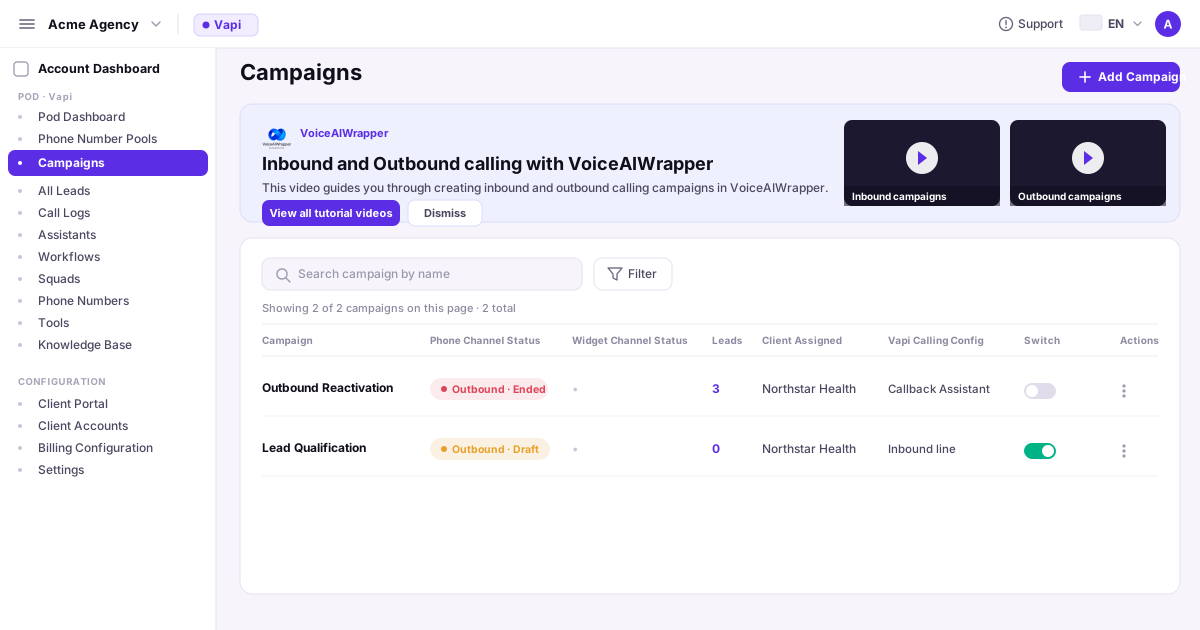
Sub-account architecture: one account, many isolated client portals with separate analytics, billing plans, and logins
Usage data segregated by client vertical, providing a clean signal for per-vertical call volume trends
Pods architecture: attach multiple providers to one client portal; run side-by-side comparisons
Enables direct latency and quality comparisons across platforms on identical use cases in production
All 5 conversational agent platforms in one account (Vapi, Retell, ElevenLabs Agents, Bolna, Ultravox)
Scale ($249/mo) and above (Starter/Growth: Vapi + Retell)
Signed BAA for HIPAA-vertical work enabling healthcare-tier access
Healthcare-vertical compliance posture (SOC 2 Type 2, GDPR, HIPAA) reflects the regulatory signals in Signal 4 above
Phone-number pool: distribute high-volume outbound across multiple numbers
STIR/SHAKEN and telephony compliance architecture signal: warm-up and number management matter for compliant outbound campaigns
WHAT VOICEAIWRAPPER ADDS NATIVELY (THE 5-PLATFORM AGGREGATOR AND AGENCY MONETIZATION LAYER)
WHAT THIS REVEALS AS A TRENDS SIGNAL
Agency markup pricing: agencies set client-facing pricing plans at any markup, currency, and frequency; provider cost never visible to client
Provider cost data passes through unmodified; no markup inflation distorts per-minute cost comparisons across the 5 platforms
Sub-account architecture: one account, many isolated client portals with separate analytics, billing plans, and logins
Usage data segregated by client vertical, providing a clean signal for per-vertical call volume trends
Pods architecture: attach multiple providers to one client portal; run side-by-side comparisons
Enables direct latency and quality comparisons across platforms on identical use cases in production
All 5 conversational agent platforms in one account (Vapi, Retell, ElevenLabs Agents, Bolna, Ultravox)
Scale ($249/mo) and above (Starter/Growth: Vapi + Retell)
Signed BAA for HIPAA-vertical work enabling healthcare-tier access
Healthcare-vertical compliance posture (SOC 2 Type 2, GDPR, HIPAA) reflects the regulatory signals in Signal 4 above
Phone-number pool: distribute high-volume outbound across multiple numbers
STIR/SHAKEN and telephony compliance architecture signal: warm-up and number management matter for compliant outbound campaigns
Architecture rule: Configure the agent inside the provider (what it says, what it knows, what tools it uses). VoiceAIWrapper syncs it via API key and adds the billing, portfolio management, and multi-provider access layer. It is not an agent builder. See the VoiceAIWrapper feature set for the complete native capability list. For the full agency revenue framing, see the Voice AI Market 2026: $47B Agency Capture companion page.
FIRST-HAND · OPERATOR OBSERVATIONS FROM RUNNING 5-PROVIDER INFRASTRUCTURE
First-hand observations from running 5-provider voice AI infrastructure
This section describes what the macro-data trends above look like from an operator perspective: building and running VoiceAIWrapper across all 5 conversational agent platforms since the platform launched in May 2025. These are trend observations, not agency revenue claims. Specific per-vertical revenue outcomes belong on the companion agency-capture page.
The capital-efficiency gap between providers: what it signals
The most significant trend signal in the vendor funding data is the capital-efficiency divergence. Retell crossed $40M ARR and 40 million calls per month while profitable on $4.6M total raised. ElevenLabs crossed $330M ARR on $680M+ raised across Series C and D. Sierra is at $150M ARR on over $1B raised. These are not comparable capital-efficiency profiles. Retell's numbers suggest that platform-layer voice AI can be built to profitability with modest capital if the architecture is right. ElevenLabs' and Sierra's numbers suggest that enterprise-grade AI platforms require institutional capital to build the compliance, brand, and sales infrastructure that enterprise procurement demands. Agencies reading these signals should note: capital-efficient providers (Retell, Bolna) have more incentive to serve the long tail of customers including agencies; capital-intensive enterprise platforms (Sierra, ElevenLabs at the top tier) are optimizing for Fortune 500 direct sales.
The multimodal voice-plus-text gap: only ElevenLabs ships it in production
As of May 2026, ElevenLabs Agents Platform is the only platform in the 5-provider stack that ships multimodal WebSocket events (voice + image + text in the same conversation) in production via sendMultimodalMessage. Vapi, Retell, Bolna, and Ultravox remain primarily voice-only for inbound/outbound calling. This is a meaningful technology differentiation for use cases where the agent must respond to both spoken and visual inputs (complex support, document review, visual troubleshooting). It is not yet a table-stakes requirement for most agency deployments, but the IBM partnership (March 2026) signals enterprise adoption pressure toward multimodal is building.
The Indian-language opportunity: Bolna is the only platform with native Indian-language infrastructure
Bolna is India-first and supports 10+ Indian languages including Hindi, Tamil, and Telugu, native-language depth that no other provider in the 5-platform stack approaches. The practical signal: agencies serving South Asian markets or South Asian diaspora verticals in North America (South Asian medical practices, Indian-American legal firms, Indian-origin financial services) have a platform-specific reason to run Bolna that does not exist with any other provider. The $6.3M General Catalyst seed round (January 2026) signals institutional backing for Bolna's global expansion plan.
The latency benchmark shift: sub-second is the 2026 table-stakes threshold
When VoiceAIWrapper was built, the industry latency conversation was about whether sub-second was achievable. By May 2026, the question has shifted: sub-second is the threshold that separates natural-sounding from bot-detectable in real-world calling. Speech-to-speech models built on speech-foundation-model architectures (Moshi by Kyutai, Ultravox by Fixie AI) demonstrate that the architectural floor is much lower than where STT-LLM-TTS pipelines sit today. The practical implication: agencies who are currently using Vapi or Retell at sub-second median are already at or below the perceptibility threshold for most callers, but the next wave of S2S deployments will make that the slow option.
STIR/SHAKEN enforcement reality: the September 2025 compliance gate
The FCC's September 18, 2025 STIR/SHAKEN third-party authentication requirement went live in September 2025. In practice: agencies running outbound AI calls through VoiceAIWrapper's supported providers need to confirm their underlying provider has STIR/SHAKEN A-level attestation on agency-controlled phone numbers. The FCC order requires that any third-party signing agent use the provider's own SPC token and certificate; the provider cannot outsource attestation-level decisions. This is not a "nice to have" compliance signal. TCPA settlements from 2026 show that telephony compliance failures are now generating $5M-$10M legal exposure per case. Agencies using the phone-number pool and warm-up protocols inside VoiceAIWrapper reduce flagging risk, but the attestation decision sits with the underlying telephony provider, not with VoiceAIWrapper.
These observations reflect direct operational experience running VoiceAIWrapper across all 5 conversational agent platforms since the platform launched in May 2025. They are presented as trend signals, not as investment advice or legal advice. For the agency revenue and pricing framing, see the companion page: Voice AI Market 2026: $47B Agency Capture.
PROVIDER PRICING TRENDS
Provider per-minute pricing trends: what the cost data signals about market direction
Provider per-minute rates are a leading indicator of market maturation. As infrastructure costs fall and competition increases, rates trend down. The current rate map shows meaningful differentiation across the 5 platforms, reflecting different cost structures, LLM selections, and margin philosophies. VoiceAIWrapper does not mark up provider minutes; these rates pass through directly to the agency. Verify current rates at each provider's live pricing page before citing them in client proposals, as rates change.
PROVIDER
PUBLISHED PER-MINUTE RATE (AS OF RESEARCH DATE)
RATE STRUCTURE
WHAT THE PRICING SIGNALS
Vapi Verify current rate: vapi.ai/pricing
$0.05/min platform fee
Platform fee only; agency also pays underlying STT, LLM, TTS provider rates separately. Typical all-in: $0.08-$0.15/min depending on LLM and TTS selection.
Disaggregated billing gives cost-conscious agencies maximum control; also means costs vary significantly by configuration choice.
Retell Verify current rate: retellai.com/pricing
$0.07+/min
All-in flat rate: STT + LLM + TTS included. No separate component billing.
Flat all-in pricing simplifies margin calculation. Lower headline rate than competitors at equivalent quality, consistent with Retell's capital-efficiency positioning.
ElevenLabs Agents Platform Verify current rate: elevenlabs.io/pricing/agents
From $0.08/min (annual Business plans, verified 2026-05-18)
Varies by plan tier. Annual Business plan pricing verified 2026-05-18 in master-brief. Check elevenlabs.io/pricing/agents for current rates.
Higher base rate reflects premium voice quality, multimodal capability, and enterprise compliance stack (SOC 2, HIPAA, PCI DSS L1). The rate premium is justified for verticals where voice quality or compliance matters.
Bolna Verify current rate: bolna.ai/pricing
$0.06/min
Competitive with Retell for Indic-language deployments. India-first pricing with US/UK/AU available.
Lower rate for Indic-language deployments reflects India-market pricing. Approaching $700K ARR on $6.3M raised; pricing will likely shift as platform scales.
Ultravox Verify current rate: fixie.ai/ultravox or partner pricing
Via partner pricing
Available through infrastructure partners (Voximplant global calling partnership, October 2025). Open-weight model available at github.com/fixie-ai/ultravox for self-hosted deployments.
Pricing opacity reflects early-stage go-to-market. Speech-FM architecture reduces inference cost compared to STT-LLM-TTS pipelines; self-hosted option means cost structure is highly variable by deployment.
Methodology: Provider per-minute rates are intentionally not hard-coded because they change as platforms scale and competition increases. Rates above are from the trends-supplement dossier and master-brief as of research date 2026-05-29. Verify against each provider's live pricing page before scoping any client proposal. VoiceAIWrapper adds no per-minute markup; these rates pass through directly. For the full agency markup math (provider cost + markup + revenue scenarios), see the companion page: Voice AI Market 2026: $47B Agency Capture.
PROVIDER STACK: COMPETITIVE MAP
Provider stack competitive map: scale signals, technology differentiation, and agency fit
Each provider runs a full conversational agent platform with its own runtime, voice technology, telephony, and analytics. VoiceAIWrapper connects to all 5 via API key and adds the agency monetization layer on top. This section maps each platform's market position from a trends perspective: what their scale signals say about market direction, and what their technology differentiation says about which use cases they are optimizing for. See the Vapi optimization guide for agencies and the white-label ElevenLabs Agents guide for per-provider configuration guides.
White Label 5 voice providers under one dashboard with VoiceAIWrapper
1VoiceAIWrapper - 5
2ChatDash - 3 (Vapi, Retell, ElevenLabs)
3Synthflow Agency - 1 (proprietary)
4Vapify - 1 (Vapi only)
5Voicerr - 1 (Vapi-focused)
6Direct ElevenLabs - 1 (ElevenLabs only)
Vapi
White Label with VoiceAIWrapper Starter + Growth + Scale + Pro
Scale signal: $50M Series B (May 12, 2026) at $500M valuation; 1 billion calls processed; 1M+ developers on self-serve. Amazon Ring evaluated 40+ vendors and chose Vapi for 100% of inbound customer support calls. Technology: Code-first, open API architecture; STT-LLM-TTS pipeline; RAG knowledge base; tool calling; telephony. VoiceAIWrapper is a listed Vapi platform partner.
Retell
White Label with VoiceAIWrapper Starter + Growth + Scale + Pro
Scale signal: $40M+ ARR; 40M+ calls per month; profitable on $4.6M total raised; Named to Wing VC Enterprise Tech 30 (2026) . Technology: Lower median latency than Vapi per Tested Media April 2026; native numbers across multiple countries; batch dialing; full conversational agent platform. The capital-efficiency signal makes Retell the category benchmark for doing more with less.
ElevenLabs Agents
White Label with VoiceAIWrapper Scale + Pro
Scale signal: $500M Series D (February 2026) at $11B valuation; $330M+ ARR; Sequoia + a16z + Lightspeed + ICONIQ; IBM enterprise partnership (March 2026). Technology: Full AI Agents Platform (voice + chat + multimodal agents; RAG knowledge base; MCP server support; 29 languages); brand voice customization; compliance stack (SOC 2, HIPAA, PCI DSS L1, GDPR). Priced from $0.08/min on annual Business plans.
Bolna
White Label with VoiceAIWrapper Scale + Pro
Scale signal: $6.3M seed (January 2026, General Catalyst); 200K calls/day; $700K ARR trajectory; India-first with expansion to US, Brazil, Southeast Asia. Technology: Sarvam AI integration (Bulbul V3 TTS for Indic languages; Sarvam selected by India's MeitY under IndiaAI Mission); native Indian carrier integrations (Plivo, Exotel, Vobiz); 11+ Indic languages.
Ultravox
White Label with VoiceAIWrapper Scale + Pro
Technology signal: Speech-foundation-model (S2S) architecture; processes audio directly without STT-LLM-TTS intermediate stages; materially lower time-to-first-token via speech-foundation-model architecture. Global calling via Voximplant partnership (launched October 2025). Open-weight model at GitHub in Llama, Gemma, and Qwen variants. The architectural outlier in the 5-provider stack, representing the direction the industry is heading.
MARKET SIZE BY SEGMENT AND REGION
Voice AI market size by segment and region: what the research firms actually report
The research firms produce different market-size numbers because they define "voice AI" differently. This table shows the verified figures from named primary research firms with their segment definitions and forecast periods. Use it to understand which number to cite for which audience (analyst vs. agency proposal vs. investor brief). The segment definition matters more than the headline figure.
SEGMENT DEFINITION
BASE YEAR + VALUE
FORECAST YEAR + VALUE
CAGR
FIRM (DATE)
AI Voice Agents (narrowest, most agency-relevant) Best anchor stat for agency proposals
Top vendors by disclosed ARR (2025-2026): the market-share signal data
Disclosed ARR figures for voice AI vendors are sparse but the available data points provide a market-concentration signal. Note that "voice AI" is not a homogeneous segment: Sierra targets Fortune 50 enterprise; ElevenLabs targets developers and enterprise API buyers; Retell targets contact center operators; Synthflow targets agency resellers. These are different customer segments within the same macro market.
Developers, enterprise API buyers, Deutsche Telekom, Revolut, Square, Ukrainian Government
$680M+ (Series C + D)
Retell Voice agent platform, contact center focus
$40M+ ARR
January 2026
Contact centers, enterprise sales and support (Anker, Asbury Auto, Pine Park Health, Medical Data Systems)
$4.6M total
Vapi Platform-layer infrastructure
"Healthy eight figures" (not disclosed)
May 2026 (at Series B close)
1M+ developers on self-serve; Amazon Ring; Kavak; New York Life; Instawork
$72M total
Synthflow White-label agency segment
Not disclosed
N/A
1,000+ customers; 45M calls handled; white-label and contact center resellers
$30M total
Bolna India-first voice orchestration
Approaching $700K ARR
January 2026 (at seed close)
India-market deployments; 200K calls/day
$6.3M total
Source notes: ARR figures are from company announcements cited in source index. Sierra ARR from TechCrunch. ElevenLabs ARR from official blog post. Retell ARR from GlobeNewswire press release. Vapi ARR from TechCrunch Series B coverage. Synthflow customer count from BusinessWire press release. Bolna ARR trajectory from TechCrunch seed announcement. No single vendor's ARR is independently audited. Use as directional market-share signals, not as precision competitive intelligence. For the full agency monetization analysis including VoiceAIWrapper's own platform cost structure, see the companion Voice AI Market 2026: $47B Agency Capture page.
VENDOR CONSOLIDATION MAP
Vendor consolidation map: M&A activity, platform partnerships, and integration signals in 2025-2026
The voice AI market is not consolidating around one acquirer. It is consolidating around integration partnerships and infrastructure investment: enterprise software stacks (Twilio, SAP, IBM) are investing in or partnering with infrastructure-layer vendors; infrastructure vendors (Vapi, Retell, ElevenLabs) are growing through enterprise adoption rather than acquisitions; the white-label agency segment has no public M&A activity yet. The table below maps the disclosed deals and what they signal about market structure.
Sequoia and A16Z both doubling down signals institutional consensus that the Agents Platform model (not TTS alone) is the durable enterprise product. "Doubling down on ElevenAgents and conversational voice models" per ElevenLabs' own announcement.
IBM + ElevenLabs Enterprise agentic AI stack
IBM (enterprise AI stack); ElevenLabs (voice capabilities)
March 25, 2026
Strategic partnership
IBM's enterprise AI stack gains production-grade voice. ElevenLabs gains access to IBM's Fortune 500 relationships. Signals enterprise software stacks are buying voice via partnership rather than acquisition.
Vapi Series B $50M at $500M valuation
Vapi (raise); Peak XV Partners (lead); Microsoft M12, Kleiner Perkins, Bessemer (participating)
May 12, 2026
Venture funding: infrastructure scale
1B+ calls processed, Amazon Ring as flagship anchor customer. Microsoft M12 investing signals Azure infra alignment. The raise at $500M valuation confirms the platform-layer model (not end-application) attracts institutional capital.
Sierra double-round $350M → $950M (15B+ valuation)
Sierra (raise); Tiger Global + GV (lead in May 2026 round)
September 2025 / May 2026
Venture funding: enterprise-direct scale
$1B+ total capital, 40%+ of Fortune 50 as customers. Sierra serves enterprise-direct (not agencies or SMBs). Its growth validates overall market size but is not a platform-layer acquisition signal.
Deepgram Series C $130M at $1.3B valuation; OfOne acquisition
Twilio and SAP co-investing alongside Deepgram's Series C is the clearest signal that enterprise software platforms are absorbing voice AI infrastructure via strategic investment rather than full acquisition. OfOne (YC-backed) acquired for agentic capability.
The only funded white-label agency competitor with disclosed terms. Accel's involvement signals institutional validation of the agency resale segment as a distinct market, not just a feature tier of infrastructure platforms. Direct Tier 1 competitor to VoiceAIWrapper.
Bolna seed round $6.3M from General Catalyst
Bolna (raise); General Catalyst (lead); Y Combinator, Blume Ventures (participating)
January 2026
Venture funding: Indic-language infrastructure
General Catalyst backing an India-first voice platform signals Indian-language voice AI is a global investment thesis, not a domestic-only opportunity. Bolna's native support for 10+ Indian languages gives it a distinct position in the emerging-markets voice AI segment.
Key pattern: The consolidation is happening at the infrastructure layer (Deepgram + OfOne) and through enterprise-software strategic investment (Twilio/SAP into Deepgram, IBM partnering with ElevenLabs). The white-label agency segment remains fragmented. For how agencies choose between these platforms, see compare white-label voice AI platforms.
QUARTERLY TREND-TRACKING CALENDAR
Quarterly trend-tracking calendar: what voice AI analysts and agency owners should monitor each quarter
The voice AI market moves on a quarterly cadence: venture rounds cluster around earnings seasons, product benchmarks drop at conferences, regulatory filings appear on a predictable calendar, and analyst reports from Gartner, Forrester, and Grand View Research update on annual or semi-annual cycles. Use this calendar to time your research refresh.
Q1 (Jan-Mar)
Funding rounds + regulatory filings
Year-end funding rounds close (Series A-C typical); watch TechCrunch and Crunchbase for voice AI raises
CES (January) surfaces hardware-layer voice AI product launches and automaker voice integration announcements
FCC Federal Register filings from Q4 proposed rules often finalize in Q1
Grand View Research and Research and Markets publish updated AI voice agents annual reports (January-March window) [T2 pattern]
State AI laws from prior year take effect January 1 (example: California AB 2602 effective January 1, 2025; California AB 489 effective January 1, 2026).
Q2 (Apr-Jun)
Vendor product launches + latency benchmarks
Google I/O (May) and Microsoft Build (May) announce LLM and speech-API updates that flow into Vapi/Retell/ElevenLabs provider stacks.
Independent latency benchmark publications: Tested Media April 2026 Retell vs. Vapi benchmark is a Q2 example of what to watch.
Spring Series B and C rounds cluster (Vapi Series B closed May 2026 as a recent example).
STIR/SHAKEN compliance enforcement windows: the September 18, 2025 FCC third-party authentication deadline is a Q3 example.
FCC quarterly commissioner meeting (July/September) often surfaces new AI voice rulemaking decisions.
State legislative sessions close mid-year; track new AI voice disclosure bills moving to signature.
EU AI Act enforcement milestones: high-risk provisions effective August 2026 are the Q3 2026 compliance trigger.
TCPA class-action settlements often reach final approval in Q3 court calendars.
Q4 (Oct-Dec)
Year-in-review reports + analyst forecasts
Stanford HAI AI Index data collection window (the report publishes in April but data pulls from Q4 of the prior year).
Gartner Hype Cycle for AI updates (typically Q3-Q4 release): tracks voice AI maturity signal alongside LLM positioning.
Vendor ARR disclosures often accompany Series B/C rounds that close in Q4 ahead of new fiscal year planning.
Deepgram, OpenAI, and ElevenLabs typically publish annual state-of-voice research or developer survey data in Q4.
California legislative bills signed October-November take effect January 1 (example: California AB 489 signed October 11, 2025).
For how the 5 supported platforms translate these trends into agency-deployable capabilities, see VoiceAIWrapper platform features .
WHEN THIS PAGE DOES NOT FIT YOUR NEED
Honest concession: when this page is not the right resource for your research goal
Go elsewhere if...
1You want the agency monetization playbook: per-client markup math, 60-minute setup, sub-account architecture, and trial CTA.This page covers macro-data trends, funding signals, regulatory developments, and the 5-platform competitive map. It is written for researchers, analysts, and agency owners doing market due diligence. If you want to know how to price a voice AI retainer, which provider to pick for each vertical, or how VoiceAIWrapper's sub-account and markup billing layer works, the companion page has all of that. Go to Voice AI Market 2026: $47B Agency Capture for the full agency monetization angle.
2You need vendor-specific implementation guides (Vapi agent configuration, ElevenLabs Agents setup, Retell outbound optimization).This page covers each provider's market position, scale signals, and technology category. It does not cover configuration steps, API key setup, or provider-specific optimization. For Vapi configuration and the documented default-config latency fix, see the Vapi optimization guide for agencies. For ElevenLabs Agents Platform setup under your brand, see the white-label ElevenLabs AI guide 2026.
3You need real-time competitive intelligence or proprietary deal-level data for a due-diligence process.This page synthesizes public market research, press releases, and announced funding rounds. It does not include: unannounced funding rounds, private ARR data, customer-level win/loss records, or proprietary competitive intelligence. For that depth, primary-source experts networks (Tegus, AlphaSense, GLG) or analyst subscriptions (Gartner, Forrester) are the right tools. This page's source methodology is documented in the sources footer and is appropriate for market context, client proposals, and trend identification, not due-diligence-grade competitive intel.
4Your need is enterprise direct-buyer procurement data (Gartner Magic Quadrant, Forrester Wave, enterprise RFP comparisons).The enterprise direct-buyer market (Sierra, Convin, Talkdesk, NICE, Genesys) operates in a different procurement channel than the agency/resale segment this page covers. If you are evaluating voice AI platforms as an enterprise direct buyer, Gartner's Conversational AI Magic Quadrant and Forrester's AI-Powered Contact Center Wave are the appropriate primary references. This page does not cover enterprise-tier RFP criteria, procurement timelines, or vendor SLA benchmarks at enterprise volume.
RESEARCHER'S CHECKLIST
This page combines market research, funding data, regulatory filings, and technical benchmarks from named primary sources. Use this checklist to avoid the most common citation and interpretation errors when building on this data.
Step 1
Always qualify which market definition you are citing before quoting a CAGR figure
The four most-cited figures (Grand View Research 39.0%, Market.us 34.8%, MarketsandMarkets 30.7%, Mordor Intelligence 22.41%) are not measuring the same market. GVR and Market.us measure AI voice agents specifically (the conversational calling layer). MarketsandMarkets measures AI voice generators (a broader category including TTS tooling). Mordor Intelligence measures the voice user interface market, which includes car infotainment, smart speakers, and ambient voice control. Never cite a CAGR without naming the research firm and the exact segment definition.
For agency client proposals, investor memos, or media coverage focused on AI voice calling agents (not ambient voice or TTS tooling), Market.us ($2.4B in 2024, $47.5B by 2034, CAGR 34.8%) and Grand View Research ($2.54B in 2025, 39.0% CAGR through 2033) are the tightest market definitions. Both focus on conversational AI agents specifically. Cite one of these two as the primary anchor stat; use others to show consensus.
Step 3
Treat vendor ARR figures as directional signals, not precision market-share data
The ARR figures on this page (Sierra $150M, ElevenLabs $330M+, Retell $40M+, Vapi "healthy eight figures") come from official company announcements alongside funding rounds. None are independently audited. Retell's $40M ARR was announced by Retell at its Wing VC ET30 listing. ElevenLabs' $330M ARR was cited in the official Series D announcement. Treat these as directional market signals, not verified financial statements.
Step 4
Verify provider per-minute pricing before using in any client-facing document
Provider pricing changes more frequently than research reports. The per-minute rates cited on this page (Vapi $0.05/min platform fee, Retell $0.07+/min, ElevenLabs $0.08/min on annual Business plans) were verified as of the research date but should be re-verified against live pricing pages before use in any proposal, press release, or investor document. Rate changes can materially affect agency margin calculations. Always link to the live pricing page, not this page, for current rates.
Step 5
Cite regulatory rules by their effective date, not their announcement date
The regulatory events on this page each have a distinct announcement date and an effective date. California AB 2602 was signed September 17, 2024, but was effective January 1, 2025. STIR/SHAKEN third-party authentication was published August 19, 2025, with compliance required September 18, 2025. EU AI Act Article 50 transparency obligations take effect August 2, 2026 (its Article 5 prohibited practices applied February 2, 2025). Always cite the effective date in any compliance document; the announcement date alone can cause a compliance gap.
Step 6
Do not cite the Tested Media latency benchmark without linking to the primary source
The sub-second median latency benchmark for Retell and Vapi is cited from Tested Media, April 2026, in VoiceAIWrapper's master-brief. A primary URL for this benchmark was not confirmed in this research pass. Before using this specific benchmark in any external document, verify the primary Tested Media report URL. The S2S model latency figures (Moshi at Kyutai GitHub, Ultravox at Fixie AI GitHub) have primary source links available and can be cited directly.
Step 7
Apply the white-label segment caveat when citing the Synthflow agency signal
Synthflow's $20M Series A (Accel, June 2025) is used on this page as the strongest public signal that institutional investors view the white-label agency resale segment as a distinct market. That inference is valid. However, no publicly available market-size estimate exists specifically for the white-label voice AI resale sub-segment. Do not extrapolate a segment dollar figure from Synthflow's funding alone. The macro forecasts from Grand View Research and Market.us cover the entire AI voice agents market, which includes enterprise direct, agency/resale, and self-serve.
Step 8
Check re-verification dates before reusing research from this page in external publications
This page was rebuilt on 2026-05-29. The sources section lists individual verification dates per source. Grand View Research and Mordor Intelligence report pages are verified live. Funding round dates are per press release dates and will not change. Provider per-minute rates and provider feature claims should be re-verified at the time of any external publication. The re-verification cadence on this page is 4-6 weeks rolling.
Step 9
Do not use secondary aggregators (Ringly.io, Tracxn, Statista) as primary citations
This page uses secondary aggregators only for corroboration, not as primary sources. Ringly.io aggregates voice AI statistics but does not conduct primary research. Tracxn sector totals for voice AI funding ($2.1B in 2024; $1.07B+ in 2025) are noted as secondary and should not be cited without a primary source for the underlying data. For any claim about market size, CAGR, segment share, or vendor revenue, trace back to the primary research firm (Grand View Research, Market.us, MarketsandMarkets, Mordor Intelligence) or the vendor's own announcement.
Step 6
For the agency monetization angle: use the sister page, not this one
his page is the macro-data and trends resource. For agency markup math, per-client revenue calculations, VoiceAIWrapper sub-account architecture, and the platform cost structure at different agency volumes, the companion page is the right citation. It covers the "how to capture this market as an agency" angle that this page deliberately does not. Cite: Voice AI Market 2026: $47B Agency Capture. Using this trends page for agency monetization math will give your audience data without context.
The market data is here. The agency capture playbook is on the sister page.
This page covers trends, funding, technology shifts, regulatory signals, and the 5-platform competitive map. For per-client markup math, 60-minute setup, sub-account architecture, and what VoiceAIWrapper costs at 5, 15, or 50 clients, go to the companion page.
Four objections to voice AI market trend data (and honest answers)
""Why trust segment-specific CAGRs when they differ by 20 percentage points across firms?"The range (Grand View Research 39.0%, Market.us 34.8%, MarketsAndMarkets 30.7%, Mordor Intelligence 22.41%) reflects four different market definitions, not four different views of the same market. Grand View Research and Market.us measure AI voice agents specifically: the conversational calling and agentic workflow layer. MarketsAndMarkets measures AI voice generators, a broader category that includes TTS tooling for non-agent use cases. Mordor Intelligence measures the voice user interface market, which adds car infotainment, smart speakers, and ambient home voice control. Analysts define these markets differently because the underlying technology overlaps across device and application categories. The practical answer: use the narrowest definition that matches your audience's context, cite the research firm by name, and state the segment definition alongside the CAGR. Never cite a CAGR number without both.
""Is voice AI growth really 34.8% CAGR, or is this inflated by AI hype in analyst projections?"The vendor-scale data provides a partial real-world check. Retell disclosed $40M+ ARR in January 2026 on only $4.6M raised; ElevenLabs disclosed $330M+ ARR at its February 2026 Series D. If both figures are accurate (they come from official company announcements), the revenue trajectory from these vendors is consistent with a market growing faster than the median B2B SaaS category. The honest caveat: analyst CAGR projections are demand models, not actuals. They are useful for client proposal context and for identifying the fastest-growing segments. They are not audited financials. The vendor ARR data is directional confirmation that the underlying market is at least growing, though the exact CAGR is a modeled forecast.
""Who actually competes: big tech (Google, Amazon, Microsoft) or venture-backed startups?"Both, but in different layers. Big tech owns the infrastructure and model layer: Google Gemini, OpenAI GPT-4o Voice, Amazon Nova Sonic feed the LLM/TTS components that Vapi, Retell, and ElevenLabs run on top of. Venture-backed startups own the agent-platform layer (Vapi $500M valuation, ElevenLabs $11B valuation) and the enterprise-direct layer (Sierra $15B valuation. The white-label agency resale layer has no publicly funded entrant above $30M (Synthflow at $30M total). Big tech is a supplier to the platform layer, not a direct competitor to it yet. The risk to monitor: if Google or Microsoft launch native white-label agency resale products, the platform layer becomes more crowded. No such announcement has been confirmed as of the research date.
""Will Google Voice Mode or OpenAI Realtime API commoditize the platform layer?"The commoditization risk is real but slow-moving. OpenAI's Realtime API (voice) is available to developers but is not a white-label agency platform: it has no sub-account architecture, no agency markup pricing, no programmatic outbound campaign controls, and no multi-tenant client portal. Google Voice Mode and Amazon Nova Sonic have the same gap. What big tech provides is the model layer (cheaper, faster inference over time), not the operations layer that agencies need. The S2S architecture trend (Moshi, Ultravox) does compress the performance gap between custom-built stacks and platform providers, which could commoditize the STT-LLM-TTS orchestration layer over a 2-4 year horizon. That is a horizon risk, not a current-market reality. The agency layer's moat is not the model; it is the sub-account architecture, compliance tier, billing engine, and portfolio management that no model API provides.
Frequently Asked Questions
Question
What is the voice AI market size in 2026?
Answer
The AI voice agents market stood at $2.54 billion in 2025 and is estimated at $3.51 billion in 2026, per Grand View Research. Broader market definitions reach higher: Mordor Intelligence puts the voice user interface market at $15.48 billion in 2025. The right figure depends on segment scope: AI calling agents specifically, or voice across all devices and platforms. Forecasts converge on $35-$52 billion by 2030-2033 across the major research firms. For agency proposals or investor memos, always name the research firm and the segment definition alongside the figure.
Question
How much funding has the voice AI sector raised in 2025-2026?
Answer
Major disclosed rounds total over $1.8 billion across 2025-2026: ElevenLabs raised $180M Series C (January 2025) and $500M Series D at $11B valuation (February 2026); Vapi raised $50M Series B at $500M valuation (May 2026); Sierra raised $950M at $15B valuation (May 2026); Bland AI raised $40M Series B (January 2025); Synthflow raised $20M Series A (June 2025); Bolna raised $6.3M seed (January 2026); Deepgram raised $130M Series C at $1.3B valuation (January 2026). No direct competitor-to-competitor acquisitions were identified in this research pass.
Question
What is the fastest-growing voice AI segment in 2026?
Answer
The AI voice agents in healthcare segment is growing fastest at 37.79% CAGR (Grand View Research), from $468M in 2024 to $3.18B by 2030. Among technology architectures, speech-foundation models (targeting sub-second latency vs traditional STT-LLM-TTS pipelines) represent the fastest-moving structural shift. APAC is the fastest-growing region at 24.17% CAGR within the voice user interface market (Mordor Intelligence, May 2026 update).
Question
Who are the top voice AI vendors by 2026 revenue?
Answer
By disclosed ARR as of early 2026: Sierra at $150M ARR (enterprise customer service agents), ElevenLabs at $330M+ ARR (voice platform and agents), Retell at $40M+ ARR (voice agent platform). Vapi reports "healthy eight figures" ARR without a specific number disclosed. Deepgram and Synthflow do not publicly disclose ARR. The market remains fragmented, with no single vendor exceeding 10% of the $2.5B+ AI voice agents segment. All ARR figures come from official company announcements, not independently audited financials.
Question
What is the latency benchmark for voice AI in 2026?
Answer
Sub-second end-to-end latency is the 2026 threshold for natural-sounding AI voice conversations. At the platform layer, Retell delivers sub-second median and Vapi delivers sub-second median (Tested Media, April 2026) . Speech-to-speech models (Moshi by Kyutai and Ultravox by Fixie AI) achieve sub-second latency by eliminating the separate STT and TTS stages. Telnyx reports low-latency p95 round-trip on co-located infrastructure across 100 concurrent PSTN calls. The practical floor is set by PSTN telephony overhead, not model speed alone.
Question
How does voice cloning compliance work in 2026?
Answer
Three compliance frameworks apply simultaneously. Federal: FCC's February 8, 2024 ruling requires prior express written consent before using AI-generated voices in robocalls (TCPA applies). State: Texas SB 140 (effective September 2024) mandates AI disclosure within 30 seconds and prohibits unconsented voice cloning, with $1,000-$10,000 per-violation private right of action. California AB 2602 (effective January 1, 2025) requires performers' explicit contractual consent plus legal or union representation for any digital replica use. EU: Article 50 of the EU AI Act requires AI disclosure to recipients of AI voice interactions, effective August 2, 2026; the Act's Article 5 prohibited practices applied February 2, 2025.
Question
Is the white-label voice AI segment growing faster than the direct-buyer segment?
Answer
The evidence points to faster agency-channel growth for the SMB and mid-market client segment. Most SMBs cannot configure and manage agent platforms internally. Synthflow's $20M Series A (June 2025, led by Accel) explicitly targeted democratizing voice AI for non-technical deployers and contact center resellers, the closest institutional signal that this channel is validated as a distinct growth market. Infrastructure cost reductions ($0.07-$0.08/min provider base rates) now make per-client economics viable for agencies serving clients at 500-2,000 minutes per month. No public market-size estimate specific to the white-label voice AI resale sub-segment was identified in this research pass.
Question
What are the biggest voice AI M&A deals of 2025-2026?
Answer
The most significant acquisition is Deepgram's purchase of OfOne (a Y Combinator-backed AI startup) in January 2026, announced alongside its $130M Series C raise. Twilio and SAP co-invested in that Deepgram round, signaling consolidation between enterprise software stacks and voice AI infrastructure through strategic investment. Sierra's $950M raise (May 2026, Tiger Global and GV) signals large-cap investors accelerating consolidation through growth capital rather than acquisitions. No direct white-label platform acquisitions were identified in this research pass.
Raj Baruah, Founder, VoiceAIWrapper
Raj built VoiceAIWrapper to give agencies the sub-account architecture, agency markup billing, and multi-provider white-label layer they would otherwise have to build from scratch on top of Vapi, Retell, ElevenLabs Agents, Bolna, and Ultravox. Because VoiceAIWrapper aggregates all 5 conversational agent platforms in a single operator account, Raj observes the market from a position that no single-provider analyst or operator has: what different provider architectures reveal about market direction, which latency and compliance thresholds trigger client decisions, and how per-minute cost structures interact with agency margin across different verticals. The market trends on this page reflect that multi-platform operational perspective, layered on top of the named primary research sources.
For the agency monetization angle (how to price a retainer, which provider to pick per vertical, what VoiceAIWrapper's sub-account architecture costs at different agency sizes), see Voice AI Market 2026: $47B Agency Capture. Healthcare-vertical agencies should review the HIPAA compliance posture before scoping client retainers.
LinkedIn: rajbaruahListed Vapi platform partnerVoiceAIWrapper LinkedInFeatured expert: Raj Baruah on ConnectivelyVoiceAIWrapper Academy community on Skool5.0/5 on SaaSHub (17 verified reviews)
Found our insights helpful? Start your voice AI white label free trial
Our product is free to use for 7 days (no credit card required). You get access to premium features available in our Scale plan during your free trial.
If you are not satisfied with our product or support, we offer you a full refund. For details, please read our refund policy in the footer of our home page.
Used by 1000+ agencies.
99.9% uptime.
60-minute setup.
Found our insights helpful? Start your voice AI white label free trial
Our product is free to use for 7 days (no credit card required). You get access to premium features available in our Scale plan during your free trial.
If you are not satisfied with our product or support, we offer you a full refund. For details, please read our refund policy in the footer of our home page.
Used by 1000+ agencies.
99.9% uptime.
60-minute setup.
Found our insights helpful? Start your voice AI white label free trial
Our product is free to use for 7 days (no credit card required). You get access to premium features available in our Scale plan during your free trial.
If you are not satisfied with our product or support, we offer you a full refund. For details, please read our refund policy in the footer of our home page.