Voice AI Market Size in 2026: Forecasts, Trends, and the Agency Opportunity

Voice AI Market Size in 2026: Forecasts, Trends, and the Agency Opportunity

The voice recognition segment is worth $22.49B in 2026 (Mordor Intelligence). Within it, the voice AI agents sub-segment is on track to grow from $2.4B in 2024 to $47.5B by 2034 at 34.8% CAGR (Market.us).

Voice AI market snapshot April 2026: 8 statistics on market size, CAGR forecasts, cost savings, and builder adoption. | voiceaiwrapper

|

Published:

|

Updated:

On this Page

Summary

Voice AI market size in 2026 and the agency opportunity

Voice AI market size in 2026 matters most to one audience: digital agencies deciding whether to launch a white-label voice AI offering. The voice recognition segment is worth $22.5B in 2026 (Mordor Intelligence). Voice AI agents inside it are forecast to grow from $2.4B in 2024 to $47.5B by 2034 at 34.8% CAGR (Market.us). Segment, regional, and vertical breakdowns for agency planning follow.

The Voice AI Market at a Glance: April 2026 Snapshot

We list eight numbers from the state of voice AI as of April 2026. Each number is sourced and dated to make it easy to confirm.

Voice AI agents market analysis: segment growing $2.4B to $47.5B by 2034 at 34.8% CAGR, with 2026 forecast. | VoiceAIWrapper

Voice recognition market: $22.49B in 2026, projected to reach $61.71B by 2031 at 22.38% CAGR (Mordor Intelligence, January 2026).

Voice AI agents segment: $2.4B in 2024, projected to reach $47.5B by 2034 at 34.8% CAGR (Market.us, August 2025).

AI voice generator market: $4.16B in 2025, projected at $20.71B by 2031, 30.7% CAGR (MarketsandMarkets).

Speech and voice recognition market: $23.70B in 2026, projected at $104.05B by 2034, 20.30% CAGR (Fortune Business Insights).

Conversational AI: $14.29B in 2025, projected at $41.39B by 2030, 23.7% CAGR (Grand View Research).

Gartner forecasts $80B in contact center labor savings in 2026, based on conversational AI automation (Gartner, August 2022 forecast).

Per-call cost: $7 to $12 for human agents, roughly $0.40 for voice AI (based on industry benchmark, 2025 to 2026).

87.5% of AI builders are actively building voice agents (2026 Voice Agent Report).

Fast answers before you read further

How big is the voice AI market in 2026?

The broader speech and voice recognition category is estimated to be valued at $22.49B (by Mordor Intelligence) and $23.70B (by Fortune Business Insights) for 2026. The narrower voice AI agents segment was valued at $2.4B in 2024.

What is the growth rate?

The voice AI market is growing at a CAGR of 22% to 35% across segments through 2030. Voice AI agents segment is growing at 34.8% (Market.us) and voice AI infrastructure segment is growing at 37.8%.

Who leads by valuation?

ElevenLabs is valued at $11B (February 2026 Series D); Deepgram is valued at $1.3B (January 2026 Series C).

We tracked these numbers while creating VoiceAIWrapper. It’s a white-label voice AI platform for agencies that works with multiple providers. To explore this market for your business, check how agencies use white-label voice AI to grow their share. Or, keep reading for the full breakdown.

Voice AI Market Size in 2026 and Forecast to 2030

The voice AI market does not have a single agreed-upon size in 2026, because different analyst firms measure different things. Understanding which segment you care about matters more than chasing a single headline number.

Current Market Valuation (2026)

The most commonly cited market sizing comes from Mordor Intelligence, which values the voice recognition market at $22.49B in 2026, up from $18.39B in 2025. Fortune Business Insights' broader speech and voice recognition category puts the 2026 number at $23.70B, with North America alone contributing $9.79B.

If you zoom in on narrower segments, the numbers change significantly:

Voice AI market forecasts by segment (Firm Data, 2024 to 2026)
Segment2025 to 2026 sizeForecastCAGRSource
Voice recognition$22.49B (2026)$61.71B by 203122.38%Mordor Intelligence
Voice AI agents$2.4B (2024)$47.5B by 203434.8%Market.us
AI voice generator$4.16B (2025)$20.71B by 203130.7%MarketsandMarkets
Speech and voice recognition$23.70B (2026)$104.05B by 203420.30%Fortune Business Insights
Voice and language intelligence$20.10B (2025)$145.03B by 203521.85%Precedence Research
Conversational AI$14.29B (2025)$41.39B by 203023.7%Grand View Research
Voice AI market segment forecasts: 6 analyst firms compared on current size, forecast size, and CAGR from 2024 to 2035. | VoiceAIWrapper

The gap between $2.4B (voice AI agents) and $23.70B (speech and voice recognition) is not a contradiction. The larger number includes mature enterprise speech-to-text software, dictation, and voice biometrics. The smaller number isolates conversational AI voice agents that hold real dialogue with customers. For an agency evaluating market opportunity, the voice AI agents segment is the more honest proxy, it's the part of the market that's genuinely new, fast-growing, and addressable with a white-label product.

Growth Forecast 2026 to 2030

Between 2026 and 2030, the voice AI market will roughly double. Conversational AI specifically is forecast to reach $41.39B by 2030 from $14.29B in 2025. The AI voice generator segment is projected to cross $20.71B by 2031, per MarketsandMarkets December 2025 update.

The single most aggressive forecast comes from Market.us: voice AI agents growing from $2.4B in 2024 to $47.5B by 2034, which implies a roughly 7.5x expansion over the next 10 years alone. That growth curve is steepest in 2026–2029, the window agencies can still enter without fighting for SMB share against established players.

For a deeper breakdown of forecast methodology and TAM calculations, see the full market sizing analysis for agency decision-makers.

Which Voice AI Segment Is Growing Fastest?

The voice AI agents segment is the fastest-growing sub-market at 34.8% CAGR. Within verticals, healthcare voice AI leads at 37.79% CAGR. Voice biometrics - a smaller but compliance-critical category is growing at 16.73% CAGR as deepfake fraud forces financial services and healthcare to authenticate callers. Mature categories like traditional IVR and basic speech-to-text are growing at 10–15%, dragging down blended market averages. ( Grand view reserach)

Voice AI market size forecast 2024 to 2034 showing growth from $2.4B to $47.5B at 34.8% CAGR per Market.us | VoiceAIWrapper

Regional Market Breakdown: Where Voice AI Revenue Is Concentrated

Voice AI market size regional share 2026: North America 40.2%, Asia-Pacific fastest growth, Europe regulated expansion | VoiceAIWrapper

North America: Mature market, still the revenue leader

North America accounted for 40.2% of voice AI agents revenue in 2024, worth approximately $0.9B on a $2.4B base (Market.us). The US alone was $1.2B. The concentration reflects early enterprise adoption, a mature contact-center outsourcing industry, and deeper venture capital in voice-first startups.

Fortune Business Insights puts the North American speech and voice recognition market at $9.79B in 2026.

Asia-Pacific: The fastest-growing region

Asia-Pacific is projected to be the fastest-growing region through 2034, with India emerging as a priority market. ElevenLabs announced expanded investment in India at the AI Impact Summit in February 2026, describing it as its largest global market by user count (ElevenLabs, February 2026).

Growth drivers in the region include multilingual support (Indic, Southeast Asian, and Mandarin-native voice models), lower unit economics on agent deployment, and BPO operators retooling existing delivery centers with voice AI to preserve margin. For agencies serving Asia-Pacific SMBs, multilingual voice AI for global markets is a core competitive requirement rather than a nice-to-have.

Europe: Regulated growth under the EU AI Act

Europe's voice AI market is growing, but more slowly and with different constraints. The EU AI Act, which entered application in phases starting August 2024, classifies certain voice AI use cases (biometric identification, emotion recognition in workplaces) as high risk. Deployments in healthcare, finance, and the public sector face higher compliance costs.

The effect on the forecast is mixed. Compliance-ready platforms gain share, low-cost generic tools lose share, and regulated verticals delay deployment by 6 to 12 months. ( AI Act)

Middle East, Africa, and Latin America

These regions are a small share of 2026 revenue but are growing from a low base. Gulf Cooperation Council countries (UAE, Saudi Arabia) are funding sovereign voice AI initiatives with Arabic-native models. Brazil and Mexico are the largest Latin American markets, driven by fintech and retail deployments.

Industry Adoption: Which Verticals Are Leading in 2026

Before the vertical-by-vertical breakdown, here is the cheat sheet. Five rows cover roughly 85% of 2026 voice AI spend.

Voice AI vertical cheat sheet · market share, top use case, compliance
VerticalMarket share or CAGRTop use caseCompliance concern
BFSI32.9% shareCollections, balance inquiries, fraud alertsPCI-DSS
Healthcare37.79% CAGRAppointment reminders, clinical documentationHIPAA, BAA required
Contact centersGartner $80B savings forecastTier-1 call deflectionTCPA on outbound
Retail21.2% adoptionOrder status, returns, post-purchasePCI-DSS
AutomotiveStandard in most new vehiclesHands-free commandsNone material
Voice AI industry adoption 2026: BFSI 32.9%, Retail 21.2%, Healthcare 37.79% CAGR, Contact Centers $80B savings | VoiceAIWrapper

Banking, Financial Services and Insurance (BFSI): 32.9% market share

BFSI is the largest vertical, holding 32.9% of the voice AI agents market in 2024 (Market.us). The drivers are well understood: high call volume, repetitive account-lookup questions, strict authentication requirements, and labor costs that absorb up to 60% of contact center budgets (Gartner).

In practice, the highest-ROI BFSI use cases are collections reminders, balance inquiries, fraud alerts, and first-line claims intake. Deployment typically starts with outbound (lower risk, measurable lift in right-party contact rate) and expands inbound once authentication and compliance are proven.

For agencies serving insurance clients specifically, AI claims processing for insurance is one of the highest-value use cases to pitch - measurable time savings per claim, clear compliance framing, and strong client retention once deployed.

Healthcare: 37.79% CAGR, fastest-growing vertical

Healthcare is the fastest-growing vertical at 37.79% CAGR (Market.us). Typical deployments include appointment reminders, prescription refill automation, and voice-driven clinical documentation.

HIPAA compliance is non-negotiable, and most general-purpose voice AI platforms do not cover it by default. Agencies serving healthcare clients need a HIPAA-compliant voice AI white-label stack with signed Business Associate Agreements, not just generic voice-bot tooling.

Contact centers: Gartner's $80B forecast in context

Gartner's 2022 forecast projected $80B in contact center labor savings from conversational AI by 2026, based on automating 10% agent interactions, up from 1.6% at the time (Gartner, August 2022). Treat this as a forecast, not a measured outcome. Audited 2026 savings numbers are not yet published.

What is measured: per-call cost has dropped from $7-$12 for human agents to roughly $0.40 for a voice AI call at scale, driven by model-inference cost declines and TTS pricing compression. For a deeper look at the deployment patterns that actually work, read the AI customer service call center guide for 2026.

Retail and e-commerce: voice commerce growth

Voice-initiated commerce was projected at $62B globally in 2025 by several analyst sources, a sharp climb from $4.6B in 2021 (ResearchAndMarkets, Grand View).

For retail, the current sweet spot is order status, returns, and post-purchase support, not new-item discovery, which still underperforms relative to visual shopping.

Agencies serving retail clients can find a deployment framework in our voice AI for retail guide.

Automotive: standard in most new vehicles

Voice recognition is now a standard feature in the majority of new vehicles sold globally, largely driven by hands-free regulations and OEM integrations with Google, Amazon, and proprietary stacks. Growth in automotive voice is slower than enterprise voice AI because the category is already saturated.

Other growing sectors

Telecom, manufacturing, education, and hospitality are all growing faster than the overall market but from smaller bases. The pattern is consistent: voice AI lands first in high-volume, repetitive interaction types (support, scheduling, reminders), then expands into judgment-heavy work as model reliability improves.

If you are an agency reading this: the verticals above, BFSI, healthcare, contact centers, are exactly the SMB tiers that cannot buy from Vapi or Retell directly. They buy from agencies. Here is how agencies are onboarding these clients in under 60 minutes with white-label. No credit card required for the 7-day trial.

If you are an agency reading this: the verticals above, BFSI, healthcare, contact centers, are exactly the SMB tiers that cannot buy from Vapi or Retell directly. They buy from agencies. Here is how agencies are onboarding these clients in under 60 minutes with white-label. No credit card required for the 7-day trial.

2026 Technology Trends Influencing Market Growth

Five shifts are driving the 2026 forecast:

  • 1Speech-to-speech models and sub-300ms latency.
  • 2Multimodal voice (Gemini, GPT-4o, Claude Opus 4.x).
  • 3Emotional intelligence and real-time tone adaptation
  • 4Edge computing and on-device voice AI.
  • 5The cost collapse (per-call cost below $0.10).

Speech-to-speech models and sub-300 ms latency

The 2023 generation of voice agents used a three-step pipeline: speech-to-text, LLM, text-to-speech. Round-trip latency sat at 1.5 to 3 seconds, which felt awkward in live conversation.

By 2026, the leading providers have shipped speech-to-speech models that collapse the pipeline. Mainstream platforms now achieve sub-500 ms latency, with some implementations below 300ms. Below about 400 ms the conversation starts to feel human. This is the single largest UX shift of the last two years.

Multimodal voice (Gemini, GPT-4o, Claude Opus 4.x)

Voice is no longer a standalone modality. The frontier models from Google (Gemini), OpenAI (GPT-4o), and Anthropic (Claude Opus 4.x) handle voice, text, and vision in a shared context. For an agent, this means it can reference an image a user sent, read back a document, and hold a voice conversation in the same session without state loss.

Emotional intelligence and hyper-personalization

Voice models can now detect frustration, excitement, and hesitation in user input and adjust response pacing and tone in real time. The use case that matters commercially is handoff: automatically transferring to a human when the model detects rising frustration, which improves CSAT without requiring a quality reviewer to listen to every call.

Edge computing and on-device voice AI

The privacy framing around voice AI has split the market in 2026. Apple has made on-device processing a core pillar of Apple Intelligence, with Private Cloud Compute handling only tasks that exceed local capability. OpenAI, by contrast, is pushing an audio-first hardware device for late 2026 with a hybrid architecture local wake-word detection but cloud-based inference for conversational workloads. ( Apple, OpenAI ) .For enterprise buyers in regulated industries, this matters: audio never leaves the device, which simplifies compliance under HIPAA, GDPR, and the EU AI Act.

The cost collapse: how voice AI dropped below $0.10 per call

Per-call inference cost for voice AI crossed below $0.10 in late 2025 for short, structured calls (appointment reminders, delivery confirmations). This is the price point at which SMB deployment becomes viable. Before the drop, only enterprises with 2,500+ agents could justify the setup cost, which Gartner estimated at $1,000 to $1,500 per conversational agent (Gartner, 2022).

For a walkthrough of why multi-provider architectures amplify these cost gains, see our multi-provider voice AI for agencies page.

Voice AI Investment in 2026: Funding, Valuations, and M&A

Voice AI funding timeline 2023 to 2026 showing ElevenLabs $11B valuation and Deepgram $1.3B round January 2026 | VoiceAIWrapper

2025 to 2026 funding totals and notable rounds

Voice AI funding reached $2.1B in 2025, a roughly 7x increase from 2022 levels (AssemblyAI).

Two rounds in early 2026 reset the market:

  • ElevenLabs: $500M Series D at $11B valuation (February 4, 2026), led by Sequoia Capital. Total funding now $781M. ARR was on track to reach $330M by the end of 2025, with revenue split roughly 50/50 between enterprise and consumer (ElevenLabs, February 2026).

  • Deepgram: $130M Series C at $1.3B valuation (January 13, 2026), led by AVP. Used in part to acquire OfOne, a Y Combinator voice AI startup focused on quick-service restaurants (Deepgram, January 2026).

Q1 2026 global VC raised $297B overall, with AI startups absorbing 81% of that capital at $242B (industry reporting).

Where the capital is going

The money is flowing to three places: infrastructure (speech-to-speech foundation models, real-time streaming), enterprise vertical agents (healthcare, BFSI, contact centers), and developer platforms. It is not flowing to generic horizontal voice assistants, which underperformed through 2024 to 2025.

M&A activity and market consolidation

Deepgram's acquisition of OfOne in January 2026 is a template for where consolidation goes next: infrastructure firms acquiring application-layer startups to prove real-world latency and accuracy at scale in specific verticals. Expect similar deals through 2026 in healthcare and financial services.

What funding trends signal for agencies

Two signals matter for agencies. First, the capital is concentrated in infrastructure and enterprise. The SMB layer, where most agency clients live, is underserved and is not being targeted directly by the well-funded players. Second, Y Combinator's recent batches have seen voice-first products account for a materially higher share of the cohort than two years ago, roughly 1 in 4, up 70% from early 2024. This is a reliable leading indicator of where application-layer competition will come from in 2026 and 2027.

The SMB-enterprise gap

The structural opportunity for agencies is simple. Enterprise voice AI budgets are being served by direct sales teams at Vapi, Retell, ElevenLabs, and Deepgram. The Fortune 500 does not need an agency intermediary.

SMBs are a different story. A ten person dental office cannot integrate Vapi directly. They need an agency to build the agent, handle telephony, manage compliance, bill them monthly, and fix it when it breaks. That is the agency wedge, and it has widened as direct-provider pricing models have stayed enterprise-oriented.

"The Fortune 500 does not need an agency intermediary. A 10-person dental office cannot integrate Vapi directly."

White-label voice AI economics

Agency margins on fully managed voice AI engagements run in a 60%-80% range on top of underlying provider cost. SMB pricing sits between $500-$5,000 per month per deployed agent, depending on volume and integration depth. Agencies with mature delivery are reporting $10K-$100K+ per month in recurring voice AI revenue.

These ranges are consistent with what we see on VoiceAIWrapper's pricing page, where the Scale plan is built around the unit economics agencies are actually operating.

White-label voice AI agency economics 2026 showing 60 to 80 percent margins and SMB market gap opportunity | VoiceAIWrapper

Multi-provider vs single-provider platforms

One of the operational decisions that most changes agency unit economics is whether to lock into a single underlying provider or support multiple.

Single-provider stacks are simpler to build on. But they break when the provider has an outage, raises prices, or deprecates a feature a client depends on. Multi-provider stacks let an agency route a given client to Vapi for outbound sales, ElevenLabs for premium voice cloning, and Retell for inbound reception, based on which provider is best for the job. The trade-off is integration complexity.

This is why we built a multi-provider voice AI platform rather than picking a single vendor to wrap, and it's the primary reason agencies switch to us from Synthflow's agency plan and similar single-provider tools.

What agencies need to launch in 2026

A production-ready white-label voice AI stack has five moving parts:

  1. A provider integration layer (Vapi, ElevenLabs, Retell, and ideally more)

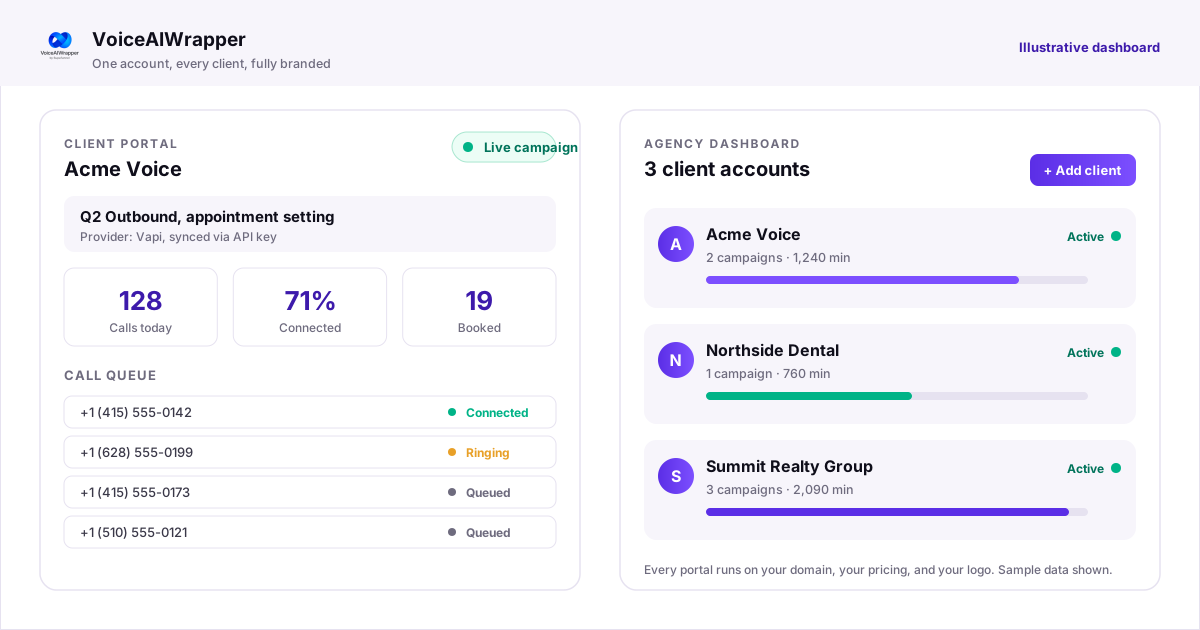
  2. A branded client portal on the agency's subdomain

  3. A billing and rebilling system that handles setup fees, subscriptions, top-ups, and overages in multiple currencies

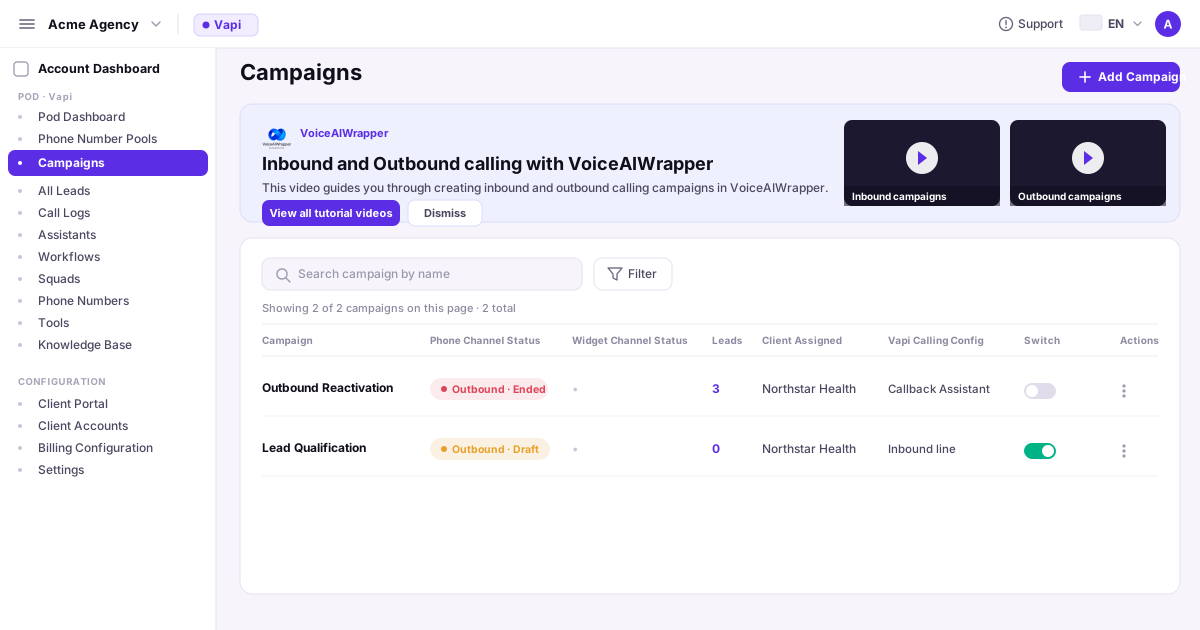
  4. Inbound and outbound call campaign tooling

  5. Analytics with call recordings and transcripts

Building this in-house takes 9 to 18 months of engineering time. Buying it off-the-shelf, on a platform like VoiceAIWrapper, moves the timeline to 60 min. Our white-label voice AI platform for agencies covers all five pieces.

Four things separate agencies that ship voice AI from agencies that keep talking about it: (1) a white-label platform with your domain and branding, not your vendor's; (2) multi-provider architecture to avoid single-vendor risk; (3) agency-grade compliance (SOC 2, GDPR, HIPAA, TCPA); and (4) a client billing infrastructure that lets you keep the full margin. Our platform features and pricing pages detail exactly what's included at each tier.

Want to see what this looks like for your agency?

Full Scale plan, no credit card required.

Voice AI Market Challenges and 2026 to 2030 Outlook

Any honest market analysis has to disclose what breaks the forecast. Here is the risk matrix before the detail.

What breaks the 2026 to 2030 forecast · risk matrix
RiskProbabilityImpact on 2026 to 2030 forecast
Model accuracy plateauLowLow
Deepfake fraud event at scaleMedium12 to 24 month slowdown
EU AI Act enforcement tighteningMediumEurope -10% to -20%
TCPA-style crackdown on AI outboundMediumOutbound segment -30%
Integration cost staying high for SMBsHighSMB adoption delayed

Technical limitations in 2026

Voice AI still struggles with noisy audio, heavy accents, and long-turn reasoning. Domain-tuned models can reduce error rates by 50% - 70% compared to general-purpose models, but training cost is non-trivial. Most production deployments pair a general-purpose voice model with a fine-tuned intent classifier for the specific use case.

Voice deepfakes and the authentication imperative

Voice cloning has reached a threshold where three seconds of source audio produces an 85% voice match, and independent research shows untrained listeners detect AI-generated voices with only ~77% accuracy - meaning nearly one in four cloned voices passes as real (Mcafee). The voice biometrics market is responding: voice biometrics was approximately $2.63B in 2025 growing at 16.73% CAGR, largely driven by anti-fraud deployments (Mordor Intelligence).

For agencies, this is both a risk (deepfake calls aimed at clients) and a product opportunity (voice authentication as an add-on service).

Regulatory evolution: EU AI Act, TCPA, industry rules

The regulatory picture is fragmented and is changing every quarter. The EU AI Act restricts certain biometric uses. See our GDPR compliance page for broader EU data governance.

The US TCPA continues to govern outbound calling, and FCC rulings in 2024 extended TCPA-style restrictions to AI-generated voices in consent contexts. HIPAA, PCI-DSS, and sector-specific rules still apply as they always have.

Agencies deploying voice AI should assume they are the compliance party of record for SMB clients. Reviewing your TCPA obligations before launching outbound campaigns is not optional.

Integration complexity

The voice AI stack has more moving parts than most SaaS categories: telephony, STT, LLM, TTS, CRM integration, billing, compliance. This is the operational reality that most forecasts skip. A realistic deployment still takes 2 to 6 weeks for a first SMB client, and the first 3 clients cost more to serve than they earn. Agencies that do not account for this in their pricing lose money on the first few engagements.

2026 to 2030 market outlook

The base case through 2030 is continued compounding at 22%-35% CAGR across segments, driven by the cost collapse, model quality gains, and the ongoing SMB-tier onboarding curve. The optimistic case adds regulated enterprise verticals unlocking after EU AI Act compliance frameworks stabilize. The pessimistic case is a fraud event (large-scale deepfake attack, regulatory crackdown on outbound AI calling) that slows adoption by 12 to 24 months.

For a view on how agency client expectations are shifting across these scenarios, see our analysis of AI white label use cases.

Frequently Asked Questions

Question

How big is the voice AI market in 2026?

Answer

The global voice AI market is worth approximately $22.49 billion in 2026, as per Mordor Intelligence's January 2026 report on voice recognition. The broader speech and voice recognition market is expected to reach $23.70 billion in the year 2026 as per Fortune Business Insights. Based on market segment studies by different analyst firms, the voice AI agents sub-segment alone stood at $2.4 billion in 2024 and is forecasted to reach $47.5 billion by 2034 at a 34.8% CAGR, according to Market.us. See the full market sizing breakdown for agency decision-makers for segment-by-segment data.


Question

What is the fastest-growing segment of the voice AI market?

Answer

The voice AI agents segment is the fastest-growing and expanding at a 34.8% CAGR from $2.4 billion in 2024 to a forecasted $47.5 billion by 2034, per Market.us. Among the highest growing verticals, healthcare voice AI is growing the fastest at a 37.79% CAGR. The AI voice generator segment (text-to-speech and voice cloning) follows at 30.7% CAGR, per MarketsandMarkets. Broader speech recognition is growing slower at 20–22% CAGR due to mature enterprise deployment requirements.


Question

Which industries are adopting voice AI fastest in 2026?

Answer

Banking, Financial Services, and Insurance (BFSI) leads with 32.9% of voice AI market share in 2026, followed by retail at 21.2%. Healthcare is the fastest-growing vertical at 37.79% CAGR, and US healthcare is projected to save $150 billion annually from voice AI automation alone. Contact centers are the largest enterprise deployment segment - 88% already use some form of AI and 81% of businesses plan to invest in AI technologies for customer experience in 2025 and beyond. (source: nextiv). Automotive, retail, and telecom round out the top adopters. For 15 vertical-specific playbooks, see the profitable voice AI use cases for agencies guide.


Question

How is the investment landscape for voice AI evolving?

Answer

Voice AI investment increased sharply in 2025–2026. Total funding reached $2.1 billion in 2025, ( 7x increase since 2022), as per AssemblyAI's 2026 Voice AI analysis. Recent marquee rounds include ElevenLabs' $500M Series D at an $11B valuation (February 2026, $330M+ ARR) and Deepgram's $130M round at $1.3B (January 2026). Roughly 1 in 4 companies in Y Combinator's recent batch are now voice-first - up 70% from early 2024. Q1 2026 saw $297B in global VC with AI startups absorbing 81%. Capital investment in increasing in developer platforms, enterprise voice agents, and voice biometrics/fraud prevention. See the voice AI competitive landscape for agencies for how this shapes the buy-vs-build decision.


Question

How much are contact centers saving with voice AI in 2026?

Answer

According to Gartner, contact centers will save $80 billion in labor cost globally in 2026 from conversational AI deployments. At the unit level, per-call costs drop from $7–$12 for a human agent to approximately $0.40 for a voice AI agent. Forrester measured 3-year ROI of 331%–391% on voice AI deployments, with one composite organization saving $10.3 million over three years. Gartner projects 1 in 10 agent interactions will be AI-automated in 2026, up from 1.6% when the forecast was first published. Read out full AI customer service call centre guide for contact center deployment patterns.


Question

How will the voice AI market evolve over the next five years?

Answer

The voice biometrics market is projected to reach $6.54 billion by 2031, growing at a 16.4% CAGR, driven by enterprise demand for authentication that can withstand AI-generated voice fraud (Modor Intelligence). Voice recognition alone will grow from $22.49B in 2026 to $61.71B by 2031 at a 22.38% CAGR per Mordor Intelligence. Four shifts define the period: (1) voice AI becomes default infrastructure for contact centers, with Gartner forecasting 1 in 10 agent interactions automated by 2026; (2) deployment moves from cloud to edge/on-device for latency and privacy; (3) voice biometrics scales to combat deepfake fraud, reaching $6B+ by 2031; (4) market consolidation reduces the long tail of providers to ~10 dominant platforms. Read the strategic forecast for agencies through 2030 for the full outlook.


Question

Who are the largest voice AI companies by revenue and valuation?

Answer

ElevenLabs leads on valuation at $11 billion after a $500 million Series D round in February 2026, with $330 million+ in annual recurring revenue per TechCrunch. Deepgram raised $130 million at a $1.3 billion valuation in January 2026. Other significant players include Speechmatics, AssemblyAI, PolyAI, Retell AI, Rime, Speechify (50M+ users), Vapi, Bolna, and Ultravox. Total voice AI funding hit $2.1 billion in 2025, up 7x since 2022. Agencies can integrate many of these providers simultaneously through a multi-provider voice AI platform.


Question

What is driving voice AI market growth in 2026?

Answer

Four converging forces are driving voice AI growth in 2026: (1) technical maturity - sub-500ms latency and near-human voice quality from speech-native models; (2) cost collapse - per-call voice AI cost dropped below $0.10 in 2025, making SMB deployment economically viable; (3) enterprise commitment - 87.5% of builders are actively deploying voice agents (not just researching), with enterprise adoption at 97% per the 2026 Voice Agent Report; (4) labor economics - Gartner's $80B in 2026 contact center savings is now a board-level priority. See the 7 voice AI trends reshaping 2026 for the full picture.


Question

Is voice AI profitable for agencies?

Answer

Yes - voice AI is one of the highest-margin services agencies can offer in 2026. Fully managed white-label voice AI engagements deliver 60–80% gross margins, with typical SMB client pricing of $500–$5,000/month per deployed agent. The global voice AI agents market is projected to grow from $2.4 billion in 2024 to $47.5 billion by 2034 at a 34.8% CAGR — and an increasing share is flowing through white-label distribution channels as agencies add voice AI to their service menus Voice AI Agents Market Report. The opportunity is largest in SMB and mid-market - tiers that can't buy from Vapi, Retell, or ElevenLabs directly. Find out more about Voice AI white label costs for agencies.


Question

What is the ROI on voice AI for business?

Answer

Businesses report 3-year ROI of 331%–391% on voice AI deployments, per a Forrester Total Economic Impact study cited across industry data. Contact centers see the fastest payback - per-call cost drops from $7–$12 to ~$0.40, meaning most deployments reach breakeven in weeks, not quarters. Healthcare providers using voice AI for documentation and patient engagement have returned 30 million clinician minutes, per Speechmatics 2026 industry analysis. First-year ROI typically exceeds 150% across deployments, with 15–40% reductions in operational costs. See how to calculate voice AI ROI for agency growth with a structured framework.


Question

How is voice AI regulated in 2026?

Answer

Voice AI regulation tightened significantly in 2026. The EU AI Act's main application date is August 2, 2026, when most provisions become enforceable - voice AI systems used in healthcare, finance, HR, law enforcement, or biometric identification are classified as "high-risk" and require documentation, human oversight, and conformity assessments. Non-compliance fines reach €35 million or 7% of global turnover. In the US, TCPA enforcement on AI-generated calls intensified in 2025–2026, making consent and do-not-call compliance critical. Healthcare deployments in the US must maintain HIPAA compliance - see our HIPAA-compliant voice AI white-label solution and TCPA compliance page.


Question

How big will the voice AI market be by 2030 and 2034?

Answer

By 2030, the voice AI market will reach approximately $41.39 billion for conversational AI (23.7% CAGR per industry synthesis), with the AI voice generator segment at $20.71 billion per MarketsandMarkets. By 2034, the voice AI agents segment alone will hit $47.5 billion at 34.8% CAGR per Market.us, while speech and voice recognition will reach $104.05 billion per Fortune Business Insights. By 2035, Precedence Research forecasts voice and language intelligence at $145 billion. Agencies that enter in 2026 capture share during the steepest part of the growth curve - see the strategic forecast for agencies through 2030.


Question

What is the difference between voice AI and conversational AI?

Answer

Voice AI is the subset of conversational AI that handles spoken language. Conversational AI covers all natural language interactions: text chatbots, voice agents, and hybrid channels. Voice AI adds speech-to-text, text-to-speech, and real-time streaming on top. In 2026, most enterprise deployments use both: conversational AI as the reasoning layer, voice AI as the interface.


Question

Is voice AI the same as a chatbot?

Answer

No. A chatbot is text-only and lives in a messaging interface. A voice AI agent handles spoken phone calls, manages conversation turns in real time, and deals with audio quality, latency, and barge-in (the caller interrupting the agent). Voice AI agents typically integrate with telephony, call recording, and compliance tooling that chatbots do not need.

If you are an agency operationalizing any of the above, VoiceAIWrapper offers a 7-day trial without a credit card. See our features page to learn more about our platform capabilities.

Author - Raj Baruah, Co Founder at VoiceAIWrapper. Raj has spent 18 years in the B2B SaaS space.

Like this article? Share it.

Related Insights

Latest Insights

Found our insights helpful? Start your voice AI white label free trial

Our product is free to use for 7 days (no credit card required). You get access to premium features available in our Scale plan during your free trial.

Risk-free refund assurance.

If you are not satisfied with our product or support, we offer you a full refund. For details, please read our refund policy in the footer of our home page.

Used by 1000+ agencies.

99.9% uptime.

60-minute setup.

Found our insights helpful? Start your voice AI white label free trial

Our product is free to use for 7 days (no credit card required). You get access to premium features available in our Scale plan during your free trial.

Risk-free refund assurance.

If you are not satisfied with our product or support, we offer you a full refund. For details, please read our refund policy in the footer of our home page.

Used by 1000+ agencies.

99.9% uptime.

60-minute setup.

Found our insights helpful? Start your voice AI white label free trial

Our product is free to use for 7 days (no credit card required). You get access to premium features available in our Scale plan during your free trial.

Risk-free refund assurance.

If you are not satisfied with our product or support, we offer you a full refund. For details, please read our refund policy in the footer of our home page.

Used by 1000+ agencies.

99.9% uptime.

60-minute setup.